The
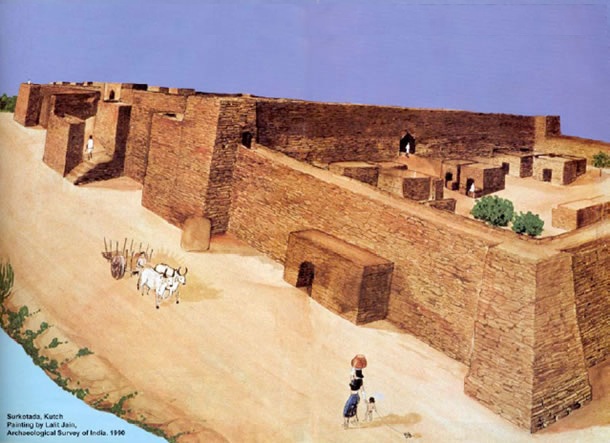
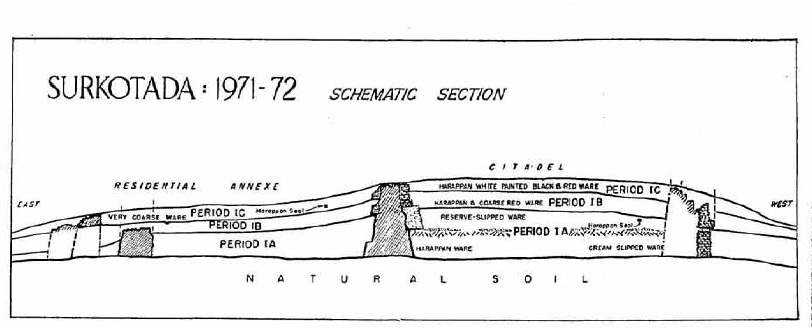
discovery of the Horse's remains from 2000 BCE, by an Indian
archaeologist, Mr. A.P. Sharma in 1971-72, remained neglected for
next twenty years or so. A celebrated archaeologist Dr. Richard H.
Meadow, in fact commented in 1987 to reject Mr. Sharma's claim
altogether and I quote:
“ It
is on the basis of this phalanx that one can ascertain from the
published photographs that the 'horse' of Surkotada, a Harappan
period site in the little Rann of Kutch, …... is likewise almost
certainly a half-ass, albeit a large one.” Unquote.
However,
more supporting evidence came to light. A Harrapan port city at
'Lothal” was discovered south of Surkotada in 1955-56 itself, by
another Indian Archaeologist and his team, Mr. S.R.Rao. It was a
major Harappan port on Kathiawar coast with a large dock built for
handling cargo and servicing ships. In further excavations at this
site, Mr. S.R.Rao made significant discovery of two figurines of
terracotta horses. One of the horses had a short stumpy tail, long
neck and pricked ears.

The
horse controversy however was sidetracked as excavating a major site,
from 1991 to 94, Indian archaeologists made a huge discovery of an
Harappan metropolis at Dholavira, merely 60 Km north of Suratkoda.
This site revealed a huge cache of artifacts, seals and sealings and
ornaments. However no evidence of presence of a horse came forthwith.

The
Sukotada horse again came to limelight, twenty years later, after
A.K.Sharma had discovered the horse remains at Surkotada, when an
Hungerian archaeologist, Sándor Bökönyi was passing through New
Delhi for a conference. He examined the bones excavated at Surkotada
and later declared in the conference in unequivocal words:
“The
occurrence of true horse (Equus caballus L ) was evidenced by the
enamel pattern of the upper and lower cheek and teeth and by the size
of and form of incisors and phalanges. Since no wild horses lived in
India in post-pleistocene times, the domestic nature of the Surkotada
horse is undoubtful.”
The
Indian archaeologist, A.K.Sharma was vindicated and received two
minutes of applause from the entire assembly. He, however felt sad
that his work was appreciated by his own countrymen only after it was
vindicated by someone from another continent. He comments:
“This
was the saddest day for me as the thought flashed in my mind that my
findings had to wait two decades for recognition, until a man from
another continent came, examined the material and declared that “
Sharma was right.” When will we imbibe intellectual courage not to
look across borders for approval? The historians are still worse,
they feel it is an attempt on the part of the “rightists” to
prove that Aryans did not come to India from outside her
boundaries.”
Sándor
Bökönyi, further stressed this point in his 1993 report to the
Director-General of the Archaeological Survey of India. Bökönyi
says in his report:
“Through
a thorough study of the equid remains of the prehistoric settlement
of Surkotada, Kutch, excavated under the direction of Dr. J. P.
Joshi, I can state the following: The occurrence of true horse (Equus
caballus L.) was evidenced by the enamel pattern of the upper and
lower cheek and teeth and by the size and form of incisors and
phalanges (toe bones). Since no wild horses lived in India in
post-Pleistocene times, the domestic nature of the Surkotada horses
is undoubtful. This is also supported by an inter- maxilla fragment
whose incisor tooth shows clear signs of crib biting, a bad habit
only existing among domestic horses which are not extensively used
for war”
The
Surkotada horse controversy, more or less came to an end after this
and it was accepted that domesticated horse was known to Harappans
from about 2000 CBE. However, the proponents of the Aryan invasion
theory had another point in their argument. They said that the use of
a spoked wheel in the chariots of the conquering Aryans made the
chariots far superior to the solid wheels used by Harappans.

This
point is very well answered by the terracotta models, recovered from
many Harappan sites, which clearly establish that the Harappans were
fully familiar with the spoked wheel. On the specimens found at
Kalibangan and Rakhigarhi, the spokes of the wheel are shown by
painted lines radiating from the central hub to the periphery, and in
the case of specimens from Banawali these are executed in low relief.
It is
now an accepted fact that there was no Aryan invasion of the India
and Harappans were never subjected to hordes of invading armies on
horseback and chariots. We must however appreciate that during
pre-Harappan and early Harappan periods, no traces of an horse have
been found anywhere. Similaraly, a horse does not not seem to have
any cultural importance in Harappan civilization, though it might
have been domesticated in mature Harappan phases. Unfortunatly, this
means that the fundamental questions that puzzled the early
historians, still remain unanswered.

Why
did a vast civilization that had spread from Swat (presently in
Pakistan) in the north to Kathiawar coast to the south and up to the
Ganga basin in the east suddenly had its demise?
Why a
civilization that was so advanced that as to have it's own script,
built ships to trade with middle east, had perfectly planned cities,
ended without leaving a legacy?


Finally,
it has been known that Harappans were idol worshipers.
They worshiped
a female figurine as Goddess of fertility and also the phallic symbol
in form of a Lingam. If there was no invading Aryan army, how did
India changed to a Vedic culture, where there was no idol worship but
Gods represented the five elements like water, wind or fire and an
Horse has great symbolic importance in religious rituals.
Not
all of these questions have been answered as yet, logical
explanations have been found for only a few.
(To be
concluded)
14
January 2013