Showing posts with label Vietnam. Show all posts

Tuesday, August 26, 2014

A Siem Reap Sojourn - Part II

As I come down to hotel lobby, my watch shows just 5 ‘O’ clock in the morning. However, my trip coordinator, Mr. Bunla is already waiting for me. I get into the car and we speed towards Angkor Wat. Watching the Sun rise from behind this temple is the Reason for my departure at this unearthly time. While traveling, I remember that the Khmer language word ‘Wat’ has come from a similar Thai word, which means a temple. I note in my mind that both these words must have come from the Sanskrit word Watika. Angkor Wat therefor means a temple city. The construction of this temple was started during the reign of Khmer King Suryavarman II or during 1113-50. However, it seems that the construction work, which took 30 years to complete, was completed only after the demise of the king, as his after death title or name, ‘Paramavishnuloka’ appears in one of the bass reliefs on the first level. It is believed that the design of this temple was made by a Brahmin minister of the king, Divakar Pandit, who was believed to be endowed with divine powers. Cambodians however attribute the temple to Hindu mythological architect of the Gods, ‘Vishwakarma.’ There has been a considerable debate as to whether Angkor Wat was built as a temple for God Vishnu or a tomb for the king. I think it is better to leave these debates to experts only.

Such kind of thoughts raced through my mind, as my car came to a screeching halt in total darkness. Whatever light I could see, was from the headlights of a streaming line of cars, which brought visitors to the temple. I get down and look in the front. I see a huge stone pedestal with some steps and railing. I climb the steps in light of my flashlight and walk in the direction where everyone else is going. We are stopped by a human chain of security guards , who inform me that the temple opens at 5.30 A.M. There is nothing to do but wait and look into the darkness. I slowly realize that the pedestal was getting filled up with people. Most of them carried in their hands some or other kind of an expensive photographic apparatus produced by leading camera manufacturers of the world. I hide my modest camera in the palm of my hand and wait patiently. At exactly 5.30 A.M. the security guards break the human chain and allow the crowd to proceed. I prefer to wait on the pedestal, as I have been told that one of the best views of ‘Angkor Wat’ Sunrise can be seen from the very place I stand.
In spite of so many people being around, only sound that I can hear is the faint rattle of a diesel engine driven pump. This is unusual because in India, whenever few people gather together, a virtual cacophony results almost immediately. After another 15 minutes, I sense some kind of black shadows far away on the background of a pitch dark bluish sky. Another few minutes gone, I can now see a huge moat of water just in front of me. This is the outer moat of Angkor temple. This one is about 200 meters wide and has a perimeter of about 5.5 Km. There is a wide causeway (12 meters or 39 feet wide) stretching in front of me for 250 meters. On other end of the causeway, I can now see a long brownish blackish line extending right up to the full breadth of my vision. Sky takes a slightly lighter shade of dark blue. The brownish line turns out to be a long covered gallery with a row of square pillars in front. On my sides, two solid stone Lions stand guarding the way to the temple. I see now that the continuity of the gallery far ahead is broken at the middle and at some distance away from the middle on both sides, by three slightly damaged Gopuras, which stand tall. These Gopuras also serve as entry gates to the inner temple complex. As things light up, I can see that the gallery and the Gopuras, which I see in the front, are really just a facade for the temple. I see clearly far behind this facade, 5 tall peaks of the temple itself. The harmony, the balance, the proportions and the symmetry, everything is highly impressive. This view can be compared only to that of the Taj Mahal. No wonder that the locals believe that Angkor Wat was built by Gods themselves. I realize that I have no words to describe this colossal monument.

 
Sun Rises from behind Angkor Wat Temple
 
Its already 6 ‘O’ clock in the morning. There is no rising Sun seen anywhere. The Sun rise was supposed to be at 5.54 A.M. Then I see that the horizon is completely covered with gray and dark gray clouds. I would not be able to see the Sun rising from behind Angkor Wat. today. I only can see some brief pinkish orange streaks on the east horizon between the clouds. I give up and decide to go to my hotel to have a quick breakfast and then return here again to see this majestic creation of the Khmers.
Famous English Author Somerset Maugham visited Angkor Wat in 1959. After his visit, he spoke to few people. His exact words were “ No one! No one should die before they see Angkor”.Angkor Wat produces that kind of reaction in your mind. The layout of this temple is a symbolic representation of the world, as described in the Hindu scriptures. Five peaks at the center represent the peaks of Mount Meru. The outer wall represents the mountain ranges at the end of the world and the moat represents the water that is beyond the borders of the world, dark, unfathomable and unknown.
I return to the temple after some hearty breakfast. I have to walk a lot today. I cross the first causeway, climb few steps and enter the central Gopura of the facade. This facade is a narrow and very long structure. In front of me, I see another raised walkway supported by a low balustrade. This walkway is 350 meters long and is 9 meters wide. At the end of the walkway, I see now for the first time, the Inner temple of Angkor Wat. Instead of walking straight to the temple, I turn right and decide to explore the facade gallery. I see a huge standing figure of Buddha at some distance. I can see that there is something odd about this figure. The figure has eight hands, four on either side. This was originally an idol of the Hindu God Vishnu, with eight arms. The head was replaced later to make him appear like Buddha. But the original carving of ornaments, garments and some golden colour can still be seen. I continue to walk along the gallery up to the end. There is a way provided to go round the facade and see the wall facing the temple. On this wall I can see some beautiful bass reliefs of Apsaras, Divine Nymphs from the heaven. I return to the central walkway and start for the inner temple.

 
Buddha that was God Vishnu
 
Towers of Angkor Wat as seen from the corner of Facade gallery
 
Carvings on the temple facing wall of the facade gallery


The main entrance is blocked due to some repair work being done and I use a diversion to enter the temple from another hall called Hall of Echos. Angkor Wat has been built on 3 levels just like the Bayon temple. The first level Galleries are of a size 215 Meters by 187 meters. The second level, rises in the middle of first level and has a size of 100 Meters by 115 Meters. Standing tall at the center of the 2nd level, third level is of the size of 60 Meters by 60 Meters square. The central sanctuary raises above this level. Third level rises an astonishing 40 Meter above second level. The total height of the temple from ground is 65 Meters or213 feet. These numbers do non mean much on paper unless one actually starts climbing up. Obviously, since it was not possible for Khmer architects to construct a multistory structure, as requisite technology and materials were yet to be developed, they must have opted for this pyramid like temple mountain construction.

 
On way up to the second level, Note the carvings on pillars and lentils 
 
I had read somewhere that there are two ways of visiting the temple. Level by level or go to the top first and then come down to the first level at the end. I choose the second alternative and start climbing the steps to second level. On my way up I can see beautiful carvings along the stair case. While climbing the steps, I can also see that the outer walls of the gallery on the second level are almost bare without any carvings. This indicates that perhaps bronze or silver panels were fixed on these walls from outside. This possibility is supported by number of holes seen in the outer walls, where wooden pegs might have been fixed to support the bronze panels. The steps finally lead me to the second level gallery walls, which face the third level structure. As I go round these inner walls, I can see that the walls and on the corners are carved with beautiful bass reliefs of Apsaras, the heavenly belles or celestial Nymphs with whom Gods live in the heaven. I wonder why repetitively such figures have been carved by the temple builders at this level. The figures may appear repetitive, but as I look closely, small and minute differences can be seen in each and every Apsara carving. The crowns, the necklaces, what the Apsaras hold in hand, differ in every frame. Some Apsaras appear single, some in groups of two and in few places, groups of four or five. It is believed that the fascination of Khmer kings with Apsaras, really began with the concept of a God-King, directly acquired from India. Khmer people believed like Indians of that period, that their Kings were incarnations of the Gods. Since the Gods always had Apsaras associated with them, Khmer kings had Apsara carvings on the second level of the temple, where ordinary citizens were not allowed and also found justification in maintaining a large troupe of concubines.

A 
Troupe of Apsaras
 
West side Tower on level 3
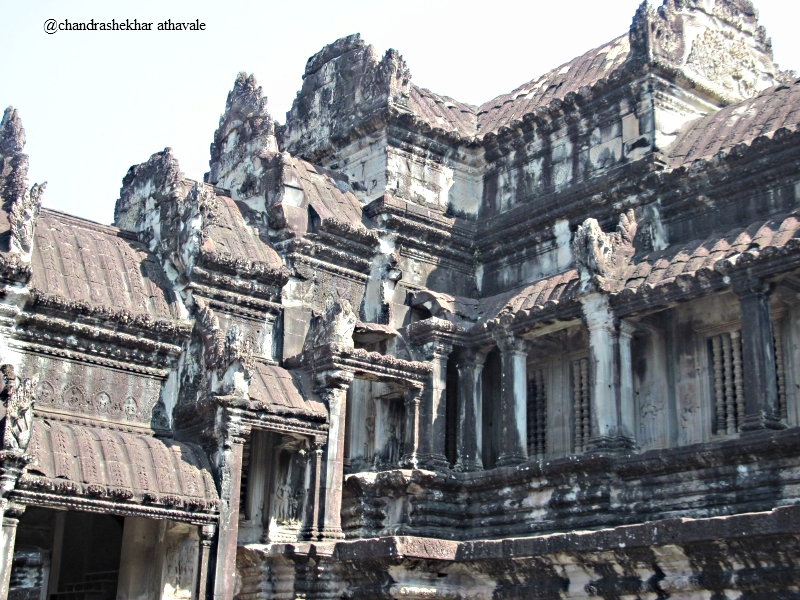
 
Level 3 galleries as seen from level 2
 
Wooden steps provided for going to level 3


As I reach the eastern face of the gallery I see a tall flight of the wooden steps with steel railings provided for the visitors to go up to the third level. This arrangement pleases me and I decide to leave the Apsaras and go up to the third level. The third level does not have bass reliefs or carvings on the walls. An indication that these were covered with either Gold or Silver sheets. Only the King and his chief priest had the privilege of coming up to this level. The central sanctuary, soars 17 Meters above this level. I was surprised to find the central core of the sanctuary, where the statue of God Vishnu would have been, completely filled up and sealed with brickwork with four odd images of Buddha installed in four directions outside the brick walls. The French excavators, digging here, had found a central shaft about 27 Meters deep filled with a hoard of Gold objects down below. What I see here is just a solid brick wall. The view around from this level is exquisitely breath taking.

 
Tower on the central Sanctuary
 
View of the west side entrance from 3rd level gallery


I start climbing down, pause briefly in the second level galleries to take a few shots, and soon reach the first level to see the main attraction of Angkor Wat, the bass reliefs on the external walls, all around the galleries. These galleries are huge. On East and West, they extend to a length of 215 meters and on North and South the length is 187 meters. On each side, there is a central Gopura to enter the temple promenade. On either side of this central Gopura, the stone walls are engraved with superbly detailed pictorials, to the height of at least 3 meters. Just imagine a canvas for a picture 100 meters long and 3 meters wide. Gives an idea to the greatness of these bass reliefs, isn’t it?

Level 1 gallery of bass reliefs
 
Surprisingly the story of each bass relief starts from the right and ends on the left. Something very unusual. This is given as one of the reasons, by proponents of the theory that Angkor Wat temple was designed as a tomb. I only feel bit inconvenienced by this left handed arrangement.
The bass relief on Southern part of the Gallery on the west shows the great war described in the Hindu Epic ‘Mahabharata’ . The war is shown in three levels, the foot soldiers on the lowest level, seniors commanders in the middle level and the princes and the kings on the top level. The detailing is so superb that I get a feeling of watching a real close and hand to hand battle going on in front of my eyes. In the final scene, Prince Arjuna is ready to launch an arrow towards his Guru, Bheeshmacharya, who is lying on a bed of arrows, waiting to die. I walk further towards the southern gallery. Here Khmer King Suryavarman II is shown leading his troops to combat. Later part of the bass relief has a very interesting story. The Hindu God of death ‘Yama’ is shown here riding a bull water buffalo. He watches his assistant ‘Chitragupta’ taking a decision about sending dead souls either to heaven or hell and forcing the sinner souls with a stick through a trap door towards hell, which is depicted on the lower level of the bass relief with all tortures and punishments. The scene is just fantastic.

 
The battle royal of Mahabharata
 
Arjuna kills his Guru Bheeshmaachaaryaa lying on a bed of arrows
 
God of death ‘Yama’ rides a bull water buffalo
 
Chitragupta pushes sinners through a trap door to hell with a stick


On the eastern gallery, full story of the churning of the cosmic sea by Gods and demons is pictured. Unfortunately except for one end, where God Shiva is braving the poison fumes of the five headed sea snake Vasuki, under strains of being used as a rope by the Gods and demons, rest of the bass relief is closed for repairs. I feel disappointed but walk on. Further stories open up from Puranas and the epic Ramayana as I walk towards North gallery. I complete my circuit around the galleries.

 
God Shiva braves the poisonous fumes exhaled by sea snake ‘Vasuki’
 
God Vishnu fights the demons riding on Garuda the eagle
 
Demon king Ravana fights Rama
 
Monkey king Hanuman fights Indrajit
 
Rama fights Ravana, Hanuman watches with a hillock held in his palm
 
Victorious King Rama rides a chariot


It is time to leave as my watch shows the time to be 1 P.M. I have spent close to 5 hours in this monument. I walk back along the walkways, turning around innumerable times, to get one last look of this colossus in stone.

 
Good Bye to Angkor Wat
 
I decide to have for my lunch, genuine Khmer food. The dishes are cooked in coconut milk and I find them very tasty. One reason for this may be the similarity with Thai cooking, which anyway I love. For desert, I try some kind of sago porridge.

I am now on my way to see the greatest fresh water lake in South-East Asia, the Tonle Sap river. This river is quite unusual not because of its large basin but something else. This river joins the great Mekong river near Phnom Penh. For most of the time of the year, Tonle Sap carries water to Mekong. However during monsoon season, the quantity water in the Mekong river starts increasing as distant snows in Tibet start melting. Mekong swells so much that sometime during month of October, waters of Tonle Sap stabilize and actually stop flowing. After this, the flow of water reverses suddenly and Mekong water starts flowing in Tonle Sap. This hydrological freak creates a huge fresh water lake in Tonle Sap river bed, where the water levels rise as much as 10 meters in this season. The reverse flow of water also bring enormous quantities of Fish to the Tonle Sap. For generations and generations, people of Cambodia have survived on this bounty of nature. I decide to take a boat ride, which turns out to be quite interesting, as I can see number of floating villages, complete with schools shops and religious places on my way. While riding the boat, I also see an amusing sign-post right in the middle of the river that says ‘One Way’. All of us see these road signs every now and then on the streets. But, this sign-post, standing in middle of the river, giving exactly the same message, appears rather strange to me.

A 
floating school
 
One way signpost on the river bed
 
On Tonle Sap anything goes as a boat


On way back, I visit a school, run by the Ministry of education, to teach budding artists in arts and crafts of Cambodia. Its fun to watch those artists work on wood , sandstone and silk to create beautiful little masterpieces, which can find their place in our living rooms.
 
Creating a God with your own hands
 
In the evening I go and watch a ballet performance. This is commonly knows as Apsara dance in Siem Reap. This form of classical dance had a long history. It originated from the Royal court dancers during reign of Khmer kings. During those days, the ballet performances were reserved for the king and his court. The art form was almost lost during the civil war. However after 1990′s , there has been a revival and formal training is given to the dancers in the School of Fine Arts in Phnom Penh. The dance form has 3500 defined movements with specific meanings. The story of the Ballet is usually about Cambodia’s origins or about a union between a hermit named Kampu and an Apsara named as Mera. I think that the story runs very parallel to the story of Sage ‘Vishwamitra’ and the Apsara ‘Menaka’ from the Indian scriptures. It is really a small small world, after all.

 
Living Apsaras from the Apsara dance
The ballet performance is quite enchanting. The attire of the dancers is very similar to the attire of the heavenly Apsaras, shown on the temple walls, except obviously for the bare part of the upper torso. The dancers wear crowns with intriguing shapes and are similar to what I have seen on the temple walls. The movements are mainly expressed through hands and facial gestures. The musical accompaniment is distinctly different either from Indian, western or Chinese music.

As I hit the bed, I feel greatly satisfied with the day. It has been a long day indeed. Tomorrow I need to travel about 30 KM away from Siem Reap, to visit the most beautiful temples of Angkor. The temples of ‘Banteay Srei’.

  (To be continued)
20 November 2010

Tuesday, May 13, 2014

Weak at the knees


Last week, I described a far reaching major strategic move by China in my blogpost “ China stations an oil rig in a disputed part of South China Sea.” I had also mentioned there, that a meeting of the ASEAN countries was due on the week-end in Myanmar. That meeting was held on schedule, but instead of any rock like support to a fellow ASEAN country, most of the member countries just paid lip sympathy and tried to generalize things by asking for a wider binding treaty for South China Sea nations. China is not expected to pay any heed to ASEAN for the simple reason that compared to its military might, ASEAN countries do not stand any chance.

Ever since last week's incident, Vietnam has been shouting itself hoarse, about China's move, on every international platform. Last week, at a round table meeting of Diplomatic Academy of Vietnam (DAV) held at Mebourne, ambassador Dang Dinh Quy, who also is the president of DAV said:

"We are deeply concerned by Chinese assertiveness in the South China sea. The Chinese navy is acting without provocation. These decisions seem to be taken by the Chinese leadership at the highest level," Then he added: “There was not much clarity in the Obama administration. That is why we want India should rise quickly. We have great expectations from India,"

In an immediate response, China says that India should not get involved in the dispute. Times of India reports that a Chinese foreign ministry spokeswoman Hua Chunying having said:

"I wish to tell the Indian people that they may not worry too much about the current situation in South China Sea," Chinese foreign ministry spokeswoman Hua Chunying said on Monday. "The facts prove that Vietnam is trying to rope in other parties and put pressure on China, (but) will not achieve its aims,"

India has a stake in this area because India's ONGC has entered into a contract
for joint exploration in the South China Sea region and China had earlier objected to Indian efforts to explore oil and gas in an island claimed by both China and Vietnam. The Chinese government does not want the ONGC to revive its contract with a state-run Vietnamese oil company

India, however can do precisely little at this point of time. General elections have been just finished in India, with results due by week end. The new Government would need time to settle in. Until such time, India is unlikely to react.

India is playing safe now and has called for freedom of navigation in the sea without naming China or Vietnam. India's external affairs ministry says: “We are concerned about the recent developments in the South China Sea and We would like to see resolution of the issue through peaceful means in accordance with universally recognized principles of international law."


In Vietnam, demonstrations were held at the Chinese embassy in Hanoi and protests elsewhere in Vietnam. Bloomberg reports that About 1,000 people marched in Ho Chi Minh City streets on Sunday while hundreds gathered in a public square in front of the Chinese embassy in the capital city of Hanoi as police officers watched without interrupting.

Coming back to the ASEAN summit, Vietnam's prime minister accused China of brazenly triggering a tense maritime standoff in contested South China Sea waters. He asked fellow Southeast Asian leaders to join his objections to China's attempt to place an oil rig in waters claimed by both Beijing and Hanoi and described the move as a dangerous violation of international law and a serious threat to security in one of the world's most important sea lanes. He also warned the ASEAN nations about Beijing's growing assertiveness in its territorial claims.

Vietnam however could not get support it hoped from ASEAN even though Chinese have been claiming huge areas of the coasts of Borneo, Brunei, Malaysia, Indonesia and the Philippines. ASEAN foreign ministers on Saturday jointly only expressed "serious concerns" over the latest confrontation and were not agreeable to directly criticize Beijing, and reiterated calls for restraint and greater urgency in multilateral talks on a code of conduct in the South China Sea. It is obvious that they do not want to do anything except for some face saving measures.

Only country that strongly supported Vietnam was the Philippines because it is facing similar situation. Other ASEAN members are obviously reluctant to take a stronger stance against China. Countries such as Singapore and Thailand, which have no claims in the South China Sea, managed taking no sides in the dispute and just urged restraint from all parties involved.

It is obvious that considering Chinese size, trade potential and also its military strength, Vietnam may not find many supporters and would have to their own thing, if they want to retain their territorial claims. As a result of similar standoff against China the Philippines have now approached for international arbitration.


Whether the Chinese ships would go back or stay put, depends upon what level the decision has been taken. If it has been taken by some lower level officials, just to test international and US response, the ships might back off. However if the decision has been taken at the top, Chinese ships would stay put. In that case, Vietnam has a real problem on hand. It can no longer depend on ASEAN countries, who have shown that they are weak at the knees as far as China is concerned and would have to do its own thing.

13th May 2014


Friday, May 9, 2014

China stations an oil rig in a disputed part of South China Sea


Perhaps emboldened by the actions of its western neighbour in Crimea, China made a major move last week in South China Sea, after years of tough talk and bullying around with smaller peripheral ASEAN nations. On first of May, Vietnamese vessels on patrol, discovered a Chinese oil rig stationed 130 nautical miles off the coast of Vietnam. It was about 119 nautical miles off Ly Son Island in Quang Ngai Province. According to Vietnam, it was a clear violation of Viet Nam's sovereignty. On 4th May 2014, when Vietnamese patrol boats tried to intercept the Chinese oil rig, Chinese escort ships with air support, intentionally collided and rammed two Vietnamese Sea Guard vessels and fired water cannons at Vietnamese vessels, causing damage. At least six Vietnamese sailors have been injured in the past few days.


As Vietnamese demanded the removal of the rig, instead of defusing the situation, Chinese further increased the complications by dispatching 80 ships to the area, including seven naval vessels. Dozens of navy and coastguard vessels from both countries are now in the area, where China has deployed the giant rig. For any one, who is familiar with Chinese tactics, it would be clear that Beijing is trying to impact its foot print in the area for the first time. China perhaps is the only country in the world, which has territorial disputes not only with many of its neighbours, but also with countries that are located far away from its borders. Besides major overland disputes with India and Vietnam, Chinese having been claiming almost entire South China Sea as its own territory and even some islands presently held by Japan in East China Sea.

China has taken an official stance that it has sovereignty over all of the South China Sea, which happens to be an important sea lane for global commercial traffic. Chinese maps show an imaginary dashed line with 9 dashes that encloses about 90 percent of the 3.5 million square kilometers of South China Sea as part of China. Even though this line was first claimed by Chinese Government in 1947, no other country objected to it then. Chinese Government submitted a territorial claim for the area of the South China Sea, falling within the 9- dashed line, on May 7, 2009 to the UN. Immediately, the Philippines lodged a diplomatic protest against China for claiming the whole of South China Sea illegally. Vietnam and Malaysia filed their joint protest a day after. As things stand, Chinese claim is being contested not only by Vietnam and Philippines but by other ASEAN countries like Taiwan, Brunei and Malaysia. Indonesia joined this group when China extended the range of South China sea disputes even further last year by claiming part of Indonesia’s Riau Islands province as its own territory by including it into its so called 9 dash line.


In spite of all the claims made by it, China had never tried to station any ship in the disputed parts of the sea, though Chinese ship continued to sail through often. With last week's action, China's strategy of maintaining status quo and only launching verbal claims, seems to have undergone a major change. International experts also note the fact that the Chinese have moved ahead in placing their oil rig immediately after President Barack Obama’s visit to four Asian countries in late April. This clearly shows Beijing's intentions to test the resolve of Vietnam, other ASEAN members and above all Washington.

China might have calculated that with developments in Ukraine, Nigeria and Syria, Washington may be unwilling to back up strong security assertions made to Japan and the Philippines during President Obama’s trip. An oil industry official in China, on condition of anonymity, confirms this when he says that the decision to position the rig appears to be a political decision rather than a commercial one. He adds that this decision reflects the will of the central government and is also related to the U.S. strategy on Asia.


After it noticed the Chinese rig, representatives from the Foreign Ministry of Vietnam met representatives of the Chinese Embassy in Ha Noi and handed over a ministerial diplomatic note to the Chinese Foreign Ministry. The note affirmed that the activities of China's drilling rig HD-981 and vessels seriously infringed on Vietnam's sovereignty, sovereign right and jurisdiction over Viet Nam's Hoang Sa archipelago, exclusive economic zone and continental shelf. They also seriously violated agreements reached by the two countries' leaders and went against the spirit and wording of the Declaration on the Conduct of Parties in the East Sea (DOC) and related regulations in international law. The note demanded that China "immediately withdraw the drilling rig, vessels, equipment and personnel from Lot 143 in Viet Nam's continental shelf and prevent the recurrence of similar acts."China did not pay much heed to Vietnamese concerns, as can be seen from subsequent developments.

Considering the fact that Vietnam stands no comparison with China's naval might, only thing it can do is to make enough noises by taking the matter to international arbitration. Since Chinese move is a political one and not commercial, the future depends on how Americans respond to the situation.

This week, another ASEAN Summit is likely to take place in Myanmar. Considering this fact, it is obvious that China has posed a challenge not just only to Vietnam but to entire ASEAN community that the South China Sea belongs to it. Much would now also depend upon how ASEAN members respond to this challenge since all of them, except for Cambodia are affected by the Chinese action.

9th May 2014


Saturday, January 12, 2013

Agent Orange


10th of August 1961, is considered as the saddest day in the last 50 years of history of Vietnam. On very this day, American aircraft had sprayed a chemical known as Agent Orange on jungles of Vietnam. This chemical was transported in steel drums, which were painted with orange stripes on the outside and this is the reason for which the chemical was commonly known as Agent orange. 


This chemical has a property by which it destroys all the flora or foliage, including shrubs, trees and grasses, on the ground, where it is sprayed. US Generals had thought that US forces find it difficult to fight the Communist Vietnamese soldiers, because they are hidden in the dense jungles of Vietnam. It was therefore decided by US chief of staff that the jungles themselves should be destroyed so that the Vietnamese soldiers would be exposed and decided to use Agent orange for this purpose. Between 1961 and 1971, or in a decade, American airplanes sprayed 80 Million Liters of Agent Orange on Vietnam Jungles. Agent Orange contains a deadly poisonous substance known as Dioxin and it was found that in this decade approximately 366 Kg of Dioxin was sprayed on Vietnamese soil.


The Army Generals, who took the decisions of spraying Agent Orange, perhaps never thought about the ill effects, this deadly poison would have, on the innocent common people of Vietnam, who were not involved in this war at all. According to an estimate, the decade of spraying of Agent Orange affected at least 4.8 Million innocent Vietnamese and at least 3 or 4 hundred thousand people must have lost their lives in this period. 


For hundreds of thousands of other people, bad long term effects were caused by this chemical, such as Cancer and Genetic mutations. Large number of children were born in subsequent years with terrible physical disabilities. Today within the southern city of Ho-Chi-Min city itself, there are more that 4000 such citizens that are affected by Agent Orange.


A social service organization known as VAVA or Vietnam Association for Victims of Agent Orange is making efforts to help the sufferers of Agent Orange. American senator John MacCain claims that US Government has spent more that 46 Million Dollars on care and rehabilitation Agent Orange affected Vietnamese people. However in 2005, in a legal suite filed against the manufacturers of Agent Orange, American judiciary has given a judgment that has ruled against the 'Agent Orange affected' Vietnamese people. Because of this judgment it has become almost impossible to get any funding from US Government for help to these affected people. This organization (VAVA) is now trying to arrange charity shows of popular rock stars to raise money to help these people. Vietnam Government has also decided to mark, 10th of August of every year as “Orange Day,” to remember these unfortunate people.


I saw recently some photographs of these affected people and also of the genetic defects with which some post war children are born with. The photographs are so pathetic and sad that it requires a special effort to stop and not to cry.

12 January 2013


Saturday, December 22, 2012

Living under a shadow


If I have to comment about the India-ASEAN summit that took place on 20-21st December 2012, in New Delhi, I can easily say without any doubt, that it is a summit clearly under a shadow. No ASEAN leader mentioned it in his speech, but it is obvious that everyone was acutely aware of the elephant in the room. In speeches, the Philippines and Vietnam referred to tensions in their region. Philippines Vice President Jejomar Binay said “At this time of rising concerns about maritime issues, the need to maintain a high level of maritime security and freedom of navigation offers us... an opportunity for enhanced cooperation.” Indonesian President Susilo Bambang Yudhoyono was perhaps more explicit when he told the summit that closer maritime cooperation with India was needed because 70 percent of the world’s traffic in petroleum products passes through the Indian Ocean from the Middle East to East Asia. He said further: “While the center of the global economy is shifting eastward, the Indian and Pacific Oceans have been and will become even more important in providing the vital sea routes for trade and commerce.”


India is hosting this ASEAN-India Commemorative Summit in New Delhi to mark the 20th anniversary of the ASEAN-India dialogue partnership and the 10th anniversary of ASEAN-India Summit-level meetings. The theme of the summit is 'ASEAN-India Partnership for Peace and Shared Prosperity'. And it aims at strengthening ties across diverse areas like trade, energy, security and cultural connectivity. The prime ministers of Singapore, Cambodia, Malaysia and Vietnam, the presidents of Myanmar and Indonesian, and the vice president of the Philippines are attending the summit along with representatives of Thailand, Laos, and Brunei.

Someone may ask; why this sudden anxiety about the maritime security? The answer is not too difficult to find. The South China Sea has become Asia’s biggest potential military flashpoint. The core of the problem is the possibility of huge oil reserves in the region, which are being explored in their territorial waters by Vietnam and the Philippines at present. China claims a huge looping area out of the South China Sea as its own. This claim conflicts directly against sovereignty claims by Vietnam and the Philippines as well as Malaysia, Brunei and Taiwan. In November 2012, China announced a plan to board and search ships that illegally enter what it considers its territory in the South China Sea. A dangerous proposition that could lead to naval clashes.

China also managed to breach the unity of ASEAN over this issue by using Cambodia, which was promised a largesse including a $100 million loan to set up Cambodia's largest cement plant. As a result, the ASEAN summit ended in acrimony in November 2012 over China’s assertiveness in the South China Sea, with its leaders failing to agree on a concluding joint statement.

India is obviously relishing this moment, as countries of South East Asia are looking to India now for maritime security. India has no territorial claim in the region, yet it has interests. It is exploring for oil and gas with Vietnam in an area contested by China. Also there is also a plan to ship liquefied natural gas from Russia through the Malacca Straits in future. It is interesting to note that few weeks ago, India’s navy chief made a statement that he was ready to deploy vessels to the South China Sea to protect exploration interests there, if needed.


In the vision statement agreed at this New Delhi summit, India and the 10-member Association of Southeast Asian Nations (ASEAN) have set their sights on a new “strategic partnership” that would bring closer political, security and economic cooperation, with special importance for the need for freedom of navigation, a contentious issue because of competing claims with Beijing over parts of the South China Sea.

It is obvious that ASEAN considers the presence of naval ships of few major powers in south China sea as a guarantee for their safety. They have already convinced US, which has started stationing a larger force of marines in south east Asia. Presence of India in Southeast Asia would provide them greater additional safety against being dominated by China.

India has great plans for improving connectivity with south east Asia. It is pushing for quick implementation of the India-Myanmar-Thailand Trilateral Highway and its extension to Laos and Cambodia. It is also planning to launch a second route that would run from India through Myanmar, Laos and Cambodia to Vietnam. These plans may take time to fructify. Since annual trade between ASEAN and India has nearly doubled in four years and India’s growing economic clout makes it appealing as a balance to other Asian powers. The emphasis on maritime security gains importance.

As China scare looms large over south east Asia, India may find that it's twenty year old, Look east policy, is finally beginning to gain traction. The New Delhi summit underscores India’s growing role in one of the world’s fastest-growing regions, South East Asia.

22 December 2012


Sunday, November 25, 2012

Great magician's cheap tricks


China is at it again. In one stroke, it has managed to antagonize again many of its neighbours, from India in the west to Philippines in the east. Starting from May 15, 2012, China's police departments started issuing a new passport called e-passport, which contains a microchip that stores digitized data of the bearer's fingerprint and signature. This is a good move no doubt because it improves the safety of the traveler and effectively prevents forgery.

However, many of China's neighbours like India, Vietnam and Philippines are furious about this new passport, because it has a watermark map of China in which Indian state of Arunachal Pradesh, Aksaichin area in Ladakh and various islands in South China Sea, including the Paracels and Spratlys are shown as as Chinese territory.

It is a calculated move to pin prick these countries only, because this map does not contain East China Sea islands administered by Japan, which calls them as Senkaku, and are being claimed by Beijing as Diaoyu islands. Japan acknowledges this fact as a Japanese foreign ministry official says, “We have confirmed that disputed islands in South China Sea appear in a map printed on new Chinese passports.” “On the other hand, Senkaku doesn’t. Therefore, we are not in a position to comment or complain.”


It is obvious that this Chinese move is intentional because this map is appearing only on the Chinese passports issued to normal citizens. This map does not appear on diplomatic or official passports.

Philippines claims part of the Spratly islands as their territory and responding to this prick from China, Philippine Foreign Secretary Albert del Rosario sent Beijing a formal protest letter, calling the maps “an excessive declaration of maritime space in violation of international law”. He says that, “The Philippines strongly protests the inclusion of the nine-dash lines in the e-Passport as such image covers an area that is clearly part of the Philippines’ territory and maritime domain,” Philippines foreign ministry spokesman Raul Hernandez has added: “If we allow that, then that would mean acquiescence to their claim of the whole of the South China Sea.”

Vietnamese foreign ministry spokesman Luong Thanh Nghi has told reporters that the Chinese documents amounted to a violation of Hanoi’s sovereignty and it had protested to the embassy. He says that Vienam Officials handed Chinese representatives “a diplomatic note opposing the move, asking China to abolish the wrongful contents printed in these electronic passports”


This new watermark map also shows Taiwan and entire South China Sea as Chinese territory. This has made other countries in South China sea, like Taiwan, Brunei and Malaysia also infuriated and all of them have protested to China.

Chinese have been trying these tricks in India for quite some time now. Some time back, Chinese started issuing stapled visas to residents of Jammu and Kashmir, terming it a “disputed territory” and had created a diplomatic row. This move was followed by denial of visas to those hailing from Arunachal Pradesh State.

Few weeks back, when India noticed this new watermark map on Chinese e-passports, it reacted strongly and told Chinese foreign ministry that this development is unacceptable. As expected, Chinese did nothing and responded with a general statement addressed to all the countries saying that the issue needed to be dealt with in a "level-headed and rational manner". A Chinese spokesman said that "Hope the countries regard it in a cool-headed manner. China would like to maintain communication with other counties to ensure convenience of travel for both Chinese and foreigners."

India has however not kept quiet and has responded by starting to imprint India's map with Aksaichin and Arunachal Pradesh shown as parts of India, on all Chinese passports received by the Indian embassy for issue of Indian visas from Chinese nationals, effectively nullifying the Chinese one-upmanship.

Indian Government reiterated to Indian Parliament this week that “ China continues to be in illegal occupation of approximately 38,000 sq km area in Jammu & Kashmir state of India. In addition, China also holds under the so-called 'Sino-Pakistan Boundary Agreement of 1963', 5,180 sq km of Indian territory in Pakistan Occupied Kashmir ceded by Pakistan to China,"

It is very difficult to predict or analyze these subtle pin pricks by China. Probably Chinese think it as a game or a move. It may be a good idea for other small nations to follow India's example and start printing their versions of maps along with their visas on Chinese passports instead of just sending protesting notes.

25 November 2012


Sunday, August 12, 2012

A little game of Ping Pong


The south China Sea conundrum is just getting more and more murkier by the month. All other nations of south east Asia except China, on the periphery of South China Sea, are much weaker, compared to China, and are finding themselves at odds with their giant neighbour. An effort was made during July 2012 by some of the South China Sea nations, to present a joint front of a sorts to China by agreeing to a joint code of conduct in South China Sea, through the association of these nations known as ASEAN. China effectively managed to bomb the move by using dormant historic rivalry between Cambodia and Vietnam. Since this tiff off between Cambodia and other nations of ASEAN has happened, their relationship in spite of efforts to patch up by Indonesia, have remain little strained, no doubt.

In an earlier post on this subject, Is India leaving South China sea conundrum? I had tried to explain, how India has got drawn in this dispute. To make things clear, I might repeat part of this history here. India's Government owned 'ONGC Videsh Limited' or OVL, (International Petroleum Company of India) had set up its office in Vietnam as early as 1988 ( then known as Hydrocarbons India Private Limited.) with the sole intention of participating in oil exploration in South China Sea region. OVL has been in few petroleum blocks in Vietnam for years and has successfully extracted gas from them. OVL has made some of the blocks commercially viable and has made profits from its activities in Vietnam and the South China Sea in last two decades. China never objected to this and lay any claim to any of the blocks. India was awarded Block 127 and 128 by Vietnam for oil exploration, located up north in Phu Kanh Basin, having roughly equal distance from the Vietnam coast and Hainan Island of China, where it has a large submarine base. Vietnam has always claimed that Phu Kanh Basin is in a continental shelf and falls in it's exclusive economic zone. India began production tests in these blocks in September 2009. However, India first decided in 2011 to get out of block 127 as no oil showed up in the exploratory well. After another year of exploration, OVL informed the oil ministry of India of it's intent to relinquish block 128, also on basis of techno-commercial (not enough oil there) considerations. Oil ministry approved the action and as per terms of contract with Vietnam, India has paid a $15 million exit fee to Petro Vietnam for getting out of the block. China never objected to any activity by OVL except making some angry noises, which were largely neglected by Vietnam.


Exiting these two blocks only for purely techno-commercial considerations, India has made it quite clear to Vietnam of its intentions of staying put in South China Sea and is in negotiations with Vietnam for getting some other blocks allotted to it. Meanwhile, sensing a vacuum created by India's exit from blocks in Phu Kanh Basin, China has suddenly upped the ante with a dangerous act of unilateralism, by putting this petroleum block, till now owned by Vietnam and only claimed by China, up for global bidding. This is likely to increase tensions in this area no doubt.

Indian foreign office, perhaps peeved by these clever Chinese antics and with a wish to support its ally Vietnam, have thrown a jab in China’s direction from a diplomatic standpoint. India has now agreed to allow Taiwan to open a consulate in Chennai. This can be straightway considered as a slap in the face for the Chinese, because they have also requested permission to open a consulate in Chennai quite some time back. India has neither refused the permission nor given it. The request has been pending for quite some time (Six or Seven months)now.

Meanwhile, India , it seems, has requested China, to allow reopening of its consulate in Tibet at Lhasa. The requests for opening new consulates are dealt by countries by principle of reciprocity. When a country asks another country for permission to open a consulate, it would have to allow the other country to return the favor. By this convention, India's request seems to be fair in order.

However, this request has put Chinese foreign office in real quandary. Tibet is China’s weak spot and the Chinese are quite sensitive about Tibet. India also allows the Dalai Lama of Tibet to run his government-in-exile from Indian soil since last half-century. India’s formal diplomatic presence in Lhasa, could turn out to be real thorn in the flesh from Beijing’s perspective. It is just not possible for the Chinese to accept India's request. Indians know this and have used it very effectively as a Quid Pro quo demand for the Chinese

It seems, a new little game of Ping Pong, has just began between China and India.

12 August 2012