Showing posts with label Mahabharata. Show all posts

Tuesday, August 26, 2014

A Siem Reap Sojourn - Part II

As I come down to hotel lobby, my watch shows just 5 ‘O’ clock in the morning. However, my trip coordinator, Mr. Bunla is already waiting for me. I get into the car and we speed towards Angkor Wat. Watching the Sun rise from behind this temple is the Reason for my departure at this unearthly time. While traveling, I remember that the Khmer language word ‘Wat’ has come from a similar Thai word, which means a temple. I note in my mind that both these words must have come from the Sanskrit word Watika. Angkor Wat therefor means a temple city. The construction of this temple was started during the reign of Khmer King Suryavarman II or during 1113-50. However, it seems that the construction work, which took 30 years to complete, was completed only after the demise of the king, as his after death title or name, ‘Paramavishnuloka’ appears in one of the bass reliefs on the first level. It is believed that the design of this temple was made by a Brahmin minister of the king, Divakar Pandit, who was believed to be endowed with divine powers. Cambodians however attribute the temple to Hindu mythological architect of the Gods, ‘Vishwakarma.’ There has been a considerable debate as to whether Angkor Wat was built as a temple for God Vishnu or a tomb for the king. I think it is better to leave these debates to experts only.

Such kind of thoughts raced through my mind, as my car came to a screeching halt in total darkness. Whatever light I could see, was from the headlights of a streaming line of cars, which brought visitors to the temple. I get down and look in the front. I see a huge stone pedestal with some steps and railing. I climb the steps in light of my flashlight and walk in the direction where everyone else is going. We are stopped by a human chain of security guards , who inform me that the temple opens at 5.30 A.M. There is nothing to do but wait and look into the darkness. I slowly realize that the pedestal was getting filled up with people. Most of them carried in their hands some or other kind of an expensive photographic apparatus produced by leading camera manufacturers of the world. I hide my modest camera in the palm of my hand and wait patiently. At exactly 5.30 A.M. the security guards break the human chain and allow the crowd to proceed. I prefer to wait on the pedestal, as I have been told that one of the best views of ‘Angkor Wat’ Sunrise can be seen from the very place I stand.
In spite of so many people being around, only sound that I can hear is the faint rattle of a diesel engine driven pump. This is unusual because in India, whenever few people gather together, a virtual cacophony results almost immediately. After another 15 minutes, I sense some kind of black shadows far away on the background of a pitch dark bluish sky. Another few minutes gone, I can now see a huge moat of water just in front of me. This is the outer moat of Angkor temple. This one is about 200 meters wide and has a perimeter of about 5.5 Km. There is a wide causeway (12 meters or 39 feet wide) stretching in front of me for 250 meters. On other end of the causeway, I can now see a long brownish blackish line extending right up to the full breadth of my vision. Sky takes a slightly lighter shade of dark blue. The brownish line turns out to be a long covered gallery with a row of square pillars in front. On my sides, two solid stone Lions stand guarding the way to the temple. I see now that the continuity of the gallery far ahead is broken at the middle and at some distance away from the middle on both sides, by three slightly damaged Gopuras, which stand tall. These Gopuras also serve as entry gates to the inner temple complex. As things light up, I can see that the gallery and the Gopuras, which I see in the front, are really just a facade for the temple. I see clearly far behind this facade, 5 tall peaks of the temple itself. The harmony, the balance, the proportions and the symmetry, everything is highly impressive. This view can be compared only to that of the Taj Mahal. No wonder that the locals believe that Angkor Wat was built by Gods themselves. I realize that I have no words to describe this colossal monument.

 
Sun Rises from behind Angkor Wat Temple
 
Its already 6 ‘O’ clock in the morning. There is no rising Sun seen anywhere. The Sun rise was supposed to be at 5.54 A.M. Then I see that the horizon is completely covered with gray and dark gray clouds. I would not be able to see the Sun rising from behind Angkor Wat. today. I only can see some brief pinkish orange streaks on the east horizon between the clouds. I give up and decide to go to my hotel to have a quick breakfast and then return here again to see this majestic creation of the Khmers.
Famous English Author Somerset Maugham visited Angkor Wat in 1959. After his visit, he spoke to few people. His exact words were “ No one! No one should die before they see Angkor”.Angkor Wat produces that kind of reaction in your mind. The layout of this temple is a symbolic representation of the world, as described in the Hindu scriptures. Five peaks at the center represent the peaks of Mount Meru. The outer wall represents the mountain ranges at the end of the world and the moat represents the water that is beyond the borders of the world, dark, unfathomable and unknown.
I return to the temple after some hearty breakfast. I have to walk a lot today. I cross the first causeway, climb few steps and enter the central Gopura of the facade. This facade is a narrow and very long structure. In front of me, I see another raised walkway supported by a low balustrade. This walkway is 350 meters long and is 9 meters wide. At the end of the walkway, I see now for the first time, the Inner temple of Angkor Wat. Instead of walking straight to the temple, I turn right and decide to explore the facade gallery. I see a huge standing figure of Buddha at some distance. I can see that there is something odd about this figure. The figure has eight hands, four on either side. This was originally an idol of the Hindu God Vishnu, with eight arms. The head was replaced later to make him appear like Buddha. But the original carving of ornaments, garments and some golden colour can still be seen. I continue to walk along the gallery up to the end. There is a way provided to go round the facade and see the wall facing the temple. On this wall I can see some beautiful bass reliefs of Apsaras, Divine Nymphs from the heaven. I return to the central walkway and start for the inner temple.

 
Buddha that was God Vishnu
 
Towers of Angkor Wat as seen from the corner of Facade gallery
 
Carvings on the temple facing wall of the facade gallery


The main entrance is blocked due to some repair work being done and I use a diversion to enter the temple from another hall called Hall of Echos. Angkor Wat has been built on 3 levels just like the Bayon temple. The first level Galleries are of a size 215 Meters by 187 meters. The second level, rises in the middle of first level and has a size of 100 Meters by 115 Meters. Standing tall at the center of the 2nd level, third level is of the size of 60 Meters by 60 Meters square. The central sanctuary raises above this level. Third level rises an astonishing 40 Meter above second level. The total height of the temple from ground is 65 Meters or213 feet. These numbers do non mean much on paper unless one actually starts climbing up. Obviously, since it was not possible for Khmer architects to construct a multistory structure, as requisite technology and materials were yet to be developed, they must have opted for this pyramid like temple mountain construction.

 
On way up to the second level, Note the carvings on pillars and lentils 
 
I had read somewhere that there are two ways of visiting the temple. Level by level or go to the top first and then come down to the first level at the end. I choose the second alternative and start climbing the steps to second level. On my way up I can see beautiful carvings along the stair case. While climbing the steps, I can also see that the outer walls of the gallery on the second level are almost bare without any carvings. This indicates that perhaps bronze or silver panels were fixed on these walls from outside. This possibility is supported by number of holes seen in the outer walls, where wooden pegs might have been fixed to support the bronze panels. The steps finally lead me to the second level gallery walls, which face the third level structure. As I go round these inner walls, I can see that the walls and on the corners are carved with beautiful bass reliefs of Apsaras, the heavenly belles or celestial Nymphs with whom Gods live in the heaven. I wonder why repetitively such figures have been carved by the temple builders at this level. The figures may appear repetitive, but as I look closely, small and minute differences can be seen in each and every Apsara carving. The crowns, the necklaces, what the Apsaras hold in hand, differ in every frame. Some Apsaras appear single, some in groups of two and in few places, groups of four or five. It is believed that the fascination of Khmer kings with Apsaras, really began with the concept of a God-King, directly acquired from India. Khmer people believed like Indians of that period, that their Kings were incarnations of the Gods. Since the Gods always had Apsaras associated with them, Khmer kings had Apsara carvings on the second level of the temple, where ordinary citizens were not allowed and also found justification in maintaining a large troupe of concubines.

A 
Troupe of Apsaras
 
West side Tower on level 3
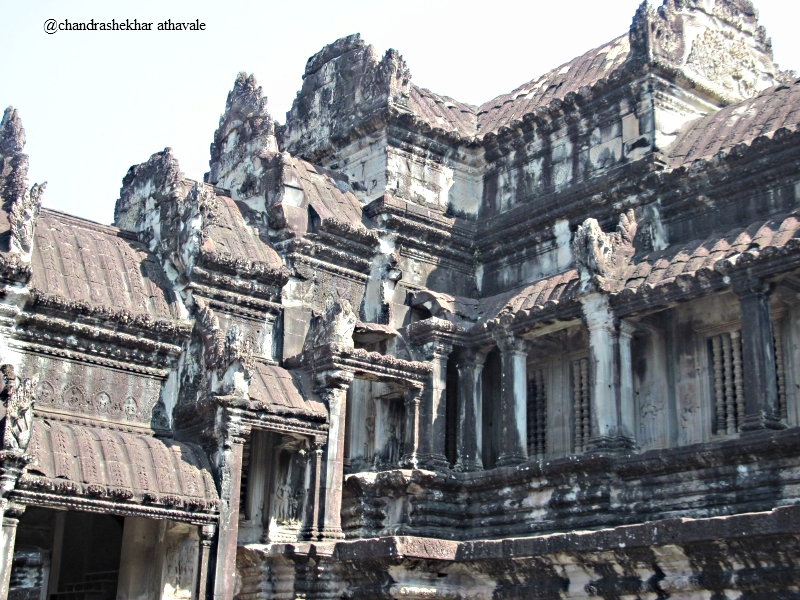
 
Level 3 galleries as seen from level 2
 
Wooden steps provided for going to level 3


As I reach the eastern face of the gallery I see a tall flight of the wooden steps with steel railings provided for the visitors to go up to the third level. This arrangement pleases me and I decide to leave the Apsaras and go up to the third level. The third level does not have bass reliefs or carvings on the walls. An indication that these were covered with either Gold or Silver sheets. Only the King and his chief priest had the privilege of coming up to this level. The central sanctuary, soars 17 Meters above this level. I was surprised to find the central core of the sanctuary, where the statue of God Vishnu would have been, completely filled up and sealed with brickwork with four odd images of Buddha installed in four directions outside the brick walls. The French excavators, digging here, had found a central shaft about 27 Meters deep filled with a hoard of Gold objects down below. What I see here is just a solid brick wall. The view around from this level is exquisitely breath taking.

 
Tower on the central Sanctuary
 
View of the west side entrance from 3rd level gallery


I start climbing down, pause briefly in the second level galleries to take a few shots, and soon reach the first level to see the main attraction of Angkor Wat, the bass reliefs on the external walls, all around the galleries. These galleries are huge. On East and West, they extend to a length of 215 meters and on North and South the length is 187 meters. On each side, there is a central Gopura to enter the temple promenade. On either side of this central Gopura, the stone walls are engraved with superbly detailed pictorials, to the height of at least 3 meters. Just imagine a canvas for a picture 100 meters long and 3 meters wide. Gives an idea to the greatness of these bass reliefs, isn’t it?

Level 1 gallery of bass reliefs
 
Surprisingly the story of each bass relief starts from the right and ends on the left. Something very unusual. This is given as one of the reasons, by proponents of the theory that Angkor Wat temple was designed as a tomb. I only feel bit inconvenienced by this left handed arrangement.
The bass relief on Southern part of the Gallery on the west shows the great war described in the Hindu Epic ‘Mahabharata’ . The war is shown in three levels, the foot soldiers on the lowest level, seniors commanders in the middle level and the princes and the kings on the top level. The detailing is so superb that I get a feeling of watching a real close and hand to hand battle going on in front of my eyes. In the final scene, Prince Arjuna is ready to launch an arrow towards his Guru, Bheeshmacharya, who is lying on a bed of arrows, waiting to die. I walk further towards the southern gallery. Here Khmer King Suryavarman II is shown leading his troops to combat. Later part of the bass relief has a very interesting story. The Hindu God of death ‘Yama’ is shown here riding a bull water buffalo. He watches his assistant ‘Chitragupta’ taking a decision about sending dead souls either to heaven or hell and forcing the sinner souls with a stick through a trap door towards hell, which is depicted on the lower level of the bass relief with all tortures and punishments. The scene is just fantastic.

 
The battle royal of Mahabharata
 
Arjuna kills his Guru Bheeshmaachaaryaa lying on a bed of arrows
 
God of death ‘Yama’ rides a bull water buffalo
 
Chitragupta pushes sinners through a trap door to hell with a stick


On the eastern gallery, full story of the churning of the cosmic sea by Gods and demons is pictured. Unfortunately except for one end, where God Shiva is braving the poison fumes of the five headed sea snake Vasuki, under strains of being used as a rope by the Gods and demons, rest of the bass relief is closed for repairs. I feel disappointed but walk on. Further stories open up from Puranas and the epic Ramayana as I walk towards North gallery. I complete my circuit around the galleries.

 
God Shiva braves the poisonous fumes exhaled by sea snake ‘Vasuki’
 
God Vishnu fights the demons riding on Garuda the eagle
 
Demon king Ravana fights Rama
 
Monkey king Hanuman fights Indrajit
 
Rama fights Ravana, Hanuman watches with a hillock held in his palm
 
Victorious King Rama rides a chariot


It is time to leave as my watch shows the time to be 1 P.M. I have spent close to 5 hours in this monument. I walk back along the walkways, turning around innumerable times, to get one last look of this colossus in stone.

 
Good Bye to Angkor Wat
 
I decide to have for my lunch, genuine Khmer food. The dishes are cooked in coconut milk and I find them very tasty. One reason for this may be the similarity with Thai cooking, which anyway I love. For desert, I try some kind of sago porridge.

I am now on my way to see the greatest fresh water lake in South-East Asia, the Tonle Sap river. This river is quite unusual not because of its large basin but something else. This river joins the great Mekong river near Phnom Penh. For most of the time of the year, Tonle Sap carries water to Mekong. However during monsoon season, the quantity water in the Mekong river starts increasing as distant snows in Tibet start melting. Mekong swells so much that sometime during month of October, waters of Tonle Sap stabilize and actually stop flowing. After this, the flow of water reverses suddenly and Mekong water starts flowing in Tonle Sap. This hydrological freak creates a huge fresh water lake in Tonle Sap river bed, where the water levels rise as much as 10 meters in this season. The reverse flow of water also bring enormous quantities of Fish to the Tonle Sap. For generations and generations, people of Cambodia have survived on this bounty of nature. I decide to take a boat ride, which turns out to be quite interesting, as I can see number of floating villages, complete with schools shops and religious places on my way. While riding the boat, I also see an amusing sign-post right in the middle of the river that says ‘One Way’. All of us see these road signs every now and then on the streets. But, this sign-post, standing in middle of the river, giving exactly the same message, appears rather strange to me.

A 
floating school
 
One way signpost on the river bed
 
On Tonle Sap anything goes as a boat


On way back, I visit a school, run by the Ministry of education, to teach budding artists in arts and crafts of Cambodia. Its fun to watch those artists work on wood , sandstone and silk to create beautiful little masterpieces, which can find their place in our living rooms.
 
Creating a God with your own hands
 
In the evening I go and watch a ballet performance. This is commonly knows as Apsara dance in Siem Reap. This form of classical dance had a long history. It originated from the Royal court dancers during reign of Khmer kings. During those days, the ballet performances were reserved for the king and his court. The art form was almost lost during the civil war. However after 1990′s , there has been a revival and formal training is given to the dancers in the School of Fine Arts in Phnom Penh. The dance form has 3500 defined movements with specific meanings. The story of the Ballet is usually about Cambodia’s origins or about a union between a hermit named Kampu and an Apsara named as Mera. I think that the story runs very parallel to the story of Sage ‘Vishwamitra’ and the Apsara ‘Menaka’ from the Indian scriptures. It is really a small small world, after all.

 
Living Apsaras from the Apsara dance
The ballet performance is quite enchanting. The attire of the dancers is very similar to the attire of the heavenly Apsaras, shown on the temple walls, except obviously for the bare part of the upper torso. The dancers wear crowns with intriguing shapes and are similar to what I have seen on the temple walls. The movements are mainly expressed through hands and facial gestures. The musical accompaniment is distinctly different either from Indian, western or Chinese music.

As I hit the bed, I feel greatly satisfied with the day. It has been a long day indeed. Tomorrow I need to travel about 30 KM away from Siem Reap, to visit the most beautiful temples of Angkor. The temples of ‘Banteay Srei’.

  (To be continued)
20 November 2010

Tuesday, February 18, 2014

China's baby hatches


The great Hindu epic, Mahabharata, describes a story, where Princess Kunti, unwed daughter of the Yadava king 'Shurasena,' gave birth to an illegitimate child. Kunti as a young princess, was devoted to the service of the gods and guests, who visited the king. An irascible sage 'Durvasa' was so much pleased with her service and devotion that he taught her a mantra as a boon, that would enable her to have sons from any god that she wished to invoke. Unfortunately, the young princess Kunti did not fully realize the implications of this boon, and overcome by curiosity, she decided to invoke Surya, the Sun God. The mantra was, of course, potent and Surya appeared in person before her. The powerful mantra also ensured that she was conceived by Surya.


As an unwed young mother, she had no choice but to abandon her child for the fear of public disgrace as Sun God Surya would not help her in caring for the newborn son, Karna. With heavy heart, she set the child afloat in a basket on a river, praying with tears in her eyes. Karna was picked up and reared by the charioteer Adhiratha and his wife Radha. He grew up to be a brave warrior, an expert in archery, a man noted for his generosity, but became an ally of the Kauravas, and an arch enemy of the Pandavas, who were legitimate sons of same Kunti, born after her marriage and therefore his own half brothers. Rest of the story is really of no interest to us here.

From this story, it may not be wrong to conclude that since time immemorial, the problem of unwanted and abandoned children has been there in every known human society. In one of the earliest surviving examples of child abandonment in Greek and Roman culture is that of Oedipus who is left to die as a baby in the hills by a herdsman ordered to kill the baby, but is found and grows up. Wikipedia lists that Moses, major prophet in Christianity, Islam, and Judaism, was given up as an infant.

According to one estimate, in USA alone, number of unwed mothers in 2011 was 1,607,773. I am not trying to say that all these new mothers wanted to abandon their offspring. But even a small percentage of this number would work out to be a big number. I could not find any statistics for India or China, but the number is likely to be even larger because of higher population base. In the local papers, stories appear now and then of unknown persons dumping newborns near the doors of orphanages and rarely even in Garbage dumps.

These unfortunate infants are mostly taken care by orphanages, if they are lucky enough to survive, and are given later mostly for adaptation to childless couples from almost the world over, where they are well taken care for. Greatest danger for such an abandoned baby however, remains to be for the first few days or hours, when they are left anonymously at some remote place.

It is estimated that 10,000 children are abandoned in China each year. Unfortunately many of these babies have disabilities or serious illnesses or some kind of severe health problems and are abandoned because their parents fear that they would not have enough money to pay for expensive medical treatment. The past records show that only one in such three abandoned babies, would survive.


Chinese Government has now come up with a scheme, which is worth emulating by others. The China Center for Children's Welfare and Adoption told the state-run news agency, Xinhua, that more than two dozen small enclosures in public places that are termed as baby hatches, had been set up in China. These enclosures have an incubator and a delayed alarm. Parents, who want to abandon their child, simply place the child in the hatch, press an alarm button and then leave, remaining anonymous, Someone then comes to retrieve the baby five to 10 minutes later. The baby hatches are expected to increase the chances of a baby surviving.


The first such baby hatch opened in the city of Shijiazhuang in Hebei province in 2011. Each Chinese province has been told to set up at least two baby hatches by the end of the year. So far, the Chinese authorities have set up 25 "baby hatches" across the country to allow parents to safely abandon their unwanted infants. Number of baby hatches have opened in the last few months. The baby hatch in Guangzhou, received 79 babies in its first 15 days.

Like anywhere else in the world, abandoning a child is illegal in China. But what happens actually on ground is quite different. Health authorities believe that the hatches provide a safe environment for something that would go on anyway. Without any doubt, baby hatches give the infants a better chance of survival than if they were dumped on the street.


There has been a criticism that these baby hatches could encourage people to give up their babies. Just like in India, Chinese families traditionally favour boys. Critics say that since the families can have only one child, the girls might get abandoned so that the parents can try again for a boy. But the experience so far shows that the babies left in the new hatches are both boys and girls. Also, notes, cash or medical records are found tucked inside the baby's clothing and are left behind with the baby. This shows that parents abandon their infants woth most reluctance.

I feel that this Chinese social measure, is very innovative and path breaking. The poor abandoned infants, who have arrived in this world for no fault of theirs, have for the first time a real chance to survive and survive well.

18th February 2014


Thursday, February 6, 2014

The feeling of pain


As we grow older, our bodies start complaining about pain of some kind or other, as a response to situations, which it does not like any more. A famous quote from a writer rightly describes the old age pain in these words: “When you get up in the morning and realise that there is no pain at all from any part of your body, trust that you are dead.” Leaving aside the humour aspect of this quote, there is a lot of truth in this. Its a daily and universal battle for most of the seniors, who have to manage pain of some kind or other all the time.

Feeling of pain is not something that is only reserved for old people. Each and everyone of us is familiar with this feeling right from our childhood. Some of the specialized pains though appear later in life. Take for example head aches due to sinuses. Since sinuses do not develop in human body till the child is 12 years old or so, sinus pain is not known to children. The Pain, which we feel is essentially of two kinds, physical pain, which occurs due to some external cause or a malfunction of a body organ and the mental agony or heart break that we face due several reasons. But mental pain is caused by stress of some kind and is more in the realm of the psychologists. I am more concerned here  about the physical pain, like head aches, stomach aches or pain in organs like hands or feet caused by multitude of reasons, even physical discomforts. Pain is such a wide spectrum phenomenon that one in five, of the population anywhere, suffers from acute or chronic pain.


There a famous story in Mahabharata, the Indian classic, about Karna, one of the greatest of warriors, who feature in the story.

“ Karna was actually a Kshatriya (Warrior race) by birth but was abandoned by his mother. A fisherman found him and raised him.  Karna however was a born fighter and interested in craft and art of war and was not ready to give up his interest. He decided to learn it from sage Parasurama, the great master of all weapons.  Unluckily for Karna, sage Parasurama had taken a vow to kill all Kshatriyas living on earth and therefore taught only to Bramhins.

Karna decided to play a trick to achieve his goal  and approached Parasurama disguised as a Brahmin and politely told him that he was a Bramhin and had  come to learn from him.  Parsuram believed in him and asked him to stay at his hermitage. Karna lived happily at Parasurama’s hermitage. He was his master’s best student and served his guru with utmost sincerity and respect.

However, one day Parasurama was laying down with his head on Karna’s lap and fell asleep soon. A flesh-eating insect bit Karna and started biting his thigh and a wound was formed which was very painful. But Karna did not move at all and bore the pain with fear that his guru might wake up from his rest. He could not brush off the insect without moving his master’s head. So he suffered the killing pain silently. But the blood, which flowed from the would touched Parasurama’s cheek and he woke up. When he saw the blood, he  jumped up and asked Karna about it. Karna then told him the whole thing and  explained, “You would have woken up if I had moved and so I stayed still. I am sorry I could not control the blood oozing out from the wound.

Parasurama was by now very sure of one thing. He knew that  no Brahmin could have suffered such a pain in silence and the boy has to be a Kshatriya. He asked Karna to tell the truth. Karna explained everything honestly. The explanation made Parasurama angry. His favorite pupil’s trick made him furious. He cursed Karna.”

Rest of the story is of irrelevance to us. I have narrated this story here, just to point out that pain threshold or the point when a physical discomfort becomes a pain, varies from a person to person. Take a simple example of the summer heat. Some people just can not tolerate the heat at all. They would start sweating profusely and generally would become very uncomfortable. Similarly few people can not tolerate chilly winds at all, while others may be enjoying them.

Then what is it that that makes a physical discomfort only for some people as painful, when the same discomfort may be just a minor irritation for others. Since everything about our bodies is decided and controlled by our genetic DNA sequencing, it is natural to assume that our pain thresholds also would be defined by or genes. Doctors however say that sensitivity to pain is complex, with wide individual variation. Previous studies have suggested  that about half of the influence is explained by genes.


 DR. Tim Spector

To determine what part of our genome actually defines this pain threshold, researchers led by Dr. Tim Spector, professor of genetic epidemiology at King's College London, decided to carry out a simple experiment. 25 pairs of identical twins, were tested for pain threshold  using a heat probe placed on the arm. Since identical twins share 100% of their genes; any difference between identical twins can not be genetic and would have to be due to their environment or changes affecting the function of their genes.

The  participants in the study were asked to press a button when the heat became painful for them, which allowed the researchers to determine their pain thresholds. Later on, researchers examined  the whole genetic codes (genomes) of the twins and compared them with 50 unrelated individuals by using  DNA sequencing. Surprisingly even though one of the twins from the pairs, had felt pain, her or his identical twin had not felt it at that point of physical discomfort. The research team was then able to detect chemical changes within nine genes, which could be correlated with pain sensitivity, that were different in one twin but not in her identical sister.

Tim Spector, says that these chemical changes in nine genes, are like a dimmer switch for gene expression. He adds: "This landmark study shows how identical twins, when combined with the latest technology to look at millions of epigenetic signals, can be used to find the small chemical switches in our genes that make us all unique - and in this case respond to pain differently. The chemical changes act like a "thermostat" or "dimmer switch" to set an individual's pain sensitivity.”


This study is important from point of view of sensitivity to pain, which is extremely complex, with wide individual variation. Even twins sharing 100% of genes have different pain thresholds, which can potentially be altered by lifestyle or medication. The study is important as it  could lead to new painkillers or lifestyle interventions.


There is often a common belief that some people have a delicate body or are weak just because their pain threshold for a particular type of pain is lower. This study very well proves that level of pain threshold is decided by our genes and has nothing to do with our being strong or delicate. With old age probably, the pain threshold also starts becoming lower.

6th February 2014


Tuesday, May 7, 2013

Mahabharata warriors finally going home


Mahabharata, the greatest Indian epic, describes a great war fought between forces of good represented by 5 Pandava princes and those of evil represented by 100 Kourava princes. The eldest of the Kouravas, Duryodhana, ran away from the battle ground in defeat and hid himself away. The Pandawas helped by Gods, soon found out, where he was hiding and challenged him to come out and fight it out with any of the 5 brothers. Duryodhana, even in his defeat, was still a great warrior and accepted the challenge, but refused to fight with any one else except Bhima, whom he considered as the only person who matched his own fighting skills.

The stage was now set for a royal battle between these two greatest warriors, who initially started the fight with their maces, soon broke them and finally resorted to bouts of wrestling with clear intention of killing the opponent. The royal fight was witnessed, besides other Pandava brothers, by Krishna and few other spectactors.

Cambodia's Khmer sculpturers chose this battle scene for creating a free standing mega sculpture, carved out of red stand stone to adorn the great temple of Hindu God Vishnu, being built by by King Jayvarman IV (928-941 CE) at Koh Ker in northern part of Cambodia, 180 miles northwest of Phnom Penh and not very far from Thai border. Sometime after 1970, during Cambodia's civil war, this grand monument was hacked and stolen from the temple premises. I have already described in these three articles ' Wrestlers of Koh Ker,' 'Would Duryodhana ever come back home?' and 'Battle Royal of Koh Ker, now come the spectators!' how 4 of the 12 statues have been discovered in USA and where they are kept at present.

The two statues of so called 'Kneeling attendants,' which according to me are actually of two other Pandawa warriors, because of their sitting stance or posture known in ancient India as 'Veerasana' or Sitting position for a warrior ready to join a battle, were found to be on display in New York's Metropolitan Museum of Art, guarding the doorway to the Museum’s Southeast Asian galleries since they opened in 1994.

Cambodian officials visited this Museum in March 2012 to photograph its Khmer items. Later, they submitted evidence to the museum, that the works had been improperly removed from the Koh Ker temple complex, such as photographs of the statue’s broken-off bases, which were left behind at the site, and witness statements that the Cambodians had collected suggesting that the statues were intact as recently as 1970.

The two Pandava princes, ready to battle were received by the New York museum as donations from art collectors, whose actions do not appear to be on board at all. In 1987, Spink & Son, a London auction house, and a longtime Khmer art collector, Douglas A. J. Latchford, jointly donated one of the two heads. A second head was donated by Raymond G. and Milla Louise Handley in 1989, who also had bought it two years earlier, also at Spink & Son. In 1992 same Mr. Latchford gave the museum the two torsos. Museum conservators reattached the heads and bodies together in 1993.( Mr Latchford was listed as owner of the 'Duryodhana' statue also, for auction by Sotheby's.) Mr Latchford agrees that the statues have been stolen from Cambodia but justifies this by saying that if they would have remained in Cambodia, Khmer Rouge would have shot them up for target practice. Very Strange argument no doubt!

Cambodian authorities began negotiations over the statues with the museum in June 2012. The museum then decided to send Sharon Cott, the Museum's general counsel, and John Guy, its Southeast Asian curator, to Cambodia in March 2013 to resolve this thorny dispute; whether these two pieces of ancient Khmer art, which the museum had for long and prominently exhibited, were actually the products of looting. It took no time for the museum officials to get convinced that the statues have indeed been smuggled out of a remote jungle temple around the time of the country’s civil war in the 1970s.

Last week the museum said it would repatriate the life-size sandstone masterworks, known as the Kneeling Attendants back to Cambodia. The museum has now told Cambodian officials in a letter that it hopes to send the objects as soon as “appropriate arrangements for transit can be mutually established.” Cambodians are naturally overjoyed and happy. The secretary of state with the nation’s Office of the Council of Ministers,, Chan Tani,, expressed his excitement about the return in these words. “This shows the high ethical standards and professional practices of the Metropolitan Museum of Art, which they are known for.”

For Millions of Khmer art lovers from all over the world, which includes me too, this is great news. My wish is that sooner or later, all the 12 statues that were constituents of this grand spectacle at Koh Ker, would be found and returned to Cambodia. Kudos to New York's Metropolitan Museum of Art.

7 May 2013


Postscript

On December 12th 2013, truce was finally called, when Sotheby’s, Decia Ruspoli di Poggio Suasa and the US federal government have come to an agreement about Duryodhana statue from Koh Ker, Cambodia. This comes seven months after the Metropolitan Museum of Art returned the pair of 10th-century Khmer statues known as the Kneeling Attendants that had been looted from the Prasat Chen temple. Sotheby’s have agreed to return the Duryodhana statue looted from the same temple that has been blocked by US from sale for two years. The negotiations have been long and arduous and legal wrangling very nasty for a cultural property dispute.

The consignor, Decia Ruspoli di Poggio Suasa, who had long owned the statue, and Sotheby’s have “voluntarily determined, in the interests of promoting cooperation and collaboration with respect to cultural heritage,” that it should be returned. In return all accusations against them that they were dealing in stolen property would be dropped.

That only leaves the Norton Simon Art Foundation in Pasadena, which still owns the other Mahabharata warrior Bhima's statue, who is Duryodhana’s opponent in the deadly battle created in stone at Koh ker, Cambodia.


12th January 2013 

Update

A ceremony was held to commemorate the return of the Duryodhana, to Cambodia on May 7, 2014 at the US Attorney’s office in New York. Sok An, Cambodia’s deputy prime minister and  Preet Bharara, right, US Attorney for the Southern District of New York, were present.

The second statue of “Bhima,” was bought in 1976 by the Norton Simon Museum in Pasadena, California. After months of discussions, the US museum also agreed to return its statue to Cambodia, according to Sok An. “Duryodhana’s” homecoming is expected in June, officials said, and it is hoped that “Bhima” will follow around the same time.

9th May 2014 


Monday, June 4, 2012

Battle Royal of Koh Ker, now come the spectators!


The story of a three dimensional sandstone sculpture at the Prasat Thom temple located on a vast archeological site called Koh Ker, about 200 miles northwest of Phnom Penh, Cambodia, is getting more and more curious. Near the entrance of the Prasat Thom sandstone temple at Koh Ker, which was dedicated to the Hindu god Vishnu, a sculpture commissioned by Cambodia's Khmer King Jayvarman IV, sometime around 930 CE and consisting of two free standing wrestlers, was discovered by the french scholars. In this sculpture, two figures of wrestlers were more than 5 feet tall and each must have weighed more than 125 Kg. The wrestlers wearing intricate headgear, were shown in battle ready stances. It is believed that the two wrestlers are none other than the Hindu mythological figures of Duryodhana and Bhima from the classical Hindu epic Mahabharata, in a battle stance.

Great Hindu epic Mahabharata, like all epics, is essentially a story of a battle between good and evil. The evil in this story is represented by hundred Kourava princes and the good by five Pandawa princes. The chief or main tormentor of good is the eldest Kourava prince 'Duryodhana'. Mahabharata describes in detail, how Duryodhana's end came. Duryodhana's closest ally 'Karna' fighting a battle royal from his chariot was defeated by supreme worrior Arjuna, by employing unfair means. Duryodhana totally disappointed now ran away and hid himself near a lake but came out later to face his destiny. Pandawa princes offered him a one to one fight with any of the Pandawa's, with weapon of his choice. Duryodhana stood up to this challenge, and agreed for a one to one battle with Bhima using a mace. Both the worriers being equally good and proficient in the skill of fighting with a mace, get into a fight.

They look and jump on each other to start this fight to finish and kill the opponent. It was this moment in the battle of good against the evil, that was picked up by King Jayvarman IV (928-941 CE) to put into a sandstone sculpture as the ideal adornment for the entrance of Prasat Thom Temple of Hindu God Vishnu. Instead of creating a bass relief as was the practice, king decided to create a sculpture in full round form, where these two worriers would be seen standing freely on ground ready to leap at each other. The sculptors, on their king's wishes, created a sculpture that was unique and extra ordinary in every sense.


I have dealt in detail, in two previous blogposts (Would Duryodhana ever come home? And Wrestlers of Koh Ker), how the twin statues of the two wrestlers Duryodhana and Bhima were plundered or looted from the site during civil war days of Cambodia. Those were the days of complete chaos, power struggle and genocide, when looters hacked the long forgotten and inaccessible temples and pillaged priceless antiquities and sold them to western collectors. The wrestler's statues were also hacked near the foot and at the ancient site of Koh Ker today, only the feet of the wrestlers, firmly anchored to the ground, remain.

It however now appears that the Koh Ker sandstone sculpture did not consist of of just two royal wrestlers. There were also at least two spectators, created in sand stone, who not only were watching this fight to finish from a side but also appeard from their stance, to be ready to join the fight, if need arose. Along with wrestlers, these spectators statues were also plundered or looted during Cambodia's civil war and have been now found displayed at present in New York's Metropolitan Museum of Art. Both the spectators statues, about 4 feet tall and weighing more than 200 pounds each, are seen wearing jeweled wristbands, armbands and crowns. One of the sculptures also is shown wearing an earring known as 'Kundala'. It is obvious that these two spectators are not ordinary bystanders or attendants as are being described by the museum. From their adornments, they are definitely princes. The sitting pose in which they have been shown is known in India as 'Battle stance' or 'Veerasana'.

For anyone, who is familiar with the story of Mahabharata, it would be obvious that these two spectators in kneeling position, can not be anyone else, except two of the Pandava Prince Bhima's (One of the two wrestlers) four brothers, Yudhishtira, Arjuna, Nakul and Sahdeva. Since both these statues look similar, I can hazard a guess. They could possibly be the Twin Brothers, Nakula and Sahdeva. Their attire, battle stance and smile on their face tells it all. They have just won an epic war, their brother is ready to destroy their principal enemy. It is natural for the sculptor, to show them smiling under such conditions. The over all grandeur of this whole Koh Ker sculpture is just unimaginable and is subject of greatest admiration. It is our misfortune that such grand art creations were hacked and looted by people for their personal greed.

The heads of the two statues had been donated to the museum in 1987 and 1989, and the two torsos were given together to the museum in 1992.Three of the items — a head and both torsos — are listed as gifts from Douglas A.J. Latchford, a British citizen living in Thailand. He says that these three items were the property of Spink & Son, a London dealer known for its sales of Asian art. Spink $ Son requested Mr. Latchford to provide financial aid to them so that the pieces can be given to museum as gift. Marsha Vargas Handley, the wife of Raymond G. Handley, has gifted the other head to the museum. She purchased it for $42,000, again from Spink & Son. Both Latchford and Handley say that Spink & Son never gave them any information regarding how they got the pieces. A spokesman for Spink says that it no longer has any of the paperwork for the statues. The museum acknowledges that beyond the names of the donors it has no records on the statues’ origins, even though it has a longstanding policy to investigate the history of donated antiquities.


US Federal prosecutors, investing the case of statue of Duryodhana already have enough evidence based on which they believe the temple was looted after 1970, during Cambodia’s civil war. They have compiled testimonies from villagers who say the temple was virtually unmolested until the 1970s, and reliant on the fact that until the late 1960s, Koh Ker lacked the roads needed to carry away such heavy statues.


The Cambodian government is now convinced that the two life-size 10th-century statues displayed in the Metropolitan Museum of Art, were looted definitely from a jungle temple of Prasat Thom. and plans to ask for their return. Im Sokrithy, a director of Apsara, the Cambodian agency that oversees heritage and land management at the sprawling temple complex in Cambodia says that “The government is very serious about moving this forward, and we are getting much legal advice. We are taking a forceful position, and we hope they can be returned.” The Museum however says that so far it has not been contacted by Cambodia and has no information to suggest the works were stolen.

Some new information has been now provided by Anne LeMaistre, the UNESCO representative in Phnom Penh, Cambodia’s capital. She says that her agency is now preparing a report with properly laid out evidence that the sculpture at the Prasat Thom temple actually consisted of a group of 12 statues. The two statues at Metropolitan Museum of Art, the statue of Dryodhana, brought to US for auction by Sotheby's and the statue of other wrestler Bhima, displayed at the Norton Simon Museum in Pasadena, Calif. USA, are all part of this 12 statue gruping. This grouping was broken up, plundered or looted when Cambodia was destabilized by civil war.

This last piece of information is simply just astonishing. I can not even imagine the kind of grand spectacle this sculpture must have been when it was safe and intact. It does not require much imagination to realize that the remaining statues would be of other characters present during this episode from Hindu classic Mahabharata. If we ever find these remaining statues, I am quite sure that two of these would be the remaining Pandava brothers, Yudhishtira and Arjuna, one of their wife 'Droupadi' and one of the most important character of them all, the real hero of Mahabharata, Lord Krishna.

4 June 2012

Postscript

On December 12th 2013, truce was finally called, when Sotheby’s, Decia Ruspoli di Poggio Suasa and the US federal government have come to an agreement about Duryodhana statue from Koh Ker, Cambodia. This comes seven months after the Metropolitan Museum of Art returned the pair of 10th-century Khmer statues known as the Kneeling Attendants that had been looted from the Prasat Chen temple. Sotheby’s have agreed to return the Duryodhana statue looted from the same temple that has been blocked by US from sale for two years. The negotiations have been long and arduous and legal wrangling very nasty for a cultural property dispute.

The consignor, Decia Ruspoli di Poggio Suasa, who had long owned the statue, and Sotheby’s have “voluntarily determined, in the interests of promoting cooperation and collaboration with respect to cultural heritage,” that it should be returned. In return all accusations against them that they were dealing in stolen property would be dropped.

That only leaves the Norton Simon Art Foundation in Pasadena, which still owns the other Mahabharata warrior Bhima's statue, who is Duryodhana’s opponent in the deadly battle created in stone at Koh ker, Cambodia.


12th January 2013


Saturday, April 7, 2012

Would Duryodhana ever come back home?


Great Hindu epic Mahabharata, like all epics, is essentially a story of a battle between good and evil. The evil in this in story is represented by hundred Kourava princes and the good by five Pandawa princes. The chief or main tormentor of good is the eldest Kourava prince 'Duryodhana'. Mahabharata describes in detail, how Duryodhana's end came. Duryodhana's closest ally 'Karna' fighting a battle royal from his chariot was defeated by supreme worrior Arjuna, by employing unfair means. Duryodhana totally disappointed now ran away and hid himself near a lake but came out later to face his destiny. Pandawa princes offered him a one to one fight with any of the Pandawa's with weapon of his choice. Duryodhana stands up to this challenge, and agrees for a one to one battle with Bhima using mace. Both the worriers being equally good and proficient in the skill of fighting with a mace, get into a fight.

They look and jump on each other to start this fight to finish and kill the opponent. It was this moment in the battle of good against the evil, that was picked up by Cambodian King Jayvarman IV (928-941 CE) to put into a sandstone sculpture as the ideal adornment for the entrance of Prasat Thom Temple of Hindu God Vishnu being built by him in his capital Koh Ker, about 80 miles from Angkor. Instead of creating a bass relief as was the practice, king decided to create a sculpture in full round form, where these two worriers would be seen standing freely on ground ready to leap at each other. The sculptors, on their king's wishes, created a sculpture that was unique and extra ordinary in every sense.


At the end of 19th century, two French scholars, Louis Delaporte and Étienne Aymonier, rediscovered Koh Ker, Prasat Thom Temple and its colossal sculptures. A French archaeologist, Eric Bourdonneau, in his report says that the work had been seen in place as recently as in the 1960s, and a road built after 1965 provided the first easy access to the site. During decades of 1960 and 1970, civil war raged in Cambodia and Prasat Chen, temple was looted. It was then, that the two statues of the worriers were hacked near the ankles and plundered. The feet and toes of the statues, firmly anchored to the ground, was all that remained at Koh Ker.

The first known auction in England of one of the statues, that of Duryodhana, came to knowledge, when a Belgian art collector bought this statue in 1975. The other statue (that of Bhima) reached mysteriously to the Norton Simon Museum in Pasadena, Calif. USA , where it has been on display since 1980.

Duryodhana statue was offered for auction by Belgian collectors last year, to Sotheby' s, who arranged the import of the artifact to US. And listed it in their catalogue for auction. When Cambodians found out about the proposed auction, they complained to Sotheby's that the artifact in fact is a stolen material and Sotheby's responded by withdrawing it from the auction. Cambodia tried to recover the artifact through a Hungarian art collector, who agreed to pay Sotheby's a sum of 1 Million Dollars but this deal fell through and finally Cambodia made a complaint to US Government.

These international artifact auctions and trades appear very strange for common person like me. In the present case, there are two statues here, whose origins can be proved without any doubt. Yet two specific criteria would have to be fulfilled in a court law to decide that it is stolen material. Firstly it would have to be established, when the artifacts were stolen? And secondly. Were there any laws in the country of origin, which considered such action of removal of artifacts (Looting?) from the original place as an unlawful action?

Luckily for Cambodia, it seems that both these criteria can be established. Firstly, French archaeologist, Eric Bourdonneau's report clearly says that the artifacts were at their source right up to 1960, which means that these were plundered after that and secondly Cambodia has recently found out that it had Patrimony laws from French Colonial era from early 20th century, which considered removal of such ancient artifacts as unlawful. Armed with this legal position, US federal agents started investigations on the case. They studied the secret e-mail messages sent by Sotheby's and soon discovered holes in Sotheby's defense that the import of statue in US is perfectly legal.

Before putting the Duryodhana statue for auction, Sotheby's engaged an expert known for her books on Khmer (Cambodian) art, Emma C. Bunker, who later agreed that she was indeed the scholar engaged. She agreed that she had tried to warn a Sotheby official not to sell the statue by action publicly but rather privately to attract less attention as “The Cambodians in Phnom Penh now have clear evidence that it was definitely stolen from Prasat Thom at Koh Ker, as the feet are still in situ.” However Ms. Banker was assured by the Sotheby officials that they have clear provenance on the statue.

US Attorney office finally put up a case last week. The forfeiture complaint was filed by the U.S. Attorney's Office for the Southern District of New York and the New York Office of U.S. Immigration and Customs Enforcement's Homeland Security Investigations. It names several reasons for Sotheby's to forfeit the Duryodhana, including the allegation that the statue constitutes stolen property introduced into the United States in violation of U.S. Law and announced that they would impound the statue for eventual return to Cambodia.

A federal judge in Manhattan however has given Sotheby’s, continued custody of the antiquity and has ruled against immediate seizure of a 1,000-year-old Cambodian statue and has fixed a future date for the case. It therefore still remains unclear whether Duryodhana would ever return home? One thing is for sure, that even if it returns to Cambodia at a later date, it would no longer stand at , Prasat Thom Temple in Koh Ker. It would certainly find a place of honour in the renowned and famous museum at Phnom Penh.

7th April 2012 


Postscript

On December 12th 2013, truce was finally called, when Sotheby’s, Decia Ruspoli di Poggio Suasa and the US federal government have come to an agreement about Duryodhana statue from Koh Ker, Cambodia. This comes seven months after the Metropolitan Museum of Art returned the pair of 10th-century Khmer statues known as the Kneeling Attendants that had been looted from the Prasat Chen temple. Sotheby’s have agreed to return the Duryodhana statue looted from the same temple that has been blocked by US from sale for two years. The negotiations have been long and arduous and legal wrangling very nasty for a cultural property dispute.

The consignor, Decia Ruspoli di Poggio Suasa, who had long owned the statue, and Sotheby’s have “voluntarily determined, in the interests of promoting cooperation and collaboration with respect to cultural heritage,” that it should be returned. In return all accusations against them that they were dealing in stolen property would be dropped.

That only leaves the Norton Simon Art Foundation in Pasadena, which still owns the other Mahabharata warrior Bhima's statue, who is Duryodhana’s opponent in the deadly battle created in stone at Koh ker, Cambodia.

12th January 2013 

Update

A ceremony was held to commemorate the return of the Duryodhana, to Cambodia on May 7, 2014 at the US Attorney’s office in New York. Sok An, Cambodia’s deputy prime minister and 
Preet Bharara, right, US Attorney for the Southern District of New York, were present.

The second statue of “Bhima,” was bought in 1976 by the Norton Simon Museum in Pasadena, California. After months of discussions, the US museum also agreed to return its statue to Cambodia, according to Sok An. “Duryodhana’s” homecoming is expected in June, officials said, and it is hoped that “Bhima” will follow around the same time.


9th May 2014