Showing posts with label travel. Show all posts

Friday, September 5, 2014

Western Ghats Wanderings - Part II

 
(Continued from) 

Dawn arrives late in the middle of a jungle. The golden rays of the morning sun get effectively blocked by the tall trees all around. I open my eyes after a very peaceful night’s sleep. Its is still dark outside. Yet I am awakened by the chirping, cooing,squawking, hooting and warbling, going all around me. It is fascinating to hear the bird songs so clearly, and so early in the morning. I look out of the window. I see nothing. Well above me, I can trace the first faint bluish tinge in the eastern sky. I remember that a very interesting visit has been planned today to a nearby site.
After a hearty breakfast, consisting of some fabulous local dishes along with bread and omelet, we leave the resort for our day’s excursion. The morning is rather pleasant , though I would have preferred a slightly lower temperature. We take the Yellapur-Sirsi road, a narrow and much pot holed path. The Sirsi town is just a medium sized town with fairly modern facilities like hospitals and even a sports stadium. There is a state highway No. 69 which joins Kumta town on the sea shore with Sirsi. After traveling on this highway for about 40 kilometers, we branch of to a much smaller road (single lane at the best.) This road passes through some of the dense jungle patches on the Sahyadris. After rattling and bumping for about 10 kilometers, the vehicle comes to a stop. There is no motorable road any further. I get down and look ahead. There is a path straight ahead, sharply sloping downwards. It must have rained here last night because soil is completely wet and slippery. The dense forest around me has still retained that moisture in the air and I feel very damp and sticky. I start walking down the slippery path with abundant caution, firmly keeping my eyes on the ground. After some distance, the path curves to left. On the corner, I locate a dry spot. I decide to pause there for few seconds and look up.


Mohini Shikhar or Pinnacle


In front of me, stands a most amazing spectacle, I have ever seen. Behind the thick undergrowth of the jungle, a jet black rock with a cragged and pinnacled shape rises above the trees. The rock is huge and has muliple sharp crests, crevices and cracks going down all the way, well below my sight. The crests and cracks, having faced the weather for ages, are rough and absolutely razor sharp. I have seen such kind of rock shapes only in sci- fi- book pictures as that from some other planet and had never even imagined that such kind of rock pinnacles can really exist anywhere on earth. This rock, except for its black shape, looks as if it has just come from some other planet. This craggy rock is called by the local people as Mohini Shikhar or Mohini Peak. 

I continue walking. Few meters away on left, the land becomes flat and on this flat land stands a magnified version of the smaller Mohini peak. This is the rock, known locally as Bhairav shikhara and rises 120 meters feet above the ground. The smaller Mohini shikhar rises to a height of 90 meters. This large pinnacled rock rises from the hillside over the tree tops, like the battlements of a castle. The nearest village from this place is called Yana and hence these pinnacles are commonly called as Yana rocks.


The magnificent Yana rocks


The Sahyadri mountain range mainly consists of black basalt rocks formed from solidification of Lava from an ancient volcanic eruption about 65 million years before. Surprisingly both pinnacles at Yana are pure crystalline limestone. Such rocks are usually formed by decay of marine animals or by crystal formation of calcium salts dissolved in water. Such ragged pinnacles formed by dripping water are found inside caves at many places around the world. The presence of such huge pinnacles on the ground and that too having jet black colour is a real natural wonder.


Another view of Yana rocks


The flat piece of land where I stand, ends at about mid way in height of Bhairav pinnacle. There is a natural cave formed here inside the rock. A shiva temple with a Linga has been built inside the cave. I have a casual glance at it and come out to photograph the rock. From the left side of the rock a path with built in steps, leads to a great horizontal gap or a cave like fissure. Since this rock is considered as some kind of religious place , one needs to remove his footwear to go up the steps. The walking surface looks rather rough and someone cautions me about the Leeches that are in abundance around the rock. Even then, having come here all the way, I just cannot avoid the temptation of an adventurous journey through this cave like structure. I remove my footwear and climb the first few steps.


Wall of the vertical fissure showing deep ravines


After climbing for some distance, I stand facing the cave, which is actually a deep crevice and I happen to be at the bottom of it. This fissure or cleft in the rock, actually almost splits the Bhairava Pinnacle into two halves. I walk into the cave. At few places the top is open to sky. At few places it gets closed with oval shaped openings bringing in bright sunlight. Even then these holes in the roof are at such an height that inside the crevice the air is still stuffy and smelly. The sides of the cave have deep vertical ravines or hollows with razor sharp edges. There are plenty of horizontal ledges which form a natural pathway for walking through. I can see many bee combs hanging from ledges at much higher level. A flock of bronze coloured flying creatures ( I really can not tell you whether they are bats or pigeons.) make a noisy exit. I keep walking. After few turns, the cleft becomes so narrow that I can barely walk through. There are few tall steps formed naturally by rocks. The going gets tougher and tougher. After doing about 80 to 90% of the round, I finally give up and return back. While returning I do see some beautiful white flowers on the side rocks.


View of Cave top


Another view of cave top


Narrow path through Cave

This place, as it happens with almost any natural wonder in India, has a mythological story. Naming the smaller pinnacle Mohini, which means a temptress, really beats my imagination. Who would be tempted by this jagged and ragged pinnacle? except may be few geologists or rock climbers. I keep my thoughts to myself and return to our vehicle and then to our resort for my lunch.
After lunch, we start again, in another direction, to visit another wonder. This time not a natural wonder but something created by human hands. I am back again on the Sirsi-Yellapur road. About 17 kilometers from Sirsi, a small road branches off towards Hulgol village. We take a turn and continue for a small distance. Ahead of us is a neat parking place for vehicles surrounded by trees from all sides. There is also a small shop on a side, selling cold drinks and snacks. Obviously this is some kind of tourist place. There is a small opening in the trees, where steps have been built to take you down on a steep slope. I start walking down the steps. The steep slope turns out to be a bank of a river. After walking number of steps I manage to reach the river bed. The river does not have much water and hundreds of rocks and stones from the river bed lying bare. Yet, when I look closely at the rocks and stones, first with my bare eyes and later through my binoculars, a feeling of amazement fills my mind. Some one has converted hundreds of these rocks, into lingas of God Shiva accompanied by his bull, Nandi. This place is known as Sahasralingam, which literally means thousand lingas. This river is known as Shalmala. This river originates somewhere near Dharwar and joins the Arabian Sea on the west. The spot is really beautiful and well deserves a visit.
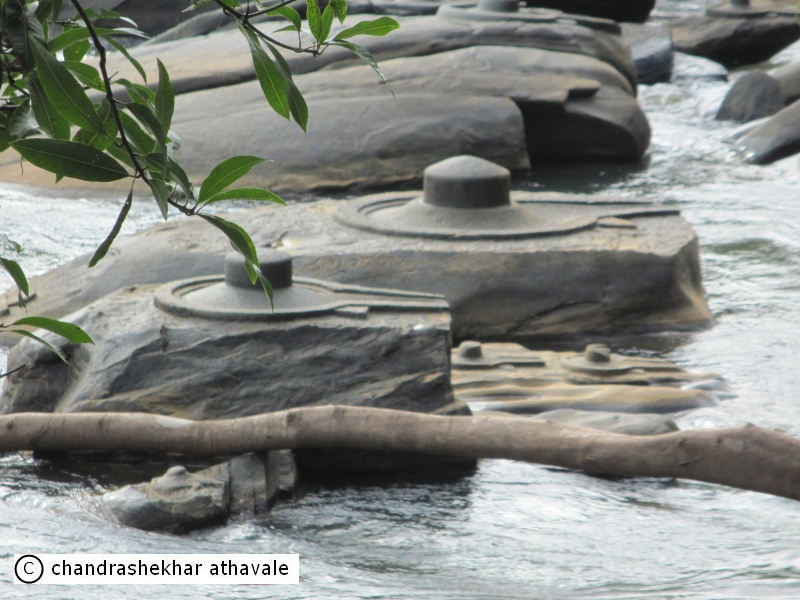


A couple of Shiva Lingas in the bed of Shalmala river


The Shiva bulls or nandis carved in river bed rocks

Yet no one knows for sure, who carved out these many lingas and the Nandi bulls in the river bed. However it is known that this place belonged to the king of Sonde, a place nearby, which now is just a village. Only sign of this ancient kingdom today is an old fort lying in ruins nearby. This King of Sonde had invited 29th successor Guru of one Vishvavandya Sarswati, who was appointed by Great Hindu Guru Shankarachraya at Kashi (Benares) as Guru of Havig Brahmanas of Gokarna temple, to come to this place and settle down. The Sonde king built a monastery for him and endowed it with land . This 29th Guru and his successors lived at this place quietly. This place was known as Sahasralinga even then because of the natural shapes of rocks in river bed, which looked like Linga of Shiva even in those times. It is obvious that for a long time people from this Math or monastery must have commissioned sculptures to create Shiva Lingas and the bulls in the river bed, so that these look more authentic. Whatever may be the true history, no one can deny the fact that this place is an extremely beautiful natural picnic spot. The local government has now built a suspension or a hanging bridge at some distance. An excellent vies of the river bed is available from the bridge.
After so much of site seeing in a day. I am feeling tired no doubt. I decide to have some Tea, hot, sweet and milky, in the true Indian style. The Tea, even in this hot weather, refreshes me and I am ready for the next spot on my itinerary.

(To be continued.)


6 November 2011

Thursday, September 4, 2014

Western Ghat wanderings -Part I

Western Ghat mountain range (Sahyadri mountains) is one of the major mountain range system of the Indian Sub continent. Located at an average distance of sixty to seventy (definitely less than a hundred kilometers) from the Western Sea Board of India, the Sahyadri mountain range extends in the North-South direction for sixteen hundred Kilometers from Nashik (Maharashtra state of India) in the North to Kanyakumari. (Southern tip of Indian sub continent). The mountain range is endowed with superb tropical rain forests on both sides, extending almost to the sea shore, in few places.
There are two ways from the North, to approach the jungles of the south Sahyadri mountains. The first route, which appears on the map as the easiest and simple, is to take the Mumbai-Goa highway near Panvel and travel up to Goa,where the road continues as National Highway 17 to reach Ankola town. At Ankola, turning left on National Highway 63, takes you to Yellapur town, which is located in the heart of the jungles of southern Sahyadri mountains. This route is actually a pain in the neck, as far as motoring is considered. This highway, in most places, is just a two lane road with very heavy traffic consisting of all sorts of vehicles and is a nightmare to drive. The other longer route is to take Mumbai-Pune expressway and then continue along the beautiful Pune-Bangalore highway right up to Hubli town and then turn on the National Highway 63 to reach Yellapur. 


I am on my way to Yellapur town, which is about seventy kilometers away from Hubli city. As I leave the hustle and bustle of the city behind me, the road passes first through a rich agricultural tract, with standing Jowar and other crops almost ready for harvesting. After another ten or fifteen kilometers, the landscape starts changing rapidly. Fields with standing crops are still there, but now I can see only paddy fields everywhere around me, lush green in few places and ripened to golden yellow in other places. As I travel further towards Yellapur town, paddy fields appear more and more intermittently, mingling seamlessly with beautiful bluish ponds, grass and isolated patches of tall trees. Slowly the huge tall trees start dominating and substitute for everything else. Very soon I am in the midst of a thick tropical rain forest. There is nothing really to see on either side of the road now, except for countless number of huge trees with large leaves, small leaves, whitish leaves and blackish leaves. There is a very heavy undergrowth of shrubs and grasses in the open spaces below the tress. Once in a while, a dried trunk of a tree lying on the ground and covered completely with creeper plants, projects out like a sore thumb through the undergrowth.


Lush Green Paddy fields

Soon I reach Yellapur town. I decide to have a cup of the tea in a roadside cafe. The town itself is just an ordinary Indian town with relaxed atmosphere. The cafe owner is not very communicative in spite of my best efforts. I drink my tea rather quietly and proceed further. From Yellapur, we branch off to a smaller and badly pot holed road, which leads to another town called Sirsi. 
 
I have made reservation in a jungle resort located somewhere along this road. A narrow track covered with red soil leads me to the resort built in an opening right in the middle of the jungle. Surprisingly, there are a large number of coconut and aracknut trees spread all around this place. Neat little cottages stand in two rows to house the visitors. A larger building on a side perhaps is the dining hall. The resort claims to provide all modern facilities like electricity, running hot water and cable television. However I soon find out that these modern day luxuries are dependent on couple of cables and electrical lines brought all the way from Sirsi town and at slightest vagaries of the mother nature are likely to go out of function. Yet this uncertainty does not bother me much as the place has a built in calm and relaxed atmosphere, which somehow makes me realize the unimportance of any of these modern day requirements. After a much delayed lunch, I doze off a little in the supreme serenity of the surroundings and wake up completely freshened up from a rather tiring road journey. The time is is around 4 PM . The dark shadows of the surrounding tall trees have already started to grab the open spaces even though the sunset is still couple of hours away. I am served a cup of hot tea and told to be ready to visit a nearby Tibetan Manastery. There are two large Tibetan monasteries in Karnataka. One is located near Kushal Nagar in Coorg district and the other one at Mundgod village, which is not very far off from my resort. Since, I have visited the Kushal Nagar monastery about a year back and have also visited number of Monasteries in Ladakh very recently, I am not greatly interested in this visit. Finally I decide to go along.


Mondgod Monastery

 
After Chinese take over of Tibet in 1955, a large number of Tibetans, including the Dalai Lama escaped to India from Chinese communist rule. Many of the immigrants were given land and other facilities by Government of India and were settled in the two colonies in Karnataka state. Tibetans settled in Mundgod village have built this monastery and is known as “ Gaden Jangtse Thoesam Norling Monastery”.

 
Maitreya Buddha

 
Idol of Tara

 
Banner depicting guardian of a cardinal direction

 
The Monastery prayer hall building is huge with curved stair case on a side. A climb up leads me to a large main prayer hall or Du-Khang of the monastery. At one end of the hall, there is a raised platform. Several idol figures are arranged behind a huge glass show case. I can easily identify the Maitreya Buddha and Tara idols. Huge painted banners, displaying brightly coloured paintings of the four guardian kings of the cardinal directions and other paintings of religious significance adorn the side walls and the spaces between the idols. As I leave the hall, a gong starts striking repeatedly with a booming sound. Suddenly the sitting places in front of the raised platform start getting filled with young monks wearing deep red or saffron robes. They sit down in rows parallel to the length of the hall. I leave the monastery as monks begin their evening prayers. When I reach my resort, it is already dark. The lights in the rows of huts appears to be the only sign of life in the vast darkness of the jungle. Dinner is served later in the main dining hall.
As I lie down on my bed, I switch off the lights. Complete darkness spreads around me. It is difficult even to see my own raised hand. Surprisingly, there are no chirping crickets or other insects to create a background sound track. I never thought that jungles could be that silent. The total darkness and silence is like an void, which absorbs me in an instant. I fall asleep in just few seconds.

(To be continued)

2 November 2011


Saturday, April 5, 2014

Cambodia's famed Angkor temples on street view now!


 At the top of Angkor Wat temple


I paid a visit to Siem Reap in Cambodia in 2011. Like any other visitor, I was just dumbfounded at the enormity of it all. I wrote a series of travelogues, yet felt that I was just trying to describe entire vastness of a sea after looking at it from a point on a beach. The famous temples of Siem Reap, like Angkor Wat, Bayon temple in Angkor Thom or the tree strangled masterpiece of Ta Prohm are so vast and extensive that I found it almost beyond my capability to describe them. It is no wonder that Angkor is a symbol of national pride for Cambodia and also it's biggest tourist attraction, receiving about 2 million visitors a year.

Talking about photographs, I must have taken 100's of shots, trying to capture the magnificence of the entire temple as well as the detailed bass reliefs that have been carved in stone on temple walls. So munificent are all of them with finest details such as clothing, jewelery, that it is almost impossible to cover them all.

Restoration work in Siem Reap goes on all the time. It is not restricted to any particular nationality. Many nations from around the globe like France and Japan have spent huge amounts of money and efforts on restoration efforts. Recently restored temple of Baphuhon is an example of this. India has a special obligation towards Siem Reap. Khmer kings, who created these fabulous pieces of architecture, between the ninth and 13th centuries, were either Hindus or Buddhists and have imbibed in this capital theirs, very essence of Indian culture. India has been actively helping Cambodia in restoration work of Ta Prohm temple.

When I returned back from Cambodia and viewed the pictures- I had shot in Siem Reap- on my computer screen, I was terribly disappointed. The imagery on my screen did not show at all, the overall grandeur, I had in my mind. At the best, my efforts were just puny, unimpressive and were not able effective at all is showing either the gigantic proportions of the entire structures or the finest craftsmanship displayed in carvings of figures and design. One of the beauties of the Siem Reap structures are their fabulous sense of symmetry and proportions. My photos just failed to bring any of these out at all. I am quite sure, that almost all visitors to Siem Reap must have had similar feelings on their returns.

 Bayon temple on street view

There is however some good news for Khmer Art lovers like me situated around the globe. The spectacular temples of Cambodia's historic Angkor civilisation have been now incorporated into Google's Street View. This means that just sitting at home in front of your computers, you can visit famous sun rise at Angkor Wat, for which I had gone there at 5 O Clock in the morning and you may not feel disappointed like me just because the sky was cloudy.

 Fine Bass relief sculptures clearly seen on street view

Google, it appears, have included as many as 90,000 new panoramic images to create these street views using all the tools such as Street View cars, Trekkers and tripods available to them to carefully photograph the exteriors and interiors of Angkor’s temples as they stand today. It is now possible to visit the temple from comforts of your house and see these great cultural and archaeological treasures in an entirely new way. I can certainly revisit the famous Bayon Temple or study the great mural depicting the full glory of the Ramayana’s Battle of Lanka showed in bass relief carvings on outer walls of Angkor Wat.

Google says in their blog; and I quote;

“After roaming the temples, you can also experience more of Angkor’s rich historical and artistic heritage through the Google Cultural Institute. From 12th-century sculpture and mid-20th century photography to modern-day renderings of medieval Angkor life, nearly 300 exhibits across the Google Cultural Institute can give you a look at Khmer culture through the ages.

We hope this new imagery will not only let people experience the scale and beauty of Angkor wherever they are, but also demonstrate how technology can change the way cultural treasures are preserved for generations to come.”

Google adds that they have plans lined up to make more than 100 of these historic sites available online with Street View on Google Maps. This is real good news and something just unbelievable.

5th April 2014


Monday, October 28, 2013

The Worst and the best!


Graphic: http://www.sleepinginairports.net/

If you ask any frequent air traveller as to the best airport, he or she has been through. The most likely answer would be either Singapore's Changi airport or Amsterdam's Scipol. On what basis do travellers say this? What are the parameteres on which people consider an airport better than other? Recently, I found a web site, The Guide to Sleeping in Airports, that tries to answer these questions and does it rather well. It lists 4 'C's on the basis of which most of the travellers would judge an airport. These are:

Comfort: crowded terminals or uncomfortable/limited seating
Conveniences: no 24-hour food options or nothing to do on a layover.
Cleanliness: dirty floors, bathrooms or food courts.
Customer Service: unfriendly staff or anti-airport sleeper policies.

I have been through many airports of the world. I have found, some extremely dirty and shabby like most airports in India are, some are very professional and machine like, there is no personal touch at all. Giant US airports like O’Hare at Chicago or JFK in New York or I would even classify San Francisco International airport in this category. If you are stuck at one of these, you would be bored to the core, as there is nothing to do at all. At some airports, everyone watches you with suspicion and you feel uncomfortable. I had this feeling in Cambodia's Siam Reap airport. In some airports, confusion reigns supreme, you are always under tension, whether you are going to catch the flight or not. India's Chennai airport is a typical example. Some airports are just confusing, like London's Heathrow. I can go on and on, but I am not writing this post just to give my readers my impressions about the world's airports.

The web site that I have mentioned above, regularly invites it's visitors to share their airport experiences on the web site. It carried out a poll recently to find out which are the worst and the best airports in the world. Readers from India, and those, who have been in India must have already guessed it. Three of India's metro airports figure in the worst airports of the world list, with Kolkata at number 3, Chennai at number 6 and Mumbai at number 8, ratings that are not even optimistic. Only point of consolation perhaps is that the worst airport in the world is not from India but Manila's Ninoy Aquino airport in Philippines.

In the best airport list, Singapore's Changi tops the list followed by Incheon at Seoul and Amsterdam. A survey respondent says about Changi: “ Silence is mandatory in the "Snooze lounge" which boasts very sleepable chair lounge, you can even ask for bedcover.” Another one says that Showers area available for a fee and food is available 24-hours.


Graphic : http://www.sleepinginairports.net/

Coming back to Indian airports, perhaps the main problem is that the travellers are not let in, even in check in counter area 3 to 4 hours before flight timing, leave aside early check in. This means that if you have a connecting flight and you arrive at the airport from some other destination, say 7 or 8 hours earlier. You would be forced to sit outside the airport on the footpath, watching your baggage. Many travellers find this very irritable.

I would like to end here with an experience of a traveller about Mumbai airport quoted on the web site mentioned above, I am sure that many hapless travellers like me, must have experienced this situation sometime or other. I quote:

“After landing past midnight and taking a bus to the terminal from the aircraft parking spot, we were greeted with a sight of sea of Muslim men and women returning from the holy pilgrimage. Had it not been the large sign in black and yellow on top of the terminal building proclaiming its name, I would've thought I were in Mecca! The queue to get through immigration was more than a mile long - however the processing was swift with numerous counters. Getting bags out of the cramped baggage collection area was a challenge though, since the carousels are notoriously short and people were literally standing on top of one another yet helplessly seeing their bags pass by - just out of reach :) Once you get your bags and clear customs - there is absolutely no waiting area (@ Arrivals) - you need to either exit the terminal or take the transfer shuttle to either of the domestic terminals. I had more than 12 hours to pass before my domestic connection hence after converting some currency at a bank located within the arrivals area, I decided to go to the domestic terminal. To my surprise, the folks @ the domestic airline wouldn't take my baggage before the check-in time! So I had to wait there with my bags for full 12 hours, depending on total strangers to look over my bags while I went to the bathroom a couple of times. There is a small cafeteria in the check-in area selling snacks and beverages at exorbitant prices. I later learnt that there is a much better cafeteria in the pre-boarding area. The newly renovated departure area @ the international terminal is surprisingly good and well-maintained with loads of eating places. All in all, I'd say not too bad an airport, but a few things need to change to increase passenger comfort.”

Happy journey!

28th October 2013


Saturday, March 2, 2013

Melaka Spice, Part I


By the time, we hit the main north-south expressway E 1 in Malaysia, my watch shows that it is already 11 o' clock in the morning. Malaysia is spread over a distance of 700 Km in north-south direction, compared to its highest east-west width of only 300 Km. This is why, its main expressway E 1, traverses a distance of almost 770 Km from the southern city of Johar Bahru, to northern town of Bukit Kayu Hitam, located almost on Malaysia-Thailand border. I had a recollection of this road in my mind as a very wide and busy artery, when I had travelled on this expressway about 8 or 10 years before. Today, Somehow, I feel that this 4 lane road is not all that great, as I always remembered it. I give a little thought to this change in my perception. The reason must have been the 6 lane expressway near my home town of Pune in India to Mumbai, which was not even ready during my last travel here on this road. I realize that I am now comparing in my mind, this road with the Pune-Mumbai expressway and that is the reason for this change in perception.

Earlier, we had crossed the border check point between Singapore and Malaysia under just 10 minutes. You do not even have to get down from the car. The road from Singapore to this border point, known as 'Second Link,' branches off into 4 or 5 lanes near the immigration check point. On the curb of each lane, a counter has been set up by Singapore immigration. Just stop the car near any of the counters, hand over your passports. You can not see what happens inside the counter, but passports are returned within few minutes. After this, you proceed ahead on a no-mans land, which is a actually a bridge. On other side or Malaysian side, again similar counters have been set up by Malaysian immigration. Repeat the passport handing over procedure and then slow down near customs counters and if they do not ask you to stop, just proceed. Perhaps, since prices of most things in Singapore are much higher than in Malaysia, customs officers are aware that people may not be be taking any contraband with them from Singapore to Malaysia and do not really bother you.

Malaysian expressway E 1, even though slightly narrower than Pune-Mumbai expressway, is now equipped with smart card sensors on each and every toll gate. You need to recharge this 'touch and go' toll card, with requisite amount in Malaysian Ringgits. Thereafter, on every toll gate, there are small machines available. The smart card is just to be touched on this machine. The machine automatically debits the toll amount from the amount stored on the card and opens the barricade in front. The entire process may take 2 or 3 seconds. In India, we have to stop the vehicle at the toll gate and give cash to a cashier, who gives a receipt and then lifts the barricade, easily wasting few minutes. Comparatively, this is a much better arrangement no doubt.

Speed limit on this highway is 110 Km per hour, but two wheelers are allowed on the expressway, which means that cars and other vehicles have to be driven much more carefully and you can seldom exceed speed of 60 or 70 Km. Surprisingly, I find that most of the drivers here tend to follow all traffic rules and drive in correct lane, which makes things easier. There are pleasant looking green stretches or lawns on both sides of the expressway, that look regularly mowed. In a few spots, I can see workers mowing the lawns with machine operated mowers. Overall, the upkeep and maintenance of the expressway appears to be of a very high order. The road side scenario appears more natural or as nature would grow it to my eyes, which are accustomed to Singapore' disciplined and orderly landscapes, where even the trees have to grow in orderly fashion like everything else. The trees, shrubs, growing here on road sides look as nature have made them: disorderly. Beyond these green lawns and few trees, I can see all along the road, miles and miles of palm trees. These trees give palm oil to Malaysia, which is exported and the farmers earn good money. These vast stretches of palm trees, somehow create a sour feeling inside me. Economically, these fields might be a boon but what about the damage to biodiversity here, when only one type of plant is allowed to grow over hundreds of kilometers.

After a pleasant journey of about 2 hours, we can see on the road side, the road sign we are waiting for: which says 'Ayer Keroh exit 1 Km.' We change the lane and the exit is right ahead. Another 2 second stop at the toll gate and I see signs, such as smaller residential buildings, traffic lights in squares, all around me, which indicate that we are in the vicinity of a medium sized town.

About a decade ago, I had visited for the first time, a restaurant named as 'Melaka Spice' in the Koregaon Park area of my home town, Pune. After that visit, I had gone there several times again to enjoy excellent Thai cuisine. Since then, this name 'Melaka' had held some kind of fascination for me. Later, some information about a narrow strip of sea between Malaysia and Indonesia called 'Melaka Straits' came into my reading. I had decided then, to make a trip to 'Melaka' sometime in future. Today, my wish was getting fulfilled.

The scenes on the road are very similar to what one can see in medium sized towns like 'Sangli' or 'Miraj' in India. Roads, squares and vehicular traffic are quite comparable. But, people appear to follow road and lane discipline well. No one seems to follow here horrible driving habits of drivers from my home town Pune, such as turning right at green signal, ahead of other vehicles, when the vehicle is standing in the left lane or suddenly turning left from right lane, when 'No left turn' board is being displayed. All 2 wheeler riders are seen riding helmets according to the rules. They do not appear to face any great hardships that 2 wheeler riders in Pune claim to face, when asked to wear a helmet. Travelling through heavy traffic for about 15 or 20 minutes, we finally succeed to reach our hotel. Our hotel has a tall 25 storey building. We ask the valet to park the car and enter the hotel. The first thing that I can see is a huge lobby with two giant sized chandeliers with hundreds of glittering lights and scores of mirrors placed at several strategic points. The first views of the hotel are no doubt impressive.


After finishing all the formalities like check in and handing over baggage to bell boys etc. I finally reach my room. The room has an oversized glass window with a crystal clear view. I slide the window curtain aside. The view outside is absolutely stunning. I can see the beautiful Melaka river with plenty of water, bending and turning at several places. On the river banks, Malaysian flags flutter in the wind. Hidden behind the river turns and bends, are small cottages with roofs that have been painted brilliant red. All empty spaces between these little cottages are filled with green foliage and fully grown, emerald green trees that provide a strikingly attractive contrast to my eyes. Like any other tropical place, the rains shower 'Melaka' also all the year round, which means that there are no layers or traces of any dust anywhere, commonly seen in all Indian towns with possible exception of towns in southern Indian state of Kerala. This clean, dust free environment is any way a specialty of all south east Asian towns from Myanmar to Indonesia.


Melaka River


A small cottage on river bank


View from the river bank


After watching the scene outside, for at least quarter of an hour, we decide to have lunch first and then leave for sight seeing. Instead of starting a search for a good place to eat, we take easy way out and decide to eat a buffet lunch at the hotel itself. Only after finishing my meal, my thoughts return again to Melaka.

To the east of Indian peninsula and to the south of Indian state of Mizoram, a narrow peninsula spreads for thousands of kilometers to south. At the end or at the tip of this peninsula, lies the island of Singapore. This long peninsula comprises of 3 independent nations: Myanmar and Thailand in the north and Malaysia in the south. Melaka city, located on the western sea board of this peninsula at about 200 Kilometers north of Singapore, is the capital of a state with similar name, within Malaysian federation. The sea coast along this land is famous and known as 'Melaka Straits.' On the other or western side of the straits, lies the 'Sumatra' island of Indonesia. The shape of the straits between 'Sumatra' and Melaka is like a funnel. Near about the Melaka city, the straits are only 1,7 mile wide. Through this narrow strip of sea, every year, more than 50000 cargo ships sail and 15 Million barrels of crude oil passes through Melaka straits every day. Almost 70% of crude oil consumed by China moves through these straits. It is said that if due to some reason this sea lane gets closed, half the shipping of the world, would need to change their shipping routes. All these figures only show, how important are the Melaka straits to the world's commerce and trade.


I drive away all these thoughts from my mind as I have not come here to study commerce or trade and get ready to step out to the city.

( To be concluded)

2 March 2013

Thursday, August 2, 2012

A Coffee Primer

I must admit that my ideas about coffee have been rather primitive. I knew that the aromatic and enthralling brew, which I love so much, came from the seeds of a certain tree. But that was about everything that I knew about this wonder brew. However, a chance recently, to a coffee plantation on the outskirts of Medikeri town in Coorg, has changed all that. During my visit, I was lucky to have been taken around the plantation, by a gentleman, who turned out to be the proud owner of the plantation. Mr. Kiron, talks coffee, lives coffee and obviously drinks coffee. He made the whole coffee production process appear so simple to me that at least for few minutes I felt like an expert coffee grower.
A mountain range, known as Western Ghats, runs parallel to the western sea board of Indian peninsula. This range is known by different names in different regions. In the North, near the city of Mumbai, the mountains are known as Sahyadri. Down South, the range is known as Bramhagiri range. Coorg region is located on the eastern slopes of this Bramhagiri range. Coorg is much in the south, just back to back with state of Kerala. This sleepy little region, set in the forested slopes, is stunningly beautiful and picturesque with tall trees and all around greenery dotted with red roofed little dwellings and red soil. One gets a feeling here, that the time has somehow stopped.
India produces about 300,000 metric tons of coffee beans annually. Out of this, Coorg region alone, produces 120000 tons. Which means that little less than half of the total coffee produced in the country is produced here in Coorg, in scores of plantations like the one owned by Mr. Kiron and visited by me. One striking feature of coffee production of India is that almost two thirds of the production is exported with domestic consumption little on the lower side.

Technically, a coffee tree can grow anywhere. However, if you plant a tree in your back yard, the chances of its bearing fruits are rather remote. Even if the tree bears fruits, they are unlikely to have the aroma and the fragrance. This is simply because the ripened fruit have no aroma at all. The aroma comes from the processing and sun drying of the fruit. In this process it absorbs the moisture from the air. For this reason, coffee grown and processed at different locations and even at different mean heights from sea level, have different aromas and tastes. This is one reason for which, coffee plantations are found on lower slopes in coorg region and not on hill tops.

Two types of Coffee trees are now grown in India. Arabica coffee plants are smaller and delicate. The leaves also are smaller. Greater care such as maintaining proper soil salinity, needs to be taken for growing Arabica plants. Compared to that, Robusta coffee trees are taller and stronger. They require much less caring than Arabica. Precisely for this reason, almost 60% of Indian coffee is of Rubusta type.


smaller tree in foreground is Arabica

Coffee fruits look red and cherry like when they ripen. Some of the fruits bear a single roundish seed. This seed demands higher price in the market and is called as Peaberry. Most of the coffee fruit or cherry bear two seeds and is sometimes called flatberry.
 
Coffee Fruit or Cherries

After ripened fruits are picked by hand, the outer pulp is removed by two methods. In the first method, the cherries are immersed into water and crushed to remove the pulp. The seeds with some pulp still attached to them, are then dried into sun. The beans produced in such a fashion are called plantation beans in India. In other method. The entire coffee cherry is dried in sun. While drying into sun, the weather, moisture in the air etc. all play a part giving a distinct aroma and taste to the coffee. Dried seeds are then graded, cleaned and polished and then sent to the market.
 

Enlightened with all this coffee talk and to be frank, a fairly exhausting walk around Mr. Kiron’s coffee plantation, I felt very obliging when Mr. Kiron suggested that we have some coffee. Some freshly brewed coffee and biscuits were served to us. The brew was just divine. It was surely one of the best coffee, I have tasted for a long time.

Tuesday, June 19, 2012

Carrying your own food on travel


Kid's story books, which I read in my childhood, always described, how the mothers of the young men or princes from the stories, going on some travel to a far off country or to kill a demon, used to pack some dream food stuff for them, which would not only satisfy their hunger but also quench their thirst, while travelling. At that age, I was never worried, whether the queen ( the mother of the prince to go on a journey) cooked this dream foodstuff herself or ordered a cook to do this. But even at that age, I always had great curiosity regarding this dream eat, which would satisfy hunger and also quench the thirst. My mother or grandmother apparently never knew how this dish was prepared. Also no one I knew ever offered me this dish. This childhood wish of mine, to eat this dream foodstuff, was never fulfilled.
I found out all of a sudden, though much later, what this dream food stuff was really made off? I remember that I had traveled earlier to Bengaluru city for some official business work. For this journey, to Bengaluru City, I had managed to obtain valid railway reservations. I had thought then that I would be able to make some arrangements for my return journey, while in Bengaluru. I had finished my work in a very satisfactory manner. But I found out later that to get railway reservations for my return journey was an impossible task with no tickets available for any of the trains at all. Someone had then advised me to make inquiries near Kempagouda circle area, where there were offices of many private bus carriers and I might be able to make some arrangements there for my return travel by Bus. I found out that every night, at least 10 to 15 luxury buses ply between Bengaluru- Pune route. I immediately made reservations for my travel back to Pune with a bus company ,which looked O.K.
In the evening, I had some leisurely dinner and reached the place from where, these buses would start for the journey. The bus was ready and left Bengaluru after a slight delay. The bus only had seats and no berths for lying down, which meant that I would have to spend the entire night just sitting up. However I was a young man then and such kind of hardship at that age was not a big hurdle. We reached the town of Belgaum around 5 in the morning. After a cup of steaming hot tea, we left again and crossed Kolhapur town at about 9 A.M. A little distance away from Kolhapur town, the bus came to a halt very abruptly. I got down from the Bus and looked ahead on the road, I could see ahead of our bus, a very long line of of vehicles, standing still on the side of the road.


After making inquiries we found out that some peasant's organization had declared a strike on that day and had blocked all the roads. The strike was to continue till 5 o'clock in the evening. There was nothing to do except dozing in my seat in the bus or stroll around the area. That day I found out for first time, how slowly our clocks actually turn. After noon, I realized that I was extremely hungry, but as a young man I had never really bothered to carry any foodstuff or water with me. A co-passenger , who had ventured out, found that there was a small shanty or a shack selling some eatables. They were serving strong tea liquor with a dash of milk and plentiful of sugar and some fried snack, which to my horror, were fried green chillies. Since there was nothing else to get, I had bought a small quantity of fried chillies. The chillies grown in the Kolhapur region are known for their hotness. True to their pedigree, the fried chillies bought by me, were so hot that I found it almost impossible to eat them.
Finally I had to satisfy my hunger with outer crusts of the fried chillies and the blackish tea liquor. By 4 o'clock in the evening, almost everyone in the bus suffered with deep hunger and thirst. A lady sitting somewhere in one of the rear seats in the bus, perhaps sensed the plight and suffering of all the fellow passengers in the bus and distributed some snacks and sweetmeats she was carrying for her daughter staying in Pune. With fifty or sixty people travelling in that bus, each one of us must have received just a small portion of the snack and a small piece of the sweet cake. That little quantity of food, which I got from that lady, made me realize that any food that you get to eat, when there is a total scarcity of anything to eat, was the magical dream foodstuff of my childhood days, carried by the princes and heroes and which their mothers always packed for them. Since that day of hunger, I made a rule for myself to always carry some eatables and a bottle of water, whenever I had to on a jaunt.
Now a days I travel mostly by air. Many people feel that there is no real need for carrying food and water in an aircraft as everything is served by the air-hostesses. However, after experiencing that there is no basic difference between a bus journey and an air journey as far as hunger and thirst are concerned, I insist and carry food even for an air journey. Few years back, I took a highly regrettable decision to travel from Singapore to India by Indian Airlines aircraft. Our flight on that day was scheduled at 7.45 in the morning. Since it was expected that the airline would serve us breakfast in flight, I reached Singapore's Changi airport at 6 AM. After completing all the formalities like immigration and security check, I was waiting near the gate around 7 AM. Just across the gate, an old looking aircraft was standing on the tarmac, which was supposed to fly us to India. All of us waited at the gate anxiously awaiting the announcement for our flight. Clock turned to 8 o'clock, 9 o'clock and then 10 o'clock. Still there was no announcement of departure. At Changi airport, once you enter departure gate, neither it is possible to get any food or drink nor it is possible to visit toilet. Finally the flight was announced at 11 AM. Since the flight was scheduled for morning the catering service in the aircraft carried some stale bread and oily Samosa's served with lukewarm tea. By the time I reached Bengaluru airport in India it was already late evening by Singapore time. Most of the passengers were dying with hunger pangs as during last 10 or 12 hours they had nothing to eat except some stale bread slices, a Samosa and some lukewarm tea. Some travellers (that included me) were unconcerned and happy because this select band of travellers had carried with them the magical dream foodstuff of the kiddy days.


From India's different regions, people who originate from Gujarat in western India, are very particular about carrying food on travel. They would invariably carry with them, on any journey, whether of few hours or few days a huge tiffin box stuffed with regular food and snacks like Sev, Gathiya,Papdi and Khakara in sumptuous quantities. I have seen many travellers from Bohra community carrying Mutton Biryani along with them. This might be carrying things too far, but I feel that one must carry at least few packs of Biscuits, sandwiches and some sweet cakes along while travelling.

During foreign travels, when you have to pass through some transit airport, there are further complications. Once travelling from Chicago in US to Mumbai in India in 1991, I was forced to spend about 11 hours (from 10 o'clock in the morning to 9 PM) at the Heathrow airport in UK. Since I was travelling back from US, I had few Dollars left with me. In those days the tea was available at the airport for half a Pound ( About 30 or 35 Rupees). Since I had only Dollars, the tea vendor took 2 Dollars from me and returned balance change in British coins. Those coins are still with me as I never had an occasion to go to UK again and pay for anything in British coins. I had no problem about food though, since I still had enough quantity of food left with me, which I had carried to US in the first place. I ate some of that food and drank cold water freely available on the airport to spend the day.

Such is the importance of carrying food when you travel. You may forget everything else, never forget to carry food for any journey. You would not have to repent and you can always enjoy your journey.


Sunday, May 6, 2012

Travelling- without a Mobile phone?


Some time back, I was travelling from Mumbai to Pune city by a train service well known as 'Deccan Queen'. These days, everything except for the name of this train service, has been changed or modified Even sixty years before, when I was just a kid, this train service was still very famous. This train then, used to have only 8 or 9 carriages, one of them being used for dining purposes. All the coaches in the train would be First class coaches. The journey was extremely comfortable and was considered as ultimate in comfort. If a family of four was travelling, an independent compartment would be made available, which offered great privacy.

Sometime in 1960's decade, chair cars appeared for the first time on the train. These push back chairs, provided in these coaches, were no doubt very comfortable. However, instead of the old arrangement of having 3 seats abreast in a row, four chair cars were now provided in a row. Under the disguise of modernization, Indian railways had very cleverly reduced effective space and privacy available for each passenger by making four people sit abreast. This sitting arrangement continued for further three or four decades. After 1990, Railways introduced air conditioned chair cars on this train service. The cars became air conditioned all right, but now 5 persons were made to sit abreast in a row. In another clever move, Indian railways managed to give even less space to the passengers on the train, charging them the same fare as before.

These new air conditioned coaches also did provide some amount of sound proofing for the passengers and the usual rattling and vibratory sounds of the train travel were heard with much less intensity. This was a good point but interestingly created another side effect. The chatting amongst co-passengers no longer remained private and was heard by everyone sitting around. Similarly, mobile ring tones and the talk also could be clearly heard by every one sitting nearby. I remember clearly that in one of my journeys from Pune to Mumbai, a person sitting just ahead of me, had by mistake, brought the house latch key with himself on the train. Apparently his wife had come to see him off on the station. This gentleman had then called his wife from train on his mobile, who was in a public transport at that time returning home, and had told her loudly the details for next 5 minutes, where he had kept the duplicate key hidden behind a window. Everyone sitting near him, came to know about his house and where they hide the house latch key. If there would have been some social miscreants around us, they could have easily taken advantage of the situation.


This 'Deccan Queen' also makes the return journey from Mumabi to Pune in the evening on the same day. During one such return journey, my co-travellers continuously kept on getting calls inquiring about their current location. They were also reporting all the time to someone or other on phone, about having reached XXX station or having just left YYY station. As we neared Pune, the phone calls were now from the people having come to Pune station for receiving the travellers. Where they should meet? What dresses are being worn by them, so they can be identified easily? Etc. Etc. Some co-travellers were also informing their families in Mumbai about having reached Pune safely. In my coach, perhaps, I was the only traveller on that day, who never received a call or made one. I have made this journey by Deccan Queen on many occasions during last thirty or forty years. All details such as, where would I get down? Where would the person who has come to receive me, be standing? Are part of an old routine for me and my family and I did not find any necessity to make calls for this purpose. There was nothing to report on phone that day.

Once travelling to Mumbai by a public bus, we got stuck in a worst kind of traffic jam. I spent entire day on the road, in a place called 'Malvali'. Finally, when the traffic started moving again, I took a return bus in the evening and came back home in the night. In those days, there were no mobile phones at all. So my family came to know about my day having been spent at ' Malvali' instead of Mumbai, only in the night. Really speaking, there are both pluses and minuses when one is carrying a mobile phone in travel. When I used to travel without mobile phones, I would to be in complete darkness about any domestic difficulties or what was happening in my factory on that day. The person in charge, in my absence, had to deal with the situations. Because of this I would have no worries about the factory, work or my home in Pune and I could concentrate on my work, for which I was any way travelling. Recently, I had gone to Delhi, with few friends of mine. All my friends were in continuous contact with their businesses in Pune. They had tough time there as they were simultaneously solving business problems from back home and were also meeting people and carrying out business deals in Delhi. Carrying your mobile on travel has plus side too. I remember that when I used to be away, I would never know about any serious problem or new business opportunity in my factory in Pune and many a times have lost god orders because of my absence.
If I am ever asked a question regarding which travel is better, one with a mobile or one without? I would definitely prefer the travel made with my mobile. If I am carrying my mobile with me on travel, (Which now I always do!) everyone including myself has a sort of secure feeling. This feeling is so much comforting, whenever I have to travel to a foreign country from Mumbai's international airport. Earlier it was not possible for a traveller to contact anyone outside from inside the airport lounges and everyone outside would be in total dark regarding actual departure. I remember a peculiar incidence when my flight to Hong Kong was delayed by 24 hours. I found it extremely difficult to inform about this delay to my people in India as well as abroad. Now you can be in contact with everyone, till about your flight is about to take off. Similarly, as soon as your flight touches ground, you can switch on the mobile and be in touch with your near and dear ones.

A mobile phone is like a double edged sword. It can cause hurt to yourself if misused. I feel that if this misuse could be avoided, this modern gadget is a real blessing for a modern traveller.


Sunday, February 5, 2012

Motoring in the South Sahydri's- Part II

Quantcast

Dawn arrives late in the middle of a jungle. The golden rays of the morning sun get effectively blocked by the tall trees all around. I open my eyes after a very peaceful night’s sleep. Its is still dark outside. Yet I am awakened by the chirping, cooing,squawking, hooting and warbling, going all around me. It is fascinating to hear the bird songs so clearly, and so early in the morning. I look out of the window. I see nothing. Well above me, I can trace the first faint bluish tinge in the eastern sky. I remember that a very interesting visit has been planned today to a nearby site.
After a hearty breakfast, consisting of some fabulous local dishes along with bread and omelet, we leave the resort for our day’s excursion. The morning is rather pleasant , though I would have preferred a slightly lower temperature. We take the Yellapur-Sirsi road, a narrow and much pot holed path. The Sirsi town is just a medium sized town with fairly modern facilities like hospitals and even a sports stadium. There is a state highway No. 69 which joins Kumta town on the sea shore with Sirsi. After traveling on this highway for about 40 kilometers, we branch of to a much smaller road (single lane at the best.) This road passes through some of the dense jungle patches on the Sahyadris. After rattling and bumping for about 10 kilometers, the vehicle comes to a stop. There is no motorable road any further. I get down and look ahead. There is a path straight ahead, sharply sloping downwards. It must have rained here last night because soil is completely wet and slippery. The dense forest around me has still retained that moisture in the air and I feel very damp and sticky. I start walking down the slippery path with abundant caution, firmly keeping my eyes on the ground. After some distance, the path curves to left. On the corner, I locate a dry spot. I decide to pause there for few seconds and look up.