Showing posts with label Pollution. Show all posts

Monday, March 16, 2015

Step by step


River Ganga is one of the longest river systems of India. The river traverses over 2,500 km, from the Gangotri glacier in the Himalayas to the Sunderbans delta in Bangladesh. The water resources of Ganga basin are used by hundreds of millions of people. Unfortunately, this use is mostly done without showing even a bit of concern about the pollution caused. As a result, Ganga remains highly polluted. Any one would wonder as to how this mightiest of rivers has become a garbage dump. There are many reasons for this pathetic state such as untreated sewage and industrial waste being dumped into the waters without remorse.

The task of reducing the pollution load of the Ganga is no doubt a daunting and challenging task. However, the clamour for a cleaner river has gained momentum in recent times, with Government establishing a clean Ganga mission for the task. Doubting Thomas's and skeptics have already questioned about success of this mission. Government says that they have taken number of steps and the results can become visible as project gains momentum.

It is quite easy to criticize work being done on such a mega project. But what is being done appears to be the right way to take up a task. Mega problems can not be solved with a quick mega solution, a step by step approach is what is required. I would like to narrate here a personal experience of mine, which readers might find interesting. In the year 1961, my home town Pune was washed with heavy floods due to breaching of two dams that supplied water to the city. I was a young man of eighteen years then. The flood waters that caused havoc in the city, also had entered my grandfather's factory, which was not very far away from the river. Next morning, I also accompanied my grandfather and father as they had entered the factory premises after the waters had receded.


It was a heart breaking view. All machinery, equipments were covered with inches of sticky mud. The factory floor was so slippery that it was even difficult to walk. All materials, tools that were in open were gone. My grandfather however remained calm. He called all the staff and workers in the open space and told them that they have two choices, either to start the factory again, for which they would have to work hard for next month, but they can keep the jobs; or close down the factory and let it being sold as scrap. In this option they all would loose their jobs. The staff and workers opted to clean up the factory.

My grandfather then arranged services of a water tanker, which would bring water from nearby wells continuously, tonnes of kerosene and other industrial solvents were ordered along with bags and bags of cotton waste. For next fifteen days, everything in the factory, from walls to furniture to machinery was washed clean with torrential water jets pumped from the tankers. Next, came the turn of washing all the machinery with kerosene and solvents to remove mud from exteriors. By the time, this was done, the electrical people had checked all the wiring and had replaced all defective wiring and fittings. After about three weeks the lights came on.

Yet the most difficult task was still to be done. Now each and every piece of machinery was completely unscrewed and dismatled with all parts laid bare on the ground. Each part was washed in kerosene to remove mud, lubricated and then reassembled with new bearings; with help from manufacturers, where help was available. The first machine tools that got going were simple center lathes. In another couple of weeks, machine shop started producing components and after about three months from that disastrous day, the first consignment of finished product left the factory premises.

I consider myself lucky, as I was able to witness this entire operation from very close quarters. It did two things to me. Firstly, my respect for my grandfather skyrocketed for his guts and calmness, which saw the factory again being brought to life. Secondly this entire episode taught me that however daunting or challenging the task may be, if you work step by step, it is possible to achieve success.

Later, I always remembered my grandfather, during my professional career, whenever I was negotiating a new business or order that prima facie looked much beyond our means an capabilities. The step by step approach always gave me confidence to complete the task.

Working step by step does not mean however, that you only think of a small portion of a project at initial stage. At this stage, the entire project in its total enormity, should be crystal clear to the top management, who should first carry out a system design on paper with blocks. Obivously, my grandfather must have had full blue print in his mind, when he started work on renovation of the factory. The inputs and outputs for each block well specified and exact. Once this is done, the attention could be now given to individual blocks and depending upon resources, work on one or more blocks can be taken up at a time. This is the time to think small and about details. Only after completing one block, the work may be taken up for the next block.

Most professional organizations work in this fashion, but even at personal level, this approach gives far better results. Four or five years ago I renovated my house. It was a major project. However once the total plan was decided, we gave detailed considerations only to the work that was going on. In this way, there were hardly any confusion or glitches at the end.

This approach also works well for report writing or even writing a work of fiction. Many a times, I have watched a film or read a novel, where after first few reels or chapters, you realise, as a spectator or a reader, that the work of fiction is not going anywhere or is getting tangled in knots, which might become undoable. We can easily conclude that such works were written without a proper block system design. As against this, consider the works of master story tellers like Agatha Christie or Daphne du Maurier. The end is always perfect, showing that the plot was ready in the author's mind, even before first line was ever written.

A step by step approach is always a winner, only when the entire system design is ready first in the initial stage itself. I hope Government has done that, in clean Ganga mission. Only this would bring success.

12th March 2015


Saturday, February 14, 2015
Toxic Environmental pollution; now and then


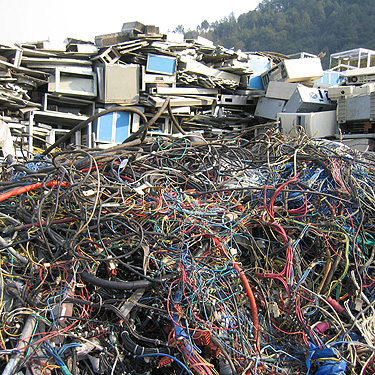
Much is said about the toxic metal pollution caused by e-waste and probably it is true. I am acquainted with a scrap dealer, whom I used to sell my factory scrap earlier. According to him, in India, the computer junk collected from us is eventually sold to big scrap dealers in Delhi, who buy this e-junk on per ton basis from shops spread all over the country, except for the plastic parts.

The street corner junk collector, simply burns off the plastic parts at the end of the day. Many of these plastic parts are quoted with metal films and most of theme are sprayed with chemicals containing Cadmium, lead, Mercury compounds and Bromides to make them anti-inflammable. The fumes created by open burning of such parts, are highly dangerous to the people in the vicinity and are also carcinogenic with continuous exposure.

The electronic junk is usually sent to Delhi by trucks or railway wagons. Here, this junk is first sorted out. The computers which are salvageable or are in working order are separated and sent to some cities in India's Rajasthan state like Bharatpur, Dholapur, Bikaner, where these are repaired or cannibalized. Whatever remains after this cannibalization and is beyond use, is again simply sent back to Delhi scrap traders for re-cycling.
A whole bouquet of heavy metals, semiconductors and other chemical compounds exist inside this e-waste. They include lead, mercury, arsenic, cadmium, copper, beryllium, barium, chromium, nickel, zinc, Lithium and Selenium, besides non metals like Chlorofluorocarbons and Polyvinyl chlorides. All these substances are hazardous to humans if inhaled or consumed. Since most of these materials are expensive, they are recovered by re-cycling in a very crude way that not only exposes the workers to these hazardous substances but also pollute the air and ground water creating a general risk for everyone.

Leave aside the e-waste. We have other huge industrial enterprises that manufacture chemicals, extract metals from ore. All these produce hazardous bye-products which pollute the ground water and air we breathe.

If one infers after reading all this, that toxic pollution caused by all such hazardous substances is a gift to us from the modern industrial world since the industrial revolution in 18th century England, there does not seem anything illogical or wrong in it. However, a new discovery has proved this inference not to be truly correct.


The Andes mountain range is a continual range of highlands along the western coast of South American continent. It runs through from north to south through seven South American countries: Venezuela, Colombia, Ecuador, Peru, Bolivia, Chile, and Argentina. In the part of the mountains, that fall within the borders of Peru, the largest glaciated area of the tropics, the Quelccaya Ice Cap is located. It is at an average altitude of 17,950 feet and spans an area of 44 square kilometers. Though the glaciated area on borders of the cap retracts every summer, the core area of the cap always remains glaciated. Thus by digging deeper in the core area, it is possible to extract ice layers formed in the past up to even five millennium before.


A paper published in the Proceedings of the National Academy of Sciences says that the researchers analysing the frozen layers below the top, using a mass spectrometer to identify chemicals, have now come out with a startling discovery that the air and water on earth was polluted with toxic metals including arsenic, chromium and lead ever since Sixteenth century, about 240 years before the industrial revolution. They have found “archives” of pre-industrial trace elements, which they could trace back to 16 century. Though the traces of toxic metals start from as early as 800 AD, particularly high levels have been found after 1532 BCE or after the demise of the Inca Empire. From here, the concentrations of trace elements show markable increases.

According to this paper, this toxic pollution can be traced back to a historical activity that happened about 500 miles away from Quelccaya Ice Cap. Around 1540, the Spanish Empire forced the Incas to work on extracting silver in Potosí’s mountaintop mines, the main source of silver at the time. The pollution from the mining and smelting activities was carried by the wind as far as Quelccaya ice cap in Peru. The Spanish conquistadors further had a technological breakthrough in 1572 when they discovered the mercury amalgamation process for extracting silver. This actually triggered an unprecedented mining boom across the Andes. In the earlier periods, the Incas, who also knew how to refine silver, used a “huyara” or wind-drafted furnace made of clay for this extraction.

The only consolation, which we can perhaps draw from this discovery is that we may not be the only humans, guilty of spoiling our environments. Our ancestors were also with us in the crime. However it does not sort out any problems or offer solutions to our problems as we keep making our environment more and more toxic.

14th February 2015



Saturday, June 14, 2014

The mountain movers


There are two well known stories from Indian mythology that mention about moving mountains. The first story is from Ramayana. During the great war, Rama fought with evil king Ravana, his brother Laxmana was injured and had gone into a coma. The only cure for him was a herb known as “Sanjivani” that grew only on one mountain in the world, known as “Dronagiri.” Rama's trusted lieutenant; Monkey God Hanuman, offered to fly to the mountain and get the herb. As promised, Hanuman flew to the mountain, but was not able to locate the herb. Since the time was running short, he decided to move the entire mountain itself to nearby of Rama's battlefield camp. When he did that, the herb could be quickly located and Laxmana was saved from a certain death.


The other story about moving a mountain is from the life story of Lord Krishna. In Krishna's village, there was a hill called as “Gowardhana.” According to the story, Krishna told the village people to worship this hill instead of God Indra, who was annoyed with this and decided to teach a lesson to the villagers. He asked his friend; rain God Varuna to flood the village with rain. When this started happening, all the villagers ran to Krishna and asked him to save them. Realising the grave danger facing them, Krishna lifted up the “Gowardhana Hill” on his finger, so that all the villagers could find shelter under it. The rain god tried his best but was not able to harm the villagers and finally gave up.

It is obvious that both these stories are great flights of fancy of some highly imaginative poets from the past. But they do tell us one thing. Moving a mountain is not a job of an ordinary human. It can be done only by super humans like Monkey God Hanuman or Lord Krishna. That is why if we want to do something so difficult that seems almost impossible or to make strenuous efforts to achieve something difficult, it can be simply described by the Idiom, that says we moved the mountains.

But if someone really decides to move or flatten a mountain, what would be the effect? Would it just mean that the mountain is no more there with only flat land left? The engineers in charge of city development in my home town Pune, have done few things in the direction and the results have been quite disastrous. Though, they have fortunately not yet moved any mountains as such, they have surely succeeded in flattening some earthen mounds and filing some minor rivulet valleys, still managing to give us a test of what kind of environmental disasters would come our way if we really decide to make major changes in natural landscapes without proper thinking for long term effect. In a series of articles- “Requiem for Pune Rivers- Part I- Part II- Part III ”, I have described these efforts and the after effects.


(Image- Nature magazine, may be copyrighted) 

But what the city engineers from my home town have not dared to do as yet, engineers from some Chinese cities have already managed to do. They have actually moved or removed the mountains and hills from within their cities. In Chinese cities like Chongqing, Shiyan, Yichang, Lanzhou and Yan'an, dozens of hilltops have been flattened and the soil and rock then used to fill in valleys creating hundreds of square kilometers of flat terrain. In Lanzhou alone, 700 mountains are being levelled to create more than 250 square kilometres of flat land.


Researchers from 'School of Environmental Science and Engineering' from Chang'an University in China led by Prof Peiyue Li have recently reported their concerns in the journal “Nature.” They say that the flattening of mountains is causing air and water pollution, soil erosion and flooding. They warn that this mountain flattening activity has been going on in China on an unprecedented scale and is likely to cause extensive environmental problems. The researchers note that however the issue that is of major concern is the safety of constructions carried out on newly land filled valleys. The concern primarily raises from the fact because no land creation projects like this have been done before in the world and there are no guidelines.


Satellite images of western Shiyan between 2010 (L) and 2012 (R) show that several peaks have been flattened
 (Image- BBC, may be copyrighted) 

Prof. Li, while explaining the reasons behind his concerns, says that mountainous cities such as Yan'an are mostly located in relatively flat valleys. The valleys are narrow and limit the development of the cities-and huge population density is also a factor. The flattening operation is raising dust levels in the atmosphere to abnormally high levels polluting it and also the waterways, causing landslides and flooding and endangering plants and animals. He adds that in Yan'an, for example, the largest construction project ever attempted is planned on piece of land that is composed of thick windblown silt. Such soft soils can subside when wet, causing structural collapse and land subsidence. Building on such soils is quite dangerous and it would take a very long time for the ground base to become stable. The researchers want the Chinese government to consult national and international experts to fully assess the risks before they continue with the project.

I think that Prof Li is right on the target, our little experience in my hometown Pune has shown that blocking the natural water flow from rivulets ends into accumulation of water in all places, which are at low level and the water does not flow out. Luckily, in Pune, we have hard basalt rock just below the surface of land and most of the buildings have foundations resting on this rocky surface. If the soil is soft and becomes soggy, one can imagine how bad the structural stability will be. With our modern earth moving machinery, it is very easy to create major changes in the landscape such as flattening of hills or filling up valleys. But unless this is done after detailed study and analysis, there are chances that we might be opting for disasters in future.

14th June 2014


Tuesday, June 10, 2014

A Face mask for the Taj Mahal!


The ancient Sanskrit texts of Ayurveda; the ancient Indian medical system, have prescribed many types of packs as cure for skin ailments as well as for beauty enhancement. One of the important treatment in this is the mud flap cure, which consists of giving a coat of a mixture of mud mixed with a few other natural substances on the body. Ayurveda believes that such a pack can do the highest level of tissue cleansing and detoxification for the body. It is said that the mud therapy is the best way for treating all type of skin related diseases and problems. Wet clay absorbs toxins from the skin and refreshes the skin. Mud application increase the beauty of the skin. Mud therapy improves blood circulation, energizes skin tissue, improves complexion and clear spots and patches on the skin. It is also believed that the Mud found in different parts of the world has different properties and to cure a particular skin ailment, it is preferable to use mud from a specific place.


One of the important mud packs well known in India is that of “Multani Mitty” or mud from Multan. It is however nothing but what is known as Fuller’s earth in the west. It has been in use as a skincare product in India since centuries, before modern cosmetic products became a rage. Indian women have used it to treat beauty problems like acne, blackheads, scars etc for centuries. Actually the term Fuller's earth refers to any clay material that has the capability to decolorize oil or other liquids without chemical treatment. Wikipedia says:

Fuller's earth consists primarily of hydrous aluminum silicates (clay minerals) of varying composition.] Common components are montmorillonite, kaolinite and attapulgite. Small amounts of other minerals may be present in fuller's earth deposits, including calcite, dolomite, and quartz. In some localities fuller's earth refers to calcium bentonite, which is altered volcanic ash composed mostly of montmorillonite. In 2005, the United States was the largest producer of fuller's earth with an almost 70% world share followed at a distance by Japan and Mexico. In the United States fuller's earth is typically derived from deposits of volcanic ash.”

Ready-made “Multani Mitty” mud packs are commonly available in India and are quite popular because they are cheap and can be easily used. We can therefore wonder that if something is so good for the humans, can it be used for a monument that is considered as the world's greatest symbol of love; The Taj Mahal?

Taj Mahal was built by the Emperor Shah Jahan in 1653 as a mausoleum for his third and favourite wife, Mumtaz Mahal, who died giving birth to their 14th child. This beautiful Mughal era building, consisting of domes and minarets has been paneled with white marble, inlaid with semi-precious stones and carvings. It is considered as one of the finest example of Mughal art in India. It was declared an Unesco World Heritage site in 1983.

This fabulous monument is situated on the bank of river Yamuna, near the city of Agra in the northern Indian state of Uttar Pradesh. Agra happens to be a busy and industrial city and there is an oil refinery nearby. Because of these reasons, the pollution levels around the monument remain high. In addition, this wonder of the world attracts millions of visitors from all over the world.


All of this takes a heavy toll on Taj Mahal with its white marble panels yellowing and losing their sheen. The archaeologists responsible for maintenance of Taj Mahal, now want to give to it a Multani Mitty mud pack treatment to remove the yellow pollution stains. Archeological Survey of India says that their chemical department has already begun the process to make the mud-pack. A 2mm-thick layer of lime-rich clay will be plastered over the affected areas of the monument and left overnight to dry. Next day, when it dries, the flakes would be removed from the surface with soft nylon brushes and washed with distilled water to remove impurities sticking to the surface. According to ASI the cleaning treatment is said to be based on a traditional recipe which is used by Indian women for centuries to restore a natural glow to their faces.

It appears that ASI has already given this beauty treatment to Taj Mahal previously on three occasions in the past: in 1994, 2001 and 2008, when a team of two dozen experts had carried out the work in small sections over a period of six months to ensure that the tourist inflow does not suffer. The cost of last treatment in 2008 was about US$ 24000 only.

We can hope that the stunningly beautiful Taj Mahal recovers its pristine beauty once again after the treatment.

10th June 2014


Wednesday, February 19, 2014

Ganga river, pilgrimages and super bugs


The latest addition to Singapore's tourist attractions is a river themed wildlife park for river dwelling animals, aptly named as 'River Safari.' The 'U' shaped theme park has been created on both sides of a bay of water, fed from Upper Seletar Reservoir. As visitors enter the park and walk along a well laid path, they can see the tranquil bay water on one side and number of water ponds with glass walled sides. Each of these ponds is named after a major river system of the world such as Mississippi, Congo, Nile, Mekong, Amazon and so on. Each of the ponds houses marine animals exclusively found in that river system. Because of the clear glass wall on one side, visitors can observe animals like crocodiles, tortoises and off course, various fishes.


One of the pond exhibits is dedicated to river Ganga, India's most sacred and revered river. A visitor can see here, critically endangered Indian Gharial- a fish eating crocodile and the goonch catfish- a reputed man eater. In the background of the pond is a structure, which looks like an Indian temple with series of steps, which are known in India as temple 'Ghats.' Visitors are likely to feel initially, that there is a problem with this particular exhibit, because unlike other exhibits, where visitors can clearly see the marine life through clear glass and crystal clear waters, in the Ganga exhibit, the marine life looks unclear and foggy. A visitor may think first that the glass side wall has not been cleaned properly. But that is not the case. Glass is cleaned every day. The problem lies with the water itself, being murky and highly polluted. A sign nearby explains, that the park authorities have taken care to keep the waters in the pond truly like that of the original river- highly polluted - and that is why the visibility is so poor. This perhaps is the best way to tell the world, how polluted the waters of the Ganga river actually are.


Ganga is one of the largest river systems of the world. This river rises in the western Himalayas in the Indian state of Uttarakhand and flows for 2525 Km to south and east through the Gangetic Plain of North India into Bangladesh, where it empties into the Bay of Bengal. It is the longest river of India and is the second greatest river in the world by water discharge. The Ganga basin is world's most heavily populated river basin with more than 400 Million inhabitants. The population density in this basin is a staggering number of 390 inhabitants per square Kilometers.

Hindu mythology considers the river Ganga as a divine mother and is worshiped as a Goddess that purifies the soul and brings new hope to the worshiper. Hindus would put few drops of Ganga water in the mouth of a dying person to absolve him of all the sins. Yet the same river, considered as ultimate form of purity, is almost dead and is now struggling to survive and breathe freely as unimaginable quantities of garbage and filth flow into it.

The main factors responsible for polluting the river are, industrial effluents, run-off from chemical fertilisers and pesticides used in agriculture, huge quantities of solid wastes released in the river, drainage from cities and towns discharged in the water, a large number of animal carcasses and hundreds of human corpses thrown into the river everyday and finally the faecal matter or human waste, that gets thrown in the river. Most of the people living in the Ganga river basin, have no sanitary facilities. They are forced to use the river for their ablution because there is no other way. This keeps fouling the river water and turning it into a source for spreading diseases. 2011 census has found out that there are about 131 million households in India that have no toilets on their premises, with eight million using public facilities and 123 million just defecating in the open. These numbers indicate the gravity of the situation.


There is more bad news for the people, who believe that the Ganga water is the purest and cures all the ills. Experts from UK’s Newcastle University and the Indian Institute of Technology, Delhi, led by professor David Graham , an environmental engineer based at Newcastle University, sampled water and sediments at seven sites along the upper Ganges in the months of May-June 2013, when millions of pilgrims travel to towns like Rishikesh and Haridwar to worship the Ganga as a mother Goddess.

The teams findings show that besides high levels of other contaminants in the water, the levels of the most deadly form of superbugs that are resistant to drugs are about 60 times higher,when millions of pilgrims travel to the river than other times of the year. The multi-drug resistant superbugs, found in Ganga waters, include the deadly NDM-1 virus also.

The NDM-1 virus was first identified in New Delhi and coded by the resistant gene blaNDM-1 . Until recently, strains that carry blaNDM-1 were only found in clinical settings or hospitals but in 2008, blaNDM-1 positive strains were found in surface waters in Delhi. Since then, blaNDM-1 has been found elsewhere in the world, including new variants.


Professor David Graham says that the temporary visitors from outside the region, overload local waste handling systems, which seasonally reduces water quality at the normally pristine sites. The study found overloading of waste treatment facilities as a factor to blame along with many cases, where untreated sewage was going straight into the river, where the pilgrims bathe. He adds:

"The bugs and their genes are carried in people's guts.If untreated wastes get into the water supply, resistance potential in the wastes can pass to the next person and spiraling increases in resistance can occur. This isn't a local problem - it's a global one. We studied pilgrimage areas because we suspected such locations would provide new information about resistance transmission via the environment . And it has - temporary visitors from outside the region overload local waste handling systems, which seasonally reduces water quality at the normally pristine sites." He blames excessive use of antibiotics as the principal cause for this and adds:

"What humans have done by excess use of antibiotics is accelerate the rate of evolution , creating a world of resistant strains that never existed before. Through the overuse of antibiotics, contamination of drinking water and other factors, we have exponentially speeded-up the rate at which superbugs might develop. For example, when a new drug is developed , natural bacteria can rapidly adapt and become resistant ; therefore very few new drugs are in the pipeline because it simply isn't cost-effective to make them."

What needs to be done then? How to protect the people visiting and living at these sites so that we make sure that the spread of resistance genes that promote life-threatening bacteria is achieved without any interference with important religious practices that are carried out by the people. Professor David Graham suggests that this can be done simply by improving waste management at key pilgrimage sites.

What is needed is a silent sanitation revolution to be undertaken on the banks of river Ganga, to improve waste management and to make her pure and free again. It is as simple as that!

19th February 2013


Thursday, December 12, 2013

Benefits of poisoning yourself


One of the sure shot remedy for getting rid of a personal worry is to look at it with a light heart or even make fun of it. I am sure that this would work for every day anxieties, but would definitely not work with real world problems and crisis, where such an attempt would only result in greater irritation and anger. For example, suppose that your child has swallowed some medicine not meant for him and someone starts telling you about the benefits of that medicare, what would be your reaction? I would definitely get irritated at the least and ask that guy to get the hell out of there for sure.

Large parts of eastern China, including its prosperous and cosmopolitan commercial capital Shanghai, have been covered in smog over the past week or so. The provincial government has cancelled flights, closed schools and forced cars off the road – and also warned children and the elderly to stay indoors. In Beijing air pollution is a perennial problem with a clear day something of a rare event. The smog is so dense that the city of Beijing can't even be seen from space. China's rapid industrialization has brought about this heavy smog everywhere. China's growth-at-all-costs economic model has poisoned much of China’s air, water and soil.


Two of China's media, state broadcaster CCTV and the widely read tabloid the Global Times, published by the Communist Party’s official People’s Daily, tried to look at the problem with a light heart, an effort aimed at China's more affluent urban population. The national broadcaster, China Central Television, came up with 'five benefits' of pollution, namely,

1 It unifies the Chinese people.

2 It makes China more equal.

3 It raises citizen awareness of the cost of China’s

4 It makes people funnier.

5 It makes people more knowledgeable (of things like meteorology and the English word haze).

In a similar effort, Global Times, the Communist Party-controlled paper, said that smog gave a military advantage to the country. The air pollution might help the Chinese military by obscuring sight lines and hide the country's weapons systems from radars and other surveillance equipment used by foreign countries. The article also went on to compare the smog to sand storms that reduced thermal imaging during the first Gulf War.

However, as it was apparent from the scathing criticism that was received, the efforts only manged to further irritate already aggravated Chinese people. There were angry reactions on Sina Weibo, Chinese Twitter, that said: "The smog makes CCTV look much stupider. They always treat us as fools," another Weibo user wrote. "It is a public tragedy that half of China is engulfed in smog. We should not entertain ourselves by this tragedy." Another one said that the only joke was the government's attitude towards this major problem. Peking University professor Wu Bihu expressed his discontent and twitted: "The smog crisis covering large parts of China has revealed the failure of the government's development strategy of only going after GDP (growth). CCTV is shameless in trying to cover up for their masters." Another reader, who commented, said: “But enemies wouldn’t need to resort to missile attacks if the smog continues to increase – people will simply be poisoned to death.”


The Beijing Daily wrote that "Smog affects our breathing. We hope it does not affect our thinking. Is the smog supposed to lift if we laugh about it?” The Dongguan Times, from a heavily industrial city close to the border with Hong Kong, said: “ CCTV’s comments were so bizarre people did not know “whether to laugh or cry. There’s nothing funny about the health dangers of smog.” Finally, the main Xinhua news agency – which had initially picked up CCTV’s supposed to be funny commentary, gave in and wrote in one of its official microblogs later that it was “totally inappropriate” to make fun of air pollution. It was clear that the great experiment to laugh it off, had failed. Both the media deleted the stories from their respective websites.

Air quality in cities remains a great concern for China's leaders, anxious to douse potential unrest in urban elites. A top US environmental regulator, Gina McCarthy on a visit to Beijing, said that China was trying to deal with the same sort of problems the United States once faced. Chinese government has closed down 2,000 cement plants on the basis of pollution control rules issued recently and has asked them to upgrade their treatment facilities by mid-2014. Government says that it would come up with new rules to punish officials who are not doing enough to check pollution.

That is all fine, but the fact remains that China is one of the most polluted country in the world today and what people want is action and not jokes to take it lightly.

12th December 2013


Wednesday, January 16, 2013

Hit by pollution on roads


Few years back, the environmental laws and norms that were in place in India, did not pay much attention to pollution caused by vehicles on the roads. It was a common sight to see huge clouds of black smoke ballooning from the exhaust pipes of diesel burning lorries. The problem actually was two fold. The fuels delivered at the pumps, used to contain lead and also other pollutants like sulfur and secondly the vehicle engines also were not designed for low or almost nil exhaust pollution.

There is a major road artery near my house in my home town Pune, with very heavy traffic flowing almost throughout the day. It used to be a nightmare to walk along this road, as air used to be thickly polluted with exhaust fumes and carbon particles. Even a short stint along the road was enough to make your eyes watery and nose stuffy. While driving on this road, it was a must to switch on the air conditioning and prevent outside air coming in.

I am mentioning this past experience just to highlight the discomfort we face in polluted environment. The pollution in a city is usually measured by weight of small particles present in the air per cubic meter. These small particles are often referred to as PM2.5 particles or the particles small enough to deeply penetrate the lungs. World Health Organization or WHO specifies 25 micrograms of PM2.5 particles per cubic meter as the safe limit.


Residents of China's capital city Beijing are facing one of the worst air pollution these days with 993 micrograms of PM2.5 particles present in one cubic meter of air. This figure works out to be 40 times the safe limit specified by WHO.

Dense smog has shrouded large areas of northern China, cutting visibility to 100 meters in some areas. There are 5 Million cars in Beijing and pollutants from vehicles mixed with pollution from factories and coal burnt for heating in the winter, have all got mixed in the smog. The winds from mountains, north and west of Beijing are always low in this season and are causing the smog to stay on. The widespread smoggy weather has led to the increase in respiratory patients and people are being advised to wear face masks to protect themselves.


China’s tightly-controlled media, usually do not raise concerns without official nod. This time however, they have joined the internet media to raise concerns over health problems linked to Government policies regarding heavy industrialization. An editorial in the China Daily blamed the pollution on the pace of urbanization, and says: “China’s process of industrialization has not finished. In the middle of a rapid urbanization process, it is urgent for China to think about how such a process can press forward without compromising the quality of urban life with an increasingly worse living environment.”


Even the state-run Global Times newspaper calls in an editorial for more transparent figures on pollution, urging Beijing to change its previous method of covering up the problems and instead publish the facts. It adds: “The choice between development and environmental protection should be made by genuinely democratic methods. Environmental problems shouldn’t be mixed together with political problems.” It even questions the differences between air quality figures given by Chinese authorities and the US embassy in Beijing.

On Sina Weibo, China’s hugely popular version of Twitter, pollution crisis still dominates the discussion. One web user put up his photograph wearing a mask and tweets “This pollution is making me so angry.”

Officials in China have a long history of covering up environmental and other problems by not releasing information. In 2003 SARS outbreak, Chinese health officials initially denied the very existance of the disease. Even in January 2013, a chemical spill into a river was only publicly disclosed five days after it happened.

I think that China's state-run newspaper Global Times is absolutely right about what it says on development and environmental protection. Even in India, we face this problem almost every day. In my home town, the city is developing at a fast pace only at the cost of environment. During my young age, Pune city weather was famous all over India as one of the best. Those days are all gone now and one of the major reasons for this is the so called development.

Perhaps, Beijing smog and pollution, is sort of a warning for other cities of the world. Its OK to have development, but it should not be at the cost of environment.

16 January 2013


Monday, January 7, 2013

Crazy Bicycles, Part II

(continued from)

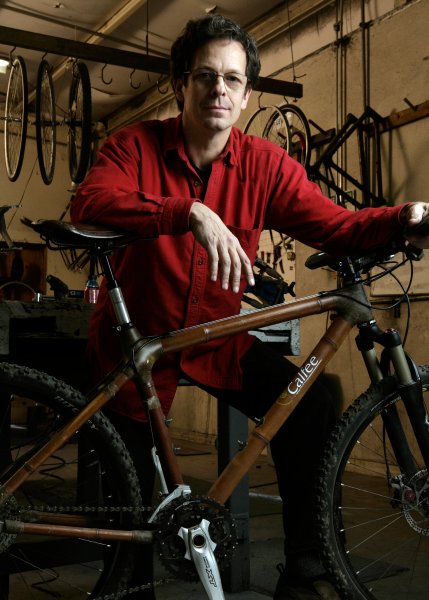
Craig Calfee is an engineer based in California. He specializes in assembly of bicycles used in bicycle racing all over the world like “Tour de France” and is considered an expert in bicycles manufactured from Aluminum and Carbon fibers. Craig has a workshop manufacturing bicycles on Pacific coast in California. However Craig is possessed for last 22 years with a craze that is something totally different than his profession. His new interest is to manufacture bicycles from Bamboo, a botanical specie that grows everywhere in the world and is classified as grasses. Craig's first bamboo frame bicycle was made about 22 years back. It worked alright except for some excess swaying. 


The main difficulty in using bamboo as a raw material is its natural tendency to crack in the middle, along its length. To overcome this problem, Craig started smoking and heating the bamboo pieces. This process of smoking and heating, usually called seasoning, is needed to be carried out slowly over a period of 3 to 4 months.

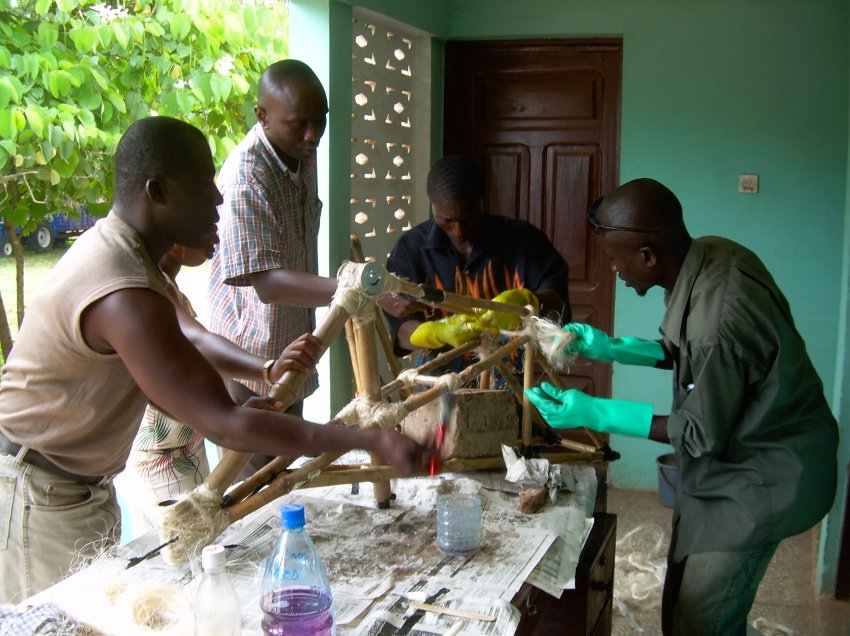
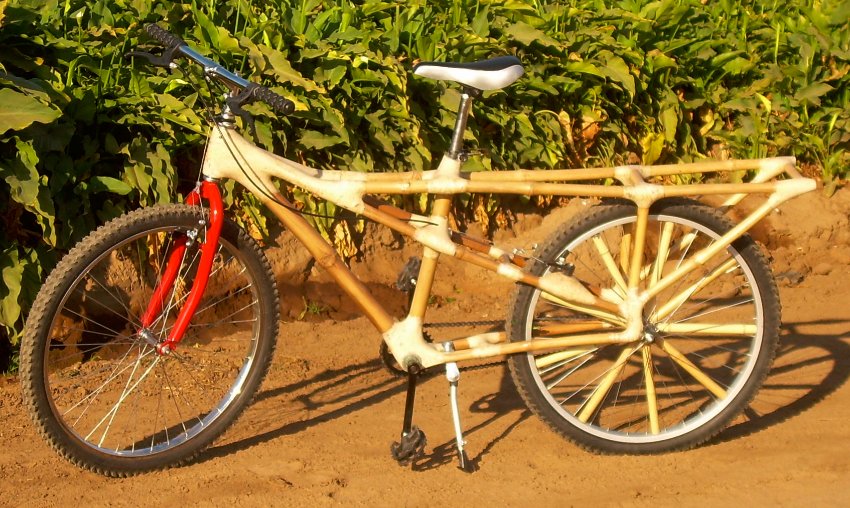
To join such bamboo pieces to each other to make a cycle frame, Craig has developed a special process using fibers extracted from a plant known as “ Hibiscus cannabinus.” Craig uses this fiber, coated with Epoxy resin, to tie bamboo pieces to each other to make the frame. Craig had to make more that 100 experimental bamboo frames for bicycles, before he could hit on the right design. According to him, his bamboo bicycle frame is stronger than a carbon fiber frame and less likely to break with frontal shocks. It stands very well to the shocks imparted to it because of the potholes and rough patches on roads. EFBe bicycle testing laboratory from Germany has recently carried out tests on this bicycle and has certified its quality. 


Craig's bamboo frame bicycle, in spite of it's lowest carbon foot print, unfortunately is very expensive to make and sells for an astronomical figure of US$ 2700, making it out of reach for anyone in developing countries. To overcome this difficulty, Craig has commenced a project called “Bamboosera”
in collaboration with Columbia University. Under this project, training is imparted to candidates from developing countries to manufacture bamboo bicycles. Once they are trained, they are in a position to start their own cottage industry to make these bicycles. In 2010, “Bamboosera” trained three groups of people from African nation of “Ghana,” to make the bicycles. This project now plans to start these training programmes in Uganda, Liberia, Philippines and New Zealand. Craig is also trying to develop a pedal powered but more sturdier vehicle from bamboo that can carry one adult person along with 4 or 5 kids.


Craig may not be the only person with a green bicycle bee in his bonnet. Three other guys; Brano Meres from Slovak republic, another California designer Nick Frey and Nicolas Meyer from Germany are actively involved in the manufacture of a green bicycle. “Biomega,” is a company from Denmark, who make a very good looking bamboo bike. There is also an ongoing project at the Technical University of Berlin developing similar bicycles called Berlin Bamboo Bikes. Nick Frey's company “Boo Bicycles” now in Colorado, also specializing in bamboo bikes.


Perhaps Nicolas Meyer from Germany has the most advanced green design for a bicycle. His bicycle is made mainly out of hemp and bamboo. His bicycle consists of 60% hemp, 15% bamboo and the rest is carbon and aluminum. He gets his hemp in bulk from a hemp store and his bamboo comes from a florist. To make the bicycle frame Meyer dips the hemp fibers into a thermal epoxy resin and then wraps them around a Styrofoam frame. The frame looks bit chunky because of this method of construction. The hemp ropes can take a lot of weight. But when there's pressure, they bend. To ensure that the saddle mounting, which is made up of two tubes, doesn't get bent out of shape, there is a three-centimeter wide band around the tubes. This method of construction makes the bike more rigid, but not any heavier. It still weighs around 1.4 kilograms, which is approximately the same as a good aluminum bike frame. Bicycle is considered as a personal transportation that creates least amount of pollution. Yet present day steel bicycles consume much power, when manufactured. If a bicycle is manufactured with least amount power and uses recycled or recyclable raw materials, it would become the most ideal vehicle for tomorrow.


Who knows? These crazy bamboo bicycles might become the standard some day. At least these designers seem to think so. 

(You can read about more crazy bicycles here in part III )

7 January 2012

Saturday, October 27, 2012

Trouble down under


With the green revolution of 1970's decade, India became self sufficient in food grain production for the first time after independence. The share of contribution to this bumper harvest, of many farmers from states like Punjab, Harayana, Rajasthan and regions surrounding national capital New Delhi, happens to be much larger than that of the farmers from other areas. The reasons for this differential farm outputs, when farmers sow the same hybrid seeds everywhere, are not difficult to ascertain. The main reasons for superior crop outputs from these areas are essentially related to the land, used for cultivation. This land, known geographically as Indus river plateau, is endowed with giant rivers that carry plenty of water in all seasons. These rivers continuously keep augmenting the underground or sub soil water reservoirs. With availability of abundance of ground water, the farmers here are able to grow crops like wheat, rice and barley round the year. 


An American agency, National Aeronautics and space administration or NASA has some time back carried out a study of the resources of water available on earth with the help of a pair of twin satellites known as GRACE. According to the findings of this study, sub soil water resources in the Indus river plateau have depleted by as much as as 109 cubic Kilometers during period of 2002 to 2008. Since it is impossible to estimate the total quantity of sub soil water that is there, it is difficult to predict as to when these sub soil water resources would dry up completely. The observations from satellites however show that the water table is going down in this area by a foot every year. A study carried out by world bank says that the farmers from this area are pumping out about 63 Cubic Kilometers volume of water each year. Out of this, only about 45 cubic Kilometers of volume of water can be replenished by the rivers flowing in this area.


According to another study done by world bank, around 60% of agriculture and 80% of non urban areas in India source their requirements of water from ground water resources. The total use of sub soil water in India is approximately 230 cubic Kilometers, which works out as 25% of the volume used by entire world. From the total number of Indian sub soil resources, around 29% resources have reached semi critical or critical stages. It is estimated that by 2025 about 60% of groundwater resources would reach critical stage. In the states of Gujarat, Harayana, Maharashtra, Punjab, Rajasthan and Tamil Nadu at least 54% of the ground water resources are already critical. India's Central Ground Water Authority has already declared about 1615 resources of ground water out of total 5725 resources, as critical and in case of 108 resources, pumping has been banned. 


Depleting stocks of ground water is not the only problem faced by the country. The quality of ground water also appears to be deteriorating rapidly. From about 600 districts in India, the ground water resources in about 254 districts are found to contain Ferrous salts above danger levels. In 224 district, groundwater has fluorides above danger mark. In 162 districts salinity of water has increased making it non potable. In 34 districts, arsenic percentages are now much higher.

In some of the states, the situation is even worst. In Gujarat, out of 26 districts as many as 21 districts have ground water with high salinity and 18 have excess fluorides. In the state of Karnataka, 21 districts out of 31 have ground water pollution with excess presence of Ferrous salts and 20 districts with excess of fluorides. In Rajasthan, as many as 27 districts face problem of high salinity in ground water and 30 districts have high fluorides. Even in the national capital region of New Delhi, 5 out of 9 districts have ground water containing high salinity, fluorides and Ferrous pollutants. If we consider the entire country about 33% of available water is now non potable.

Such polluted water, not only is a health hazard, but if consumed, is also dangerous if supplied to crops. It has been observed that crops grown on such polluted water, also contain all these dangerous pollutants.

The authorities need to take two fold action. Firstly all such polluted water must be treated to remove the pollutants before used and secondly the the quantity that is pumped out from ground also needs to be regulated. Recent development of Reverse Osmosis water purifiers has been an extremely lucky break for India as it I now possible to purify water at a very low cost. However, If above steps are not taken up immediately, India is likely to face extremely serious situation after next 15 to 20 years. There seems to be no doubt about it.

27 October 2012


Saturday, September 22, 2012

A Cure worse than the disease

Every day I return home for lunch around 1 PM, when I always see a junk collector's handcart parked on the street corner, along with the owner standing nearby. Surprisingly, I have never seen usual junk like empty bottles, tin cans, paper boxes and broken bathroom fittings on his cart. On the contrary, his cart is always parked with old Personal Computers, old CRT monitors, broken printers and all that kind of discarded electronic or e-junk. I have been always wondering, where from he manages get every day so many computers and printers? Finally, I decided to ask him directly and satisfy my curiosity. Few days back, I stopped my car near his cart and inquired with him, about the junk he had collected on his cart that day. The answers , which he gave me were quite revealing. All the electronic junk like computers, printers and old telephones, which he had on his cart, was collected by him on the same day. I naturally asked him about what exactly he does with the junk. He told me that there is a shop in the city, which buys only electronic junk on weight basis from junk collectors like him, so he goes to the shop at the end of the day and sells the collected junk to the shop. 
 
20081215-india-e-waste

I am acquainted with a scrap dealer, whom I used to sell my factory scrap earlier. By chance, I met him couple of days ago. I casually asked him about the electronic junk. According to him, the computer junk collected from the hard cart junk collectors is actually sold to big scrap dealers in Delhi, who buy this e-junk on per ton basis from shops spread all over the country. By now I was very curious about this electronic junk trade. I decided to do some research on the net. What I found was interesting but not very palatable.

Let us trace out the entire journey of the e-junk from the household to final destination. In the first place, what my street corner cart owner had told me was half truth. The scrap dealer, who purchases e-junk from him does not buy broken plastic parts or moulded plastic cabinets. So my street corner cart owner, simply burns off the plastic parts at the end of the day. Many of these plastic parts are quoted with metal films and most of theme are sprayed with chemicals containing Cadmium, lead, Mercury compounds and Bromides to make them anti-inflammable. The fumes created by open burning of such parts, are highly dangerous to the people in the vicinity and are also carcinogenic with continuous exposure. Our hand cart owner does not even know that he is playing with his own life by burning the plastic parts in open. 
 
e-waste

The bulk purchased electronic junk is usually sent to Delhi by trucks or railway wagons. Here, this junk is first sorted out. The computers which are salvageable or are in working order are separated and sent to some cities in India's Rajasthan state like Bharatpur, Dholapur, Bikaner, where these are repaired or cannibalized. Such cannibalized computers then are sold to traders from smaller towns or schools for as low a price as 30 to 40% of the price of a similar new computer. Whatever remains after this cannibalization and is beyond use, is again simply sent back to Delhi scrap traders. I have been always under impression so far that these non salvageable computers along with broken junk are used as a landfill and are simply dumped into pits, dug into earth and covered up finally with loose soil. The realities however quite differ from this and what happens later with the junk is extremely polluting and unhygienic. 
 
219501_circuit_board

The trade in old Personal Computers and other e-junk, taking place in India's capital Delhi, has now reached such gigantic proportions that Delhi along with being called India's capital, may be also called as Capital of scrapped computers and e junk. As per present figures, every year, Delhi recycles more than 20000 tons of e-junk and it is likely that this figure could be much higher in coming few years. Besides re-cycling the e-junk collected from throughout the country, such electronic junk is now reaching Delhi from almost all advanced nations of the world, who do not want to do anything with the junk but simply discard it. A Ton of e-scrap is sold in Delhi market for about 20000 Rupees (US$ 365.00) From this e-junk it is possible to recycle or salvage around 10 Grams of Gold and 30 to 40 Kg of Copper and other metals worth 40000 Rupees.(US$ 730.00)

From above mentioned figures, it may appear that this is a very lucrative business. But this recycling is being done in Delhi in such hazardous and deadlier way that anyone would come to the conclusion that this cure for disposal of e junk is worse that the problem of creation of the junk itself.

This recycling work goes on in small villages surrounding Delhi. You can watch 10 to 12 year old kids shaking trays filled with electronic printed circuit boards in acid filled drums that come to almost their height. They were rubber hand gloves but are not provided with any mask or googles. Small droplets of acid can drop on these children any time. Similarly the entire air surrounding these sheds is saturated with acid fumes. All the kids working here suffer from cough and breathing problems. Under such conditions, when the work is over, these kids find solace in drinking hard illicit liquor. 
 
delhi-ewaste2

The residue that collects in the acid drums is collected each day. This residue contains all the metallic salts. The metals like copper are later recovered from the residue. Other e-junk containing glass an plastic are similarly recycled in other small sheds with furnaces. The working conditions here also are equally horrible. Within Delhi metropolitan area the rules are very strict about child labour and working conditions. Hence this entire recycling work is done in sheds set up in small villages on periphery of Delhi. Since the profitability of this business is more than 100%, it continues to grow and flourish without bothering about the environment and health of child labour utilized.

With the popularity and the fact that manufacturers continuously keep bringing newer and newer models out, the mobile phones are latest additions to e-junk. Because of this, old scrapped mobile phones are being brought to Delhi for recycling. No one seems to be bothered that by bringing in this poisonous junk from everywhere in world to Delhi and recycling it, we are causing a great harm to the environment and immeasurable damage to the health and well being of these poor children, who are forced to work in these recycling sheds.

21 September 2012