Showing posts with label Malaysia. Show all posts

Thursday, April 24, 2014

Trouble brews up again in Malacca Straits


Everything appeared peaceful and normal at midnight, aboard Naninwa Maru-1, a Japanese tanker ship as it cruised along the Malaysian coast on the night of 16th April 2014, carrying Diesel oil to Myanmar from Singapore. Most of the crew members, who were of Indonesian, Thai, Myanmar and Indian nationalities, were fast asleep except for the ones, who were on duty. Around 1 AM one of the crew members could not believe his own eyes as he saw about five or six men armed men with a pistol and a (machete) suddenly appear aboard the ship. Before the surprised crew could offer any resistance, pirates subdued and tied up the crew, robbed the vessel and took control.

The pirates then must have signaled their accomplices because suddenly from no where, two tanker ships appeared on the horizon. The pirates briskly started pumping the Diesel from the tanks on Naninwa Maru-1 to these two tankers. The pirates after pumping out more than half of the 5 million liters of diesel, made off. Several hours later after the attackers had fled, the crew discovered three shipmates were also missing, presumably taken as hostage. Malaysian domestic media report that the abducted men were Indonesians. The possibility of these men being accomplices of the pirates can not be denied. Only further investigation would bring out the truth. The ship is now berthed off Port Klang, Malaysia’s main port, for investigations.

The incident took place when Naninwa Maru-1 was just 16 Nautical miles away from the Malaysian coastline. No great imagination is required to guess that the tanker was in the waters of the Malacca Straits. A place that has a long history of pirates hijacking ships passing through the channel. Malacca is located some two hundred kilometers north of Singapore. The city is the capital of State of Malacca within federal Malaysia. What makes Malacca so special is the narrow patch of sea along its shoreline. This funnel shaped narrow strip of Sea, called straits of Malacca, is sandwiched between Malaysian coast line on the eastern side and Indonesian island of Sumatra on the western side. In fact, at the narrowest part, which happens to be located near the city of Malacca, the straits are just a few kilometers wide. What makes the Malacca straits important as well as most crucial for the world’s shipping is the fact that this is the shortest practical opening for any sea faring ship sailing from South China Sea to the Indian Ocean or vice versa. (The other sea lane is through Sunda strait, between islands of Java and Sumatra in Indonesia. This route is much longer compared to Malacca straits sea lane.)


About 50000 ships cross this narrow strip of Sea every year. I read somewhere, that each and every day 15 million barrels of crude oil is transported through the straits. 70% of the oil that China consumes every year passes through here. If due to some reasons, the straits are closed to shipping, half of world’s shipping fleet would be forced to divert their sea faring routes. Straits of Malacca actually connect the Andaman Sea on the west to the South China Sea near Singapore. It is a true bottle-Neck of the world.

The US Energy Information Administration identifies the Malacca Strait, which connects the Indian Ocean with the South China Sea and Pacific Ocean, as one of the world’s two “most strategic choke points” for oil trade along with the Strait of Hormuz in the Persian Gulf. It is the shortest sea route between the Middle East and Asia with about 15.2 million barrels of oil a day transported along the waterway in 2011, according to the EIA. About 90 percent of that was crude.

Speaking historically, Malacca straits was always considered as one of the most dangerous places on Sea, as with such heavy cargo traffic, sea pirates found it extremely lucrative for their criminal activities. Even in recent history, there have been case of piracy in Malacca straits. In the year 1999, a 9000 ton freighter named as MV Alondra Rainbow had disappeared from here, when on way to Japan with a cargo of Aluminum ingots. This ship with a crew of 17 was abducted by some 15 armed gangsters. After a week, the crew was found floating helplessly in a rubber life boat near Thailand coast with no trace of their ship. After a month, Indian Navy and the Coast guard, discovered a ship of similar description near the Indian coast. The ship was chased and fired upon by the Indian Coast guard, when the pirates surrendered. It was found on inspection, that half of the ship’s cargo was gone, the name of the ship was changed, it was showing a different flag and the pirates were trying to flood the ship to sink it. In the year 2002 alone, 36 ships were attacked here. In 2003, 60 ships were attacked. When the situation reached such alarming proportions, the insurance companies started declaring the Malacca straits area as war zone and refused to insure the ships or the cargo. US government indicated that unless littoral states take effective action, US navy would have to patrol this area. After this, Governments of Malaysia, Indonesia, Thailand and Singapore realized the gravity of the situation and started joint patrolling. There was a realization soon that the naval resources of these countries were not adequate for the task This lead to an agreement between as many as 16 nations including India, from the surrounding areas, to provide protection to shipping in the straits.. This agreement is known as ‘Regional Cooperation Agreement on Combating Piracy and Armed Robbery against Ships in Asia’. After this agreement, the piracy in the straits has reduced almost to nil. Indian Navy participates in this security environment as per this agreement and Indian Naval ships are seen patrolling frequently in the Straits of Malacca.

The situation in Malacca straits then improved dramatically. Perhaps because of the measures taken by various Governments, only one fishing vessel was the only ship that was hijacked in the Strait of Malacca in all of 2012 according to the statistics available on International Maritime Bureau web site. Unfortunately, pirating seems to be picking up again in the Malacca straits and nearby areas, this year. On 10th October 2013, an oil-products tanker was hijacked off Malaysia’s Pulau Aur in the South China Sea on Oct. 10, about 67 miles northeast of Singapore. Pirates stole the ship’s cargo before abandoning it on Oct. 15, the IMB’s website shows. This vessel is believed to be Danai 4, carrying marine gasoil from Singapore to Vietnam.

Within just a month from this act of piracy, the pirates struck again on 7th November 2013, five pirates armed with guns and knives boarded 3,254 deadweight tonne (dwt) GPT-21 tanker operated by Singapore firm Global Unique Petroleum about 7.3 nautical miles (13.5 kilometers) west of Malaysia’s Pulau Kukup in the Strait of Malacca, about 34 miles west of Singapore. The armed hijackers tied up all the crew members and held them hostage in one cabin. Later they ordered the Master to steer the ship to a pre-designated position where another unknown orange hull tanker came alongside. The C/O and the bosun were forced to operate the mooring winches and then the cargo pumps and valves to transfer oil into the unknown tanker. The pirates, prior to leaving the hijacked tanker, also stole personal belongings of the crew. The gasoil cargo on ship could be worth more than $2.7 million according to some Singapore sources.


Singapore headquarters of the Regional Cooperation Agreement on Combating Piracy and Armed Robbery against Ships in Asia (ReCAAP) says that as things stand, attacks by gangs armed with guns and knives on shipping in the Malacca Strait have ranged from 12 to 20 incidents a year over the last three years. According to Regional security officials, armed gangs prowling the Malacca Strait may be part of a syndicate that can either have links to the crew on board the hijacking target or inside knowledge about the ship and cargo. Such hijacks lead to seizing tankers so that gasoil cargoes can be transferred and sold on the black market.

Malacca straits waters remain a hotbed for pirate attacks and petty theft and unless strong measures are taken by the regional Governments, such incidences shall continue to take place.

24th April 2014

Saturday, November 23, 2013

The world of LEGO figurines


In the year 1975, when I returned back home from my first ever tour of Europe, I knew that my son, then just 6 years old, would be eagerly awaiting my arrival for his first ever foreign gift of chocolates and toys. I had already purchased from the prestigious Harrods store in London, a grand gift for him, which fitted my meager budget and crippling import restrictions, India had in those days. After I reached home, I had opened my bags and had seen my son's face lit up as I handed over the gifts to him.

After so many years, I still see the same scene repeated again, whenever my son, now a businessman, returns home from one of his frequent trips abroad and hands over gifts to his 9 year old son. Though, so many years have passed in between and there are no more import restrictions, there is something that is surprisingly the same. It is the gift that has remained the same through all these years. By now, many of the readers might have correctly guessed the gift. It surely is a brand new LEGO set.

LEGO remains even today, one of the top favourites of children from all over the world. LEGO's flagship product still remains its famous 8 legged interlocking plastic brick. These LEGO bricks can be assembled and connected in many ways, to construct such objects as vehicles, buildings, and even working robots. Anything constructed can then be taken apart again, and the pieces used to make other objects. The child's imagination is the limit here, nothing else. As of 2013, around 560 billion Lego parts had been produced.

In 1978, LEGO produced its first minifigures, which resemble humans as well as animals and have since become a staple in most sets. These minifigures, many a times called as "minifig" are small plastic articulated figurines that have become hugely successful with over 3.7 billion produced. Some of the figurines are named as specific characters, (such as from Star Wars) or are of LEGO's own creation. Most are unnamed and are designed simply to fit within a certain theme such as police officers, astronauts and pirates. Even simple everyday figurines of babies, girls and boys, moms and pops, grandparents are also supplied with suitably named sets. They are highly customizable and parts from different figures can be mixed and matched, resulting in a large number of combinations.

Over the years, LEGO figurines have become collectibles and are also sold separately as keychains and magnets. LEGO executives have been using personalised minifigures in place of business cards, with email and phone details on the front and back of the torso, and hair and facial features designed to resemble each executive. They also appear in video games and short films.


Considering the immense international popularity of LEGO figurines, it was no wonder that they appeared in advertisements. But now they are also being used to deliver a powerful political message to the viewers very effectively. A photo of a LEGO man stopping a line a LEGO tanks was published by China’s Netease Web site as a part of a slide show to mark Children’s Day on June 1. 2013. It was perhaps the most powerful pictorial commentary that commemorated the anniversary of Tiananmen Square Massacre crackdown in Beijing of June 3–4, 1989, when troops with assault rifles and tanks inflicted thousands of casualties on unarmed civilians trying to block the military’s advance on Tiananmen Square in the heart of Beijing, which student demonstrators had occupied for seven weeks.


This week, LEGO figurines have appeared on the walls in Malaysia delivering a powerful message. The original mural first appeared on a wall in the southern Malaysian city of Johor Baru, just across a narrow strip of sea from Singapore. The mural depicted a woman drawn in the style of a LEGO figurine walking towards a street corner, where a black-clad, knife-wielding LEGO figurine robber waited to pounce. The mural, by 27 year Lithuanian artist Ernest Zacharevic, who lives in Penang, was intended as a commentary on the city’s reputation for crime. The very fact, that only last year, a Legoland theme park has opened not very far from this city and many tourists from Singapore and other places are visiting Johor Baru, to visit the amusement park, makes the use of LEGO figurines in this mural much more significant.

Angry city officials quickly painted white paint over the figurines, but the image has struck a chord in the minds of the people concerned over crime. Within next few days, the images of the street mural have gone viral on the net. Across Malaysia, many versions of the mural have popped up. Copies of the mural by other artists as well as paper cut-outs featuring the figurines have appeared at sites in Johor Baru, the capital Kuala Lumpur and elsewhere. Social media web sites are filling with photos of the copies.

A new Facebook page has appeared in Chinese ( Malaysia has a large Chinese minority) that is dedicated to the phenomenon and has drawn more than 16,000 “likes.” Advertisements for sale of Tee shirts with the figures of figurines printed on them have appeared on Facebook with 20 ringgit ($6) apiece, as the price. One posting in Chinese declared Zacharevic “Malaysia’s Banksy,” after the British street art superstar.

Malaysians have been expressing increasing alarm over a perceived rise in crime in recent years, with gang wars being played in the cities. Effective use of LEGO figurines just proves how efficacious they can be.

Those of my readers, who are from India, can easily remember how effective the advertisements from the Milk products co-operative 'Amul' are, which always show a neatly turned out small chubby girl along with other characters and a catch line that relates to any news worthy event. The LEGO figurines are proving to be efficacious in a similar fashion. It is clear that the international media have found a new powerful tool to address concerns of the people; The world of LEGO figurines.

23rd November 2013

Wednesday, November 13, 2013

Piracy on the rise in Malacca straits again


Malacca is located some two hundred kilometers north of Singapore. The city is the capital of State of Malacca within federal Malaysia. What makes Malacca so special is the narrow patch of sea along its shoreline. This funnel shaped narrow strip of Sea, called straits of Malacca, is sandwiched between Malaysian coast line on the eastern side and Indonesian island of Sumatra on the western side. In fact, at the narrowest part, which happens to be located near the city of Malacca, the straits are just a few kilometers wide. What makes the Malacca straits important as well as most crucial for the world’s shipping is the fact that this is the shortest practical opening for any sea faring ship sailing from South China Sea to the Indian Ocean or vice versa. (The other sea lane is through Sunda strait, between islands of Java and Sumatra in Indonesia. This route is much longer compared to Malacca straits sea lane.)

About 50000 ships cross this narrow strip of Sea every year. I read somewhere, that each and every day 15 million barrels of crude oil is transported through the straits. 70% of the oil that China consumes every year passes through here. If due to some reasons, the straits are closed to shipping, half of world’s shipping fleet would be forced to divert their sea faring routes. Straits of Malacca actually connect the Andaman Sea on the west to the South China Sea near Singapore. It is a true bottle-Neck of the world.


The US Energy Information Administration identifies the Malacca Strait, which connects the Indian Ocean with the South China Sea and Pacific Ocean, as one of the world’s two “most strategic choke points” for oil trade along with the Strait of Hormuz in the Persian Gulf. It is the shortest sea route between the Middle East and Asia with about 15.2 million barrels of oil a day transported along the waterway in 2011, according to the EIA. About 90 percent of that was crude.

Speaking historically, Malacca straits was always considered as one of the most dangerous places on Sea, as with such heavy cargo traffic, sea pirates found it extremely lucrative for their criminal activities. Even in recent history, there have been case of piracy in Malacca straits. In the year 1999, a 9000 ton freighter named as MV Alondra Rainbow had disappeared from here, when on way to Japan with a cargo of Aluminum ingots. This ship with a crew of 17 was abducted by some 15 armed gangsters. After a week, the crew was found floating helplessly in a rubber life boat near Thailand coast with no trace of their ship. After a month, Indian Navy and the Coast guard, discovered a ship of similar description near the Indian coast. The ship was chased and fired upon by the Indian Coast guard, when the pirates surrendered. It was found on inspection, that half of the ship’s cargo was gone, the name of the ship was changed, it was showing a different flag and the pirates were trying to flood the ship to sink it. In the year 2002 alone, 36 ships were attacked here. In 2003, 60 ships were attacked. When the situation reached such alarming proportions, the insurance companies started declaring the Malacca straits area as war zone and refused to insure the ships or the cargo. US government indicated that unless littoral states take effective action, US navy would have to patrol this area. After this, Governments of Malaysia, Indonesia, Thailand and Singapore realized the gravity of the situation and started joint patrolling. There was a realization soon that the naval resources of these countries were not adequate for the task This lead to an agreement between as many as 16 nations including India, from the surrounding areas, to provide protection to shipping in the straits.. This agreement is known as ‘Regional Cooperation Agreement on Combating Piracy and Armed Robbery against Ships in Asia’. After this agreement, the piracy in the straits has reduced almost to nil. Indian Navy participates in this security environment as per this agreement and Indian Naval ships are seen patrolling frequently in the Straits of Malacca.

The situation in Malacca straits then improved dramatically. Perhaps because of the measures taken by various Governments, only one fishing vessel was the only ship that was hijacked in the Strait of Malacca in all of 2012 according to the statistics available on International Maritime Bureau web site. Unfortunately, pirating seems to be picking up again in the Malacca straits and nearby areas, this year. On 10th October 2013, an oil-products tanker was hijacked off Malaysia’s Pulau Aur in the South China Sea on Oct. 10, about 67 miles northeast of Singapore. Pirates stole the ship’s cargo before abandoning it on Oct. 15, the IMB’s website shows. This vessel is believed to be Danai 4, carrying marine gasoil from Singapore to Vietnam.


Within just a month from this act of piracy, the pirates struck again last week. On 7th November 2013, five pirates armed with guns and knives boarded 3,254 deadweight tonne (dwt) GPT-21 tanker operated by Singapore firm Global Unique Petroleum about 7.3 nautical miles (13.5 kilometers) west of Malaysia’s Pulau Kukup in the Strait of Malacca, about 34 miles west of Singapore. The armed hijackers tied up all the crew members and held them hostage in one cabin. Later they ordered the Master to steer the ship to a pre-designated position where another unknown orange hull tanker came alongside. The C/O and the bosun were forced to operate the mooring winches and then the cargo pumps and valves to transfer oil into the unknown tanker. The pirates, prior to leaving the hijacked tanker, also stole personal belongings of the crew. The gasoil cargo on ship could be worth more than $2.7 million according to some Singapore sources.

International maritime Bureau has now put up this warning on its web site.

Malacca Straits: Although the number of attacks has dropped substantially due to the increase and aggressive patrols by the littoral states authorities since July 2005, ships are advised to continue maintaining strict anti piracy watches when transiting the straits. Currently, there are no indications as to how long these patrols will continue or reduce.

Singapore Straits: Vessels are advised to remain vigilant and to continue maintaining adequate anti piracy watch and measures. Pirates/robbers attack ships while underway or while anchored at the Straits.


Malacca straits waters remain a hotbed for pirate attacks and petty theft and it would be necessary for all the regional Governments to step up monitoring to see that such incidences are not repeated.

13th November 2013

Tuesday, March 5, 2013

Melaka Spice Part III


As I have mentioned earlier, Melaka port was attacked by a Portuguese armada in the year 1511 and had defeated the Sultan ruling there. For 100 years prior to this, Melaka was a capital of a Kingdom ruled by a Sultan in the Malaysian Peninsula. In the year 1400 a Hindu king known as 'Parameshwar' was ruling over Singapore. He was dethroned and had to run away from Singapore. Eventually, he arrived at Melaka and decided to make Melaka as the new capital of his kingdom. At that time, most of the subjects of this king were also Hindus. In year 1409, king 'Parameshwar' accepted Islamic religion as a precondition to his marriage to a Muslim princess, then he accepted a new name for himself and became known as 'Iskandar Shah.' After this, most of his citizens also accepted Islamic religion. 'Iskandar Shah's' descendents ruled over Melaka until 1511 and after their defeat at the hands of the Portuguese, then ruling Sultan ran away to Bukit Bintang in Malaysia and then to Sumatra island.


Melaka Fort

The new European rulers of Melaka were not able to hold on the importance and historic glory of the Melaka Port. The trade passing through this port declined further and further. After the British took over Melaka port from Dutch, they appointed a figure head Sultan and called him 'Sultan of Johar.' He was asked to look after the affairs, particularly concerning labour strife between local Malay labour and Chinese labour brought in for working in Tin mines and rubber plantations.

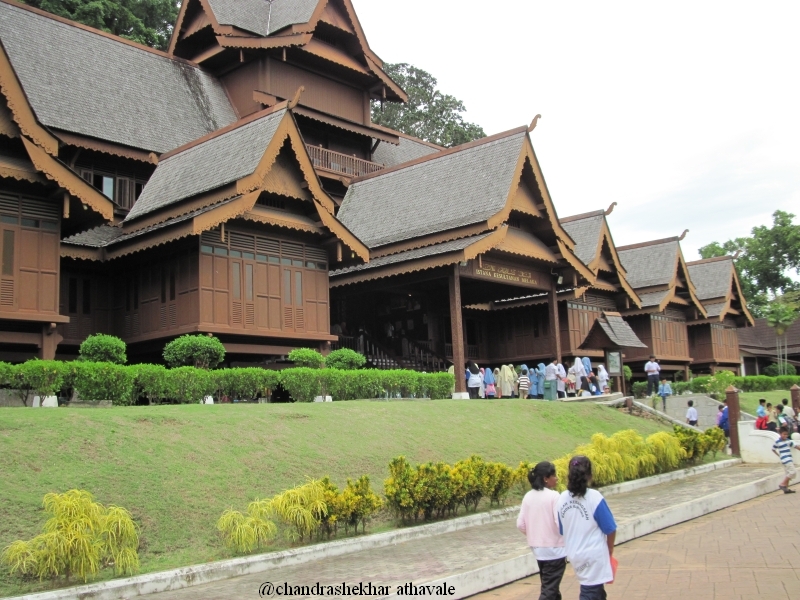
The traditional palace of the sultans of Melaka from 'Iskandar Shah's dynasty was actually located near the fortified post of 'Porta d’ santiago' built by the Portuguese. After Portuguese defeated the Sultan, they destroyed this palace totally. In 1984, The Government of Melaka and the federal Government of Malaysia, rebuilt a new wooden palace, exactly as per original plans, which luckily remained conserved and housed a museum of artifacts and objects from the Sultan era in that building.

I am walking on my way towards this palace, not very far from the gate of 'Porta d’ santiago.' After seeing this great effort put in by the Governments of Melaka and Malaysia, my heart is saddened again, as I remember the empathy of the Government of Maharashtra in India, to conserve the historic heritage of the city of Pune, my home town. It is a sad reflection, that leave alone establishing museums etc; even historic structures are not being conserved and are just allowed to decay and crumble.

The villages in Malaysia are known as Kampung. The houses in these villages are built in an exquisite manner. Thick wooden poles are made to stand up in the ground by burying their ends, deep under ground. Horizontal wooden beams are tied or nailed to these poles at a height about 5 or 6 feet. A wooden hut is constructed on these horizontal beams. It is easily possible for any one, to walk below a house in a Kampung. The rebuilt Sultan palace here, looks like a long series of Kampung houses. built one after other. The central portion of the palace has a built in stair case, which can take you the second floor. Since the lowest floor itself is at a height of about 6 feet, to enter the palace, one needs to climb a flight of stairs. The palace however, appears very comfortable and suitable for the hot and sultry equatorial weather.


Sultan's palace


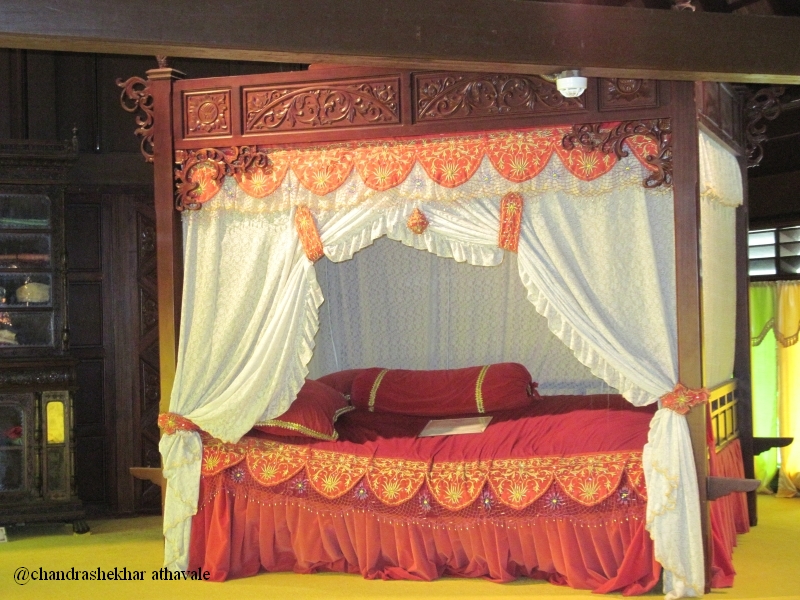
Bed Room


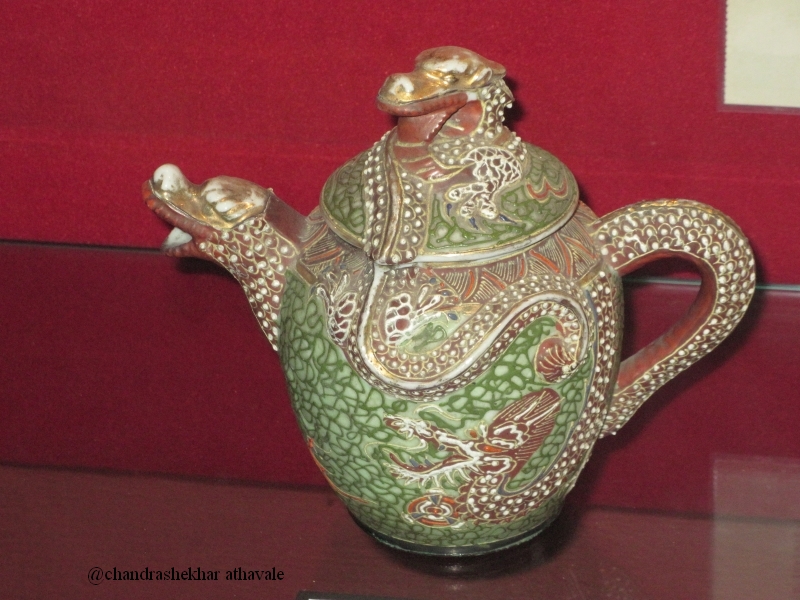
A Tea pot


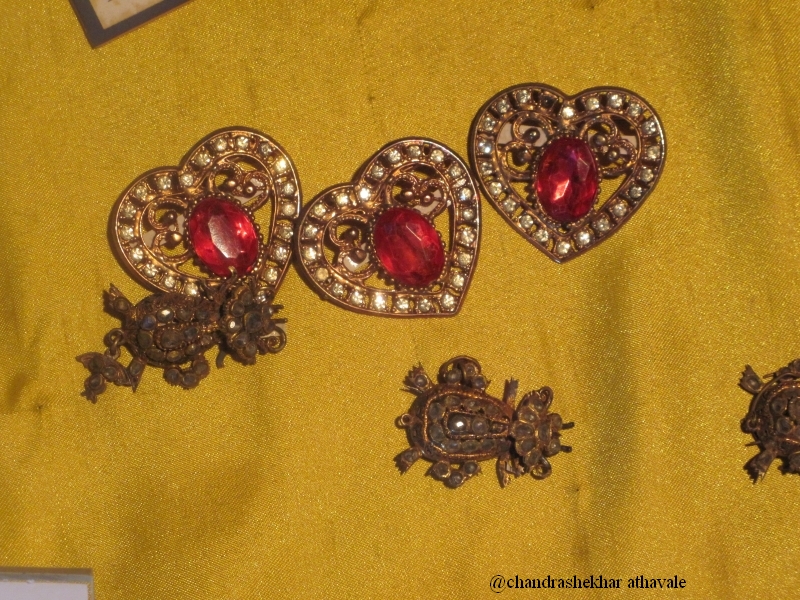
Royal Jewelery


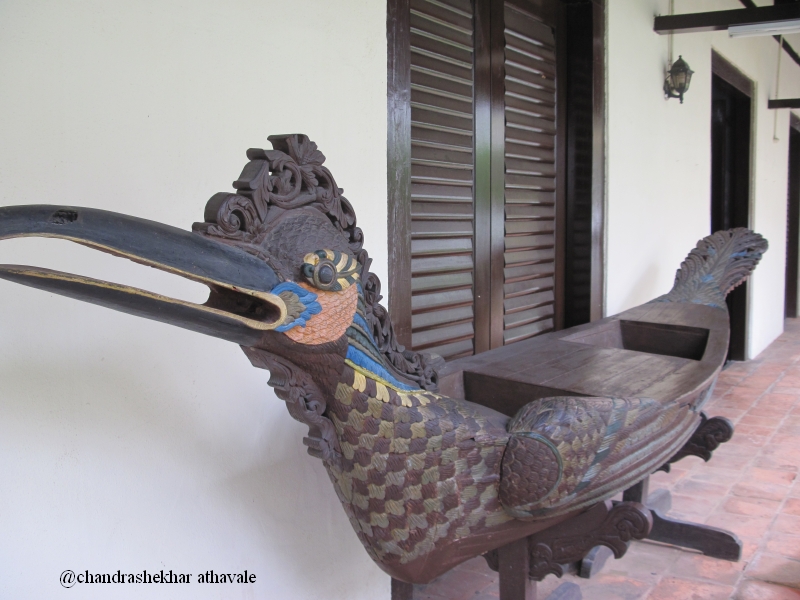
The museum exhibits include a beautiful collection of the attires and dresses, Jewelery, Ceramics, silverware of those periods. As I have mentioned above, a large number of traders from different nationalities had settled down in Melaka. Some of the exhibits show the distinguishable clothes worn by these traders along with the items they mainly traded. I have been wandering around this museum for more than one and half hour and realize that I have yet not had anything to eat since morning, and reluctantly step back from the palace.


The Royal Boat


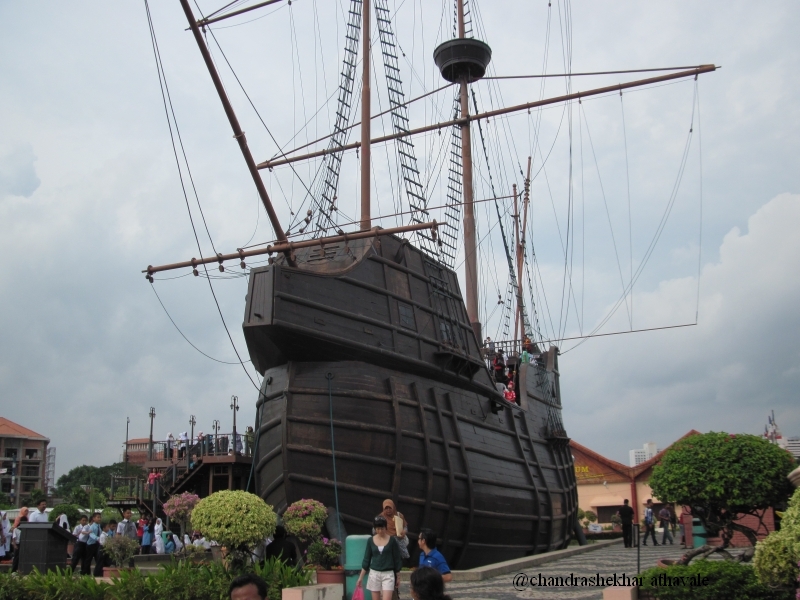
After lunch, I decide to visit the Maritime museum, not very far away from the palace. A Portuguese man-of-war or a warship ' Flor de La Mar ' was sunk off the Melaka harbour in the naval wars between Portuguese and Dutch. In 1990, Government of Melaka built a replica of the original warship according to original plans and have housed this maritime museum in this ship standing on hard ground. In Pune, we have a club called Boat Club or in Mumbai, there is another club known as Yacht Club. In both these clubs, I have seen many items used on ships and boats. That probably is the reason for my subdued level of interest in this museum. But the warship itself is worth a visit. They also have many models showing old cargo ships and warships, which are very noteworthy.


Maritime museum


A bridge next to the Maritime Museum takes me to a narrow congested street. This street is well known and is considered as Melaka's top tourist attraction. Almost every visitor to Melaka, definitely visits this street at least once, during his visit. This street is known as 'Jonkar Street' The street, prima facie, looks like Mumbai's famous 'Luhar Chawl Street from a distance, but as I go nearer, it opens for me a gold mine of antiquities, curios and small tidbits. No one asks you about buying anything here, You can do window shopping comfortably even for 2 hours here. In the night, this street gets converted to a street food mall and is like a street banquet for foodies, who love southeast Asian food. I keep wandering on the street and indulge myself with some of the snacks and purchasing some totally unnecessary stuff. Obviously, making purchases of such things, is and essential part of any tourism. It is a great fun, I am sure.

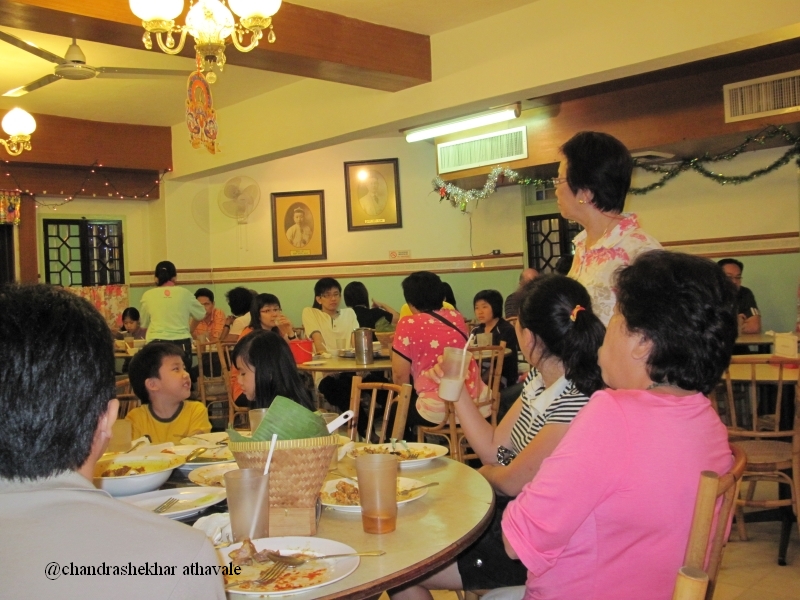
Chinese labour started arriving in Malaya from Nineteenth century, to work in Tin mines and rubber plantations. Those arrived, naturally settled down here later and brought their own Chinese culture and food with them here. After almost two centuries, the original Chinese food and culture has got amalgamated with the Malay food and culture to produce a new food and culture for these people of Chinese origin, now settled in Malaysia. These Malay Chinese are called here as 'Nonya-Baba' or 'Baba-Nonya' and their special recipes are called as 'Nonya food.' In Melaka city, specialized restaurants have now come up, who serve 'Nonya' food. I am on my way to have my dinner in one such joint called 'Ole Sayan,' which specializes in Nonya food.


Nonya Restaurant (Specially decorated for Deepavali)


The restaurant is jam packed with a mixed crowd, mostly of Chinese origin, few Caucasians and sprinkling of other Asians like us. In Mumbai, we have Udipi restaurants, where taking of orders and delivery of food is done at super fast speed. This restaurant has a similar culture. The basic ingredients of Nonya dinner still remain as made from rice, noodles, chicken and prawns. The dishes are quite tasty and sumptuous. I order a special Nonya desert after my dinner. It is called as 'Chandol,' and is made from Noodles made from red beans flour, palm syrup and frozen coconut milk.

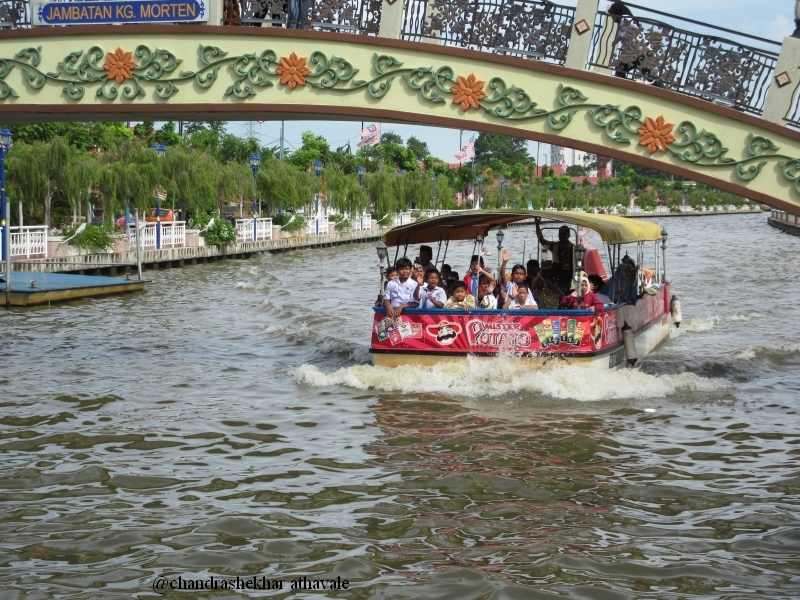
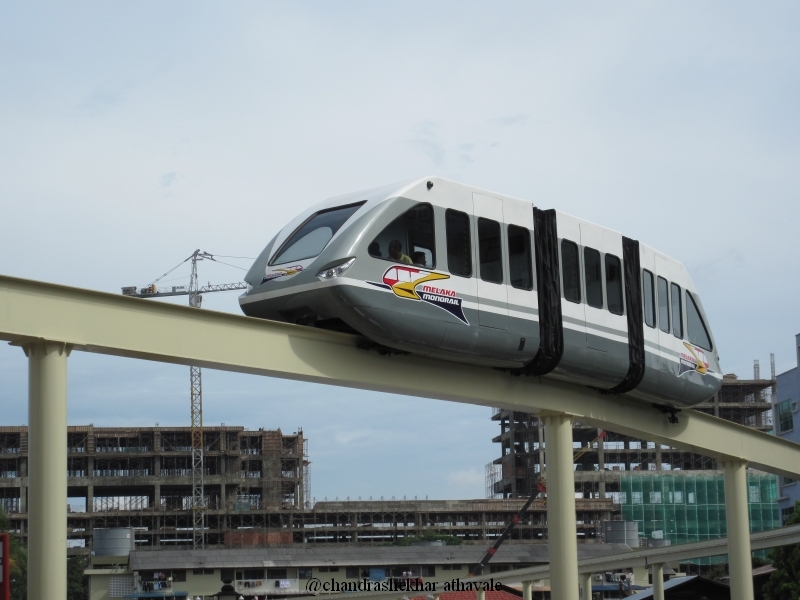
The Government here is making an earnest effort to create more and more attractions for the tourists to make Malaka a great tourism spot. There is a monorail now, that runs along Melaka river. Off course, one can always take a river cruse. New attractions like Butterfly park, Amusement Park, have come up. The efforts are being made to make this a recreational spot, where the whole family can spend few days of fun. Since Malaysian Ringgit is much cheaper than Singapore Dollar, Singaporeans find this spot very attractive. However, largest number of tourists that come to Melaka, appear to be Japanese. Bus loads of Japanese are seen arriving in Melaka from Japan via Kuala Lumpur.


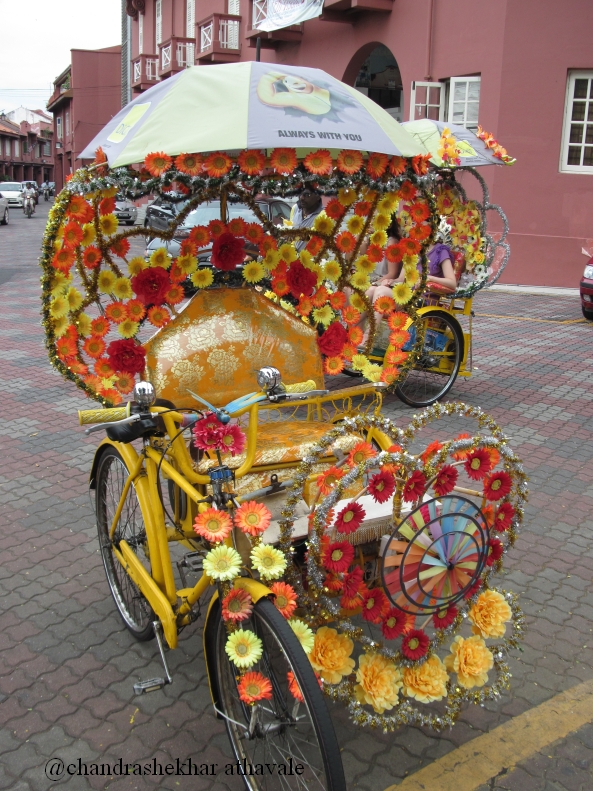
Trishaw


River Cruse


Mono rail


Better the vacation spot, quicker goes the time. This is very true and time for my departure has already arrived rather hurriedly, I keep thinking. Still, I have to leave Melaka now. We are told that we can have some high tea before we leave. Actually, right now, neither I am hungry nor it is the time for my meals. But when on vacation, do we have to follow routine or rules? Off course not, then why not sit at home only? I decide to indulge myself in one of the finest cuisines that the hotel offers. As we leave Melaka, I know that I shall cherish and remember every small detail of last few days for long time to come. 

(concluded) 

5 March 2013

Sunday, March 3, 2013

Melaca Spice, Part II


The first thing that I notice in the old parts of the Melaka city is the extreme orderliness of the traffic. This is because, except for one or two major roads, all other roads are one way streets. It becomes a lot easier for the pedestrians to walk along or cross the streets because the vehicular traffic keeps flowing only in one direction. Melaka can be even called as one way city. This traffic arrangement means that even on curvy, narrow roads in old city, one never experiences any traffic jams and traffic moves, sometimes slowly but smoothly. Besides that, I also observe the disciplined way in which all drivers drive here and follow traffic rules except for the Tricycle Rickshaws or Trishaws. I feel that this method of controlling traffic by making most of the streets as one way, might solve the congestion on streets of my home town, Pune. Few years back, traffic police in Pune, implemented one way traffic, on two major streets in the town; J M Road and Fergusson College road, after a great effort, because almost everyone staying in that area opposed the plan. But since then, the traffic congestion in that area is a thing of the past. With that experience, to implement one way traffic plans in entire city would require a Herculean effort on part of the Police, but it is well worth trying from what I see here in Melaka.

While touring the old city, I sense that the city's history and importance of it's geographical location, keeps blending with the modernity all the time. This is only a medium sized city with a population of seven or eight hundred thousand people, what my home town Pune was in 1970's decade. The older parts of this city are all located around the Melaka port, which means that the history of the city is concentrated in this area. Like the fort area, built by British, in the city of Mumbai, a fort existed here also and almost all the sites worth seeing are well within this fort walls. This makes it easier for a tourist like me to just walk around and see everything.

I have already written about the locational importance of Melaka. For this reason, from historical times, Melaka inhabitants always had sprinklings of Arab, Indian, Malay and Chinese traders, who used to camp here. Large consignments of Java spices, Chinese silk, salt, minerals, perfumes, gold, Chinese ceramics and wine were transshipped and traded at this port for many centuries. From 1450 CE Sultan of Melaka ruled over this city. In 1511, a Portuguese armada invaded Melaka port and finally Sultan had to surrender the port to them. After this, Melaka became a Portuguese colony. The Portuguese started controlling the entire trade in the region because of their control of Melaka. This could not be tolerated by other European powers. In 1641, Portuguese armada and Dutch naval ships fought many a battles off the coast of Melaka. This naval war was won by the Dutch and they took control of the port. The British, now firmly in control of India, could not accept the fact that a port of such great importance was controlled by Dutch. Naval skirmishes between British and Dutch navy continued till finally British exchanged areas of Sumatra island under their control with Dutch in 1824 and took possession of Melaka.

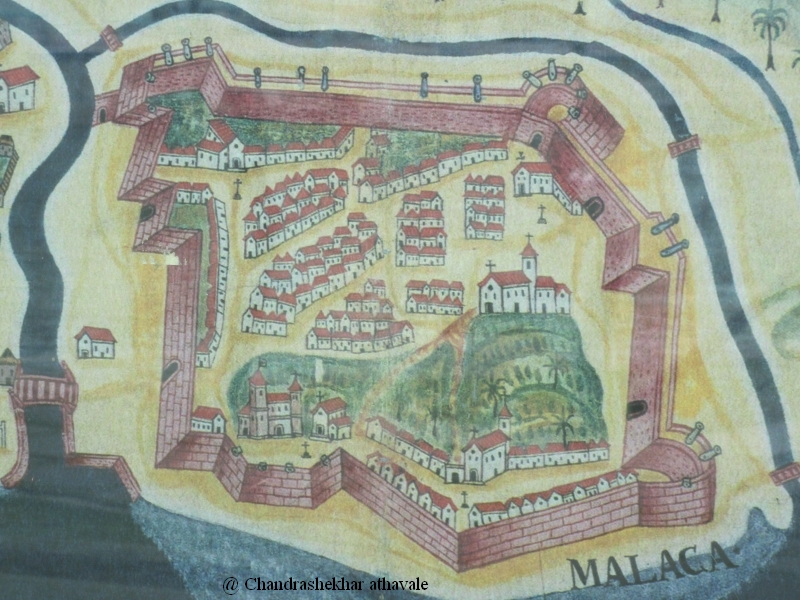
This 300 year occupation of Melaka fort, first by Portuguese, then Dutch and finally by British has left many ruins of buildings in the fort area of Melaka. For anyone, who loves history, Melaka fort is like a gold mine of history. UNESCO has declared Melaka as a World Heritage Site in 2008. The present Governments of Melaka as well as federal Government of Malaysia, have fully realized the tourism potential of this place and have taken up number of development projects, making Melaka an interesting place for tourists. A holiday in Melaka is considered by many a tourists as a pleasant and delightful experience no doubt. 


Stadthuys


Town Center


Since most of the places of tourist interest in Melaka are around the town center, I start my walking tour of the city from here only. The town center consists of a a crimson coloured old structure and a nearby clock tower. This structure is known here as ' Stadthuys' and was built by the Dutch rulers in 1650 as Governor's residence. Next to this structure, an old church built in 1753, stands tall. Both these buildings have been well maintained and their crimson colour makes them look monumental and splendid. Because of this colour, this entire town center area, looks very impressive to say the least. ' Stadthuys' now houses a museum, which displays large number of artifacts and objects related to Dutch and English rulers. The exhibits include swords, period furniture, rifles, hand guns, revolvers, pistols, Gun shots, bullets, Chinese ceramics, terracotta pots, old plans and models of old fort. I sadly recollect the fact that my home town of Pune is surely much richer in history. However, except for private collection in Raja Kelkar Museum, there is no other museum that tells or describes history of Pune to new generations. We do not even know how 'Shaniwar Wada,' the grand palace built by 'Bajirao Peshawa' really looked like. I feel rather sad at this empathy of my home town people at their history, while I look at the museum here in 'Stadthuys.'

Down below, in the 'Town Center,' I can see number of Trishaws standing in a line. These Trishaws are considered as one of the special attraction of Melaka. We have Bicycle Rickshaws in Kolkata, India, but these Trishaws here, have the passenger side car attached to the side of the Bicycle, instead of at behind as done in Kolkata Rickshaws. Because of this construction, the passengers can see ahead without any hinderence and can take photographs at will. These Trishaws are all highly decorated with plastic flower garlands and electric lights and dazzle in the nights. They have built in music systems and mostly play Bolywood film songs, which are very popular, here in Malaysia. I must admit that 'Stadthuys.' looks strikingly imposing during night time with floodlights focused on the building, which bring out the crimson red colour rather well.


Guns and Gun shots


A Dutch Pistol


Part of ramparts of the Dutch fort and guns positioned on it


Around the Melaka fort, there was a fortification rampart built from stones. Soldiers with field guns, always used to be on duty on top of the rampart. A portion of the fortification wall adjoining the Melaka river has been preserved along with the Guns. I have a look at it and then carry on to climb a small hill just behind the ' Stadthuys.' On this hill a Portuguese Captain had built a church in 1521. I climb the hill and have a look at the ruins of the church, which anyway are not very important or impressive. To be frank, I am hardly interested in looking at these ruins. I have taken the trouble of climbing this hill for only one reason. I want to have a good look at the famous straits of Melaka, which can not be seen from anywhere else.


Straits of Melaka; Narrow neck of a bottle


Straits of Melaka is the only gateway available to enter South China sea from Indian Ocean and is shaped like a bottle with a narrow neck. Here in Melaka, this narrow strip of sea is only couple of Kilometers wide. I can see from the hill top, an almost continuous line of ships sailing in the straits. This is the real indicator of the volume of ships sailing through here.

On the west side of this hill, there is an old gate known as Porta d’ santiago. In 1521, after taking possession of Melaka, the Portuguese admiral of the fleet, Afonso de Albuquerque had built this majestic gate and a fortified post behind it. After 1824, during British rule, the post was demolished. When news of this demolition reached Warren hastings, then Governor gereral of British India, he ordered that demolition should be stopped and the ruins should be preserved.. The gate, saved in this way, was later preserved by the British and then by Malaysians in a very careful manner.

I have a feeling of deep appreciation for the way, this historic ruin has been preserved by the Malaysians. In India, many people think that destroying such signs of historic foreign rule is a great symbol of their patriotic feelings and nationalism and want to remove all such old monuments and structures to erase parts of unpleasant history. Nothing can be further from the truth. There is no such thing as good history or bad history. If we could preserve history, along with historic monuments, the future generations could learn about the errors and mistakes committed in the past. If we destroy all the signs and symbols of history, how do we learn about the past? What would happen then is nothing else but repetition of past follies and errors, again and again.


Porta d’ santiago


During my school days, I often walked to my school in Pune city, in the mornings and crossed a bridge known as 'Lakdi Pool.' I would see every day, a square built platform paved with stones, standing near one of the banks of the river 'Mutha.' I often used to wonder about that platform: who must have built it? and why was it built? In 1961 great floods, this platform was totally destroyed and only few paving stones could be seen lying around. Later on, I came to know from a well known historian that Narayanrao Peshwa, one of the Peshwa rulers of Pune, who was murdered at the orders of his own uncle in a palace intrigue, was cremated here. His cut limbs were brought here in gunny bags and then were cremated in a fire. A horrible story no doubt, but that platform was always the mute witness to that horror story. Now since it is gone, no one would probably know about this bad part of history ever.

There are at least 15 museums around the Town center of Melaka, which include even museums of stamps and even kites. With the limited time at my disposal, I can probably manage to visit a few at the most. I decide to start with the Palace of the Sultan and the museum it contains.

(To be concluded)

3rd March 2013


Saturday, March 2, 2013

Melaka Spice, Part I


By the time, we hit the main north-south expressway E 1 in Malaysia, my watch shows that it is already 11 o' clock in the morning. Malaysia is spread over a distance of 700 Km in north-south direction, compared to its highest east-west width of only 300 Km. This is why, its main expressway E 1, traverses a distance of almost 770 Km from the southern city of Johar Bahru, to northern town of Bukit Kayu Hitam, located almost on Malaysia-Thailand border. I had a recollection of this road in my mind as a very wide and busy artery, when I had travelled on this expressway about 8 or 10 years before. Today, Somehow, I feel that this 4 lane road is not all that great, as I always remembered it. I give a little thought to this change in my perception. The reason must have been the 6 lane expressway near my home town of Pune in India to Mumbai, which was not even ready during my last travel here on this road. I realize that I am now comparing in my mind, this road with the Pune-Mumbai expressway and that is the reason for this change in perception.

Earlier, we had crossed the border check point between Singapore and Malaysia under just 10 minutes. You do not even have to get down from the car. The road from Singapore to this border point, known as 'Second Link,' branches off into 4 or 5 lanes near the immigration check point. On the curb of each lane, a counter has been set up by Singapore immigration. Just stop the car near any of the counters, hand over your passports. You can not see what happens inside the counter, but passports are returned within few minutes. After this, you proceed ahead on a no-mans land, which is a actually a bridge. On other side or Malaysian side, again similar counters have been set up by Malaysian immigration. Repeat the passport handing over procedure and then slow down near customs counters and if they do not ask you to stop, just proceed. Perhaps, since prices of most things in Singapore are much higher than in Malaysia, customs officers are aware that people may not be be taking any contraband with them from Singapore to Malaysia and do not really bother you.

Malaysian expressway E 1, even though slightly narrower than Pune-Mumbai expressway, is now equipped with smart card sensors on each and every toll gate. You need to recharge this 'touch and go' toll card, with requisite amount in Malaysian Ringgits. Thereafter, on every toll gate, there are small machines available. The smart card is just to be touched on this machine. The machine automatically debits the toll amount from the amount stored on the card and opens the barricade in front. The entire process may take 2 or 3 seconds. In India, we have to stop the vehicle at the toll gate and give cash to a cashier, who gives a receipt and then lifts the barricade, easily wasting few minutes. Comparatively, this is a much better arrangement no doubt.

Speed limit on this highway is 110 Km per hour, but two wheelers are allowed on the expressway, which means that cars and other vehicles have to be driven much more carefully and you can seldom exceed speed of 60 or 70 Km. Surprisingly, I find that most of the drivers here tend to follow all traffic rules and drive in correct lane, which makes things easier. There are pleasant looking green stretches or lawns on both sides of the expressway, that look regularly mowed. In a few spots, I can see workers mowing the lawns with machine operated mowers. Overall, the upkeep and maintenance of the expressway appears to be of a very high order. The road side scenario appears more natural or as nature would grow it to my eyes, which are accustomed to Singapore' disciplined and orderly landscapes, where even the trees have to grow in orderly fashion like everything else. The trees, shrubs, growing here on road sides look as nature have made them: disorderly. Beyond these green lawns and few trees, I can see all along the road, miles and miles of palm trees. These trees give palm oil to Malaysia, which is exported and the farmers earn good money. These vast stretches of palm trees, somehow create a sour feeling inside me. Economically, these fields might be a boon but what about the damage to biodiversity here, when only one type of plant is allowed to grow over hundreds of kilometers.

After a pleasant journey of about 2 hours, we can see on the road side, the road sign we are waiting for: which says 'Ayer Keroh exit 1 Km.' We change the lane and the exit is right ahead. Another 2 second stop at the toll gate and I see signs, such as smaller residential buildings, traffic lights in squares, all around me, which indicate that we are in the vicinity of a medium sized town.

About a decade ago, I had visited for the first time, a restaurant named as 'Melaka Spice' in the Koregaon Park area of my home town, Pune. After that visit, I had gone there several times again to enjoy excellent Thai cuisine. Since then, this name 'Melaka' had held some kind of fascination for me. Later, some information about a narrow strip of sea between Malaysia and Indonesia called 'Melaka Straits' came into my reading. I had decided then, to make a trip to 'Melaka' sometime in future. Today, my wish was getting fulfilled.

The scenes on the road are very similar to what one can see in medium sized towns like 'Sangli' or 'Miraj' in India. Roads, squares and vehicular traffic are quite comparable. But, people appear to follow road and lane discipline well. No one seems to follow here horrible driving habits of drivers from my home town Pune, such as turning right at green signal, ahead of other vehicles, when the vehicle is standing in the left lane or suddenly turning left from right lane, when 'No left turn' board is being displayed. All 2 wheeler riders are seen riding helmets according to the rules. They do not appear to face any great hardships that 2 wheeler riders in Pune claim to face, when asked to wear a helmet. Travelling through heavy traffic for about 15 or 20 minutes, we finally succeed to reach our hotel. Our hotel has a tall 25 storey building. We ask the valet to park the car and enter the hotel. The first thing that I can see is a huge lobby with two giant sized chandeliers with hundreds of glittering lights and scores of mirrors placed at several strategic points. The first views of the hotel are no doubt impressive.


After finishing all the formalities like check in and handing over baggage to bell boys etc. I finally reach my room. The room has an oversized glass window with a crystal clear view. I slide the window curtain aside. The view outside is absolutely stunning. I can see the beautiful Melaka river with plenty of water, bending and turning at several places. On the river banks, Malaysian flags flutter in the wind. Hidden behind the river turns and bends, are small cottages with roofs that have been painted brilliant red. All empty spaces between these little cottages are filled with green foliage and fully grown, emerald green trees that provide a strikingly attractive contrast to my eyes. Like any other tropical place, the rains shower 'Melaka' also all the year round, which means that there are no layers or traces of any dust anywhere, commonly seen in all Indian towns with possible exception of towns in southern Indian state of Kerala. This clean, dust free environment is any way a specialty of all south east Asian towns from Myanmar to Indonesia.


Melaka River


A small cottage on river bank


View from the river bank


After watching the scene outside, for at least quarter of an hour, we decide to have lunch first and then leave for sight seeing. Instead of starting a search for a good place to eat, we take easy way out and decide to eat a buffet lunch at the hotel itself. Only after finishing my meal, my thoughts return again to Melaka.

To the east of Indian peninsula and to the south of Indian state of Mizoram, a narrow peninsula spreads for thousands of kilometers to south. At the end or at the tip of this peninsula, lies the island of Singapore. This long peninsula comprises of 3 independent nations: Myanmar and Thailand in the north and Malaysia in the south. Melaka city, located on the western sea board of this peninsula at about 200 Kilometers north of Singapore, is the capital of a state with similar name, within Malaysian federation. The sea coast along this land is famous and known as 'Melaka Straits.' On the other or western side of the straits, lies the 'Sumatra' island of Indonesia. The shape of the straits between 'Sumatra' and Melaka is like a funnel. Near about the Melaka city, the straits are only 1,7 mile wide. Through this narrow strip of sea, every year, more than 50000 cargo ships sail and 15 Million barrels of crude oil passes through Melaka straits every day. Almost 70% of crude oil consumed by China moves through these straits. It is said that if due to some reason this sea lane gets closed, half the shipping of the world, would need to change their shipping routes. All these figures only show, how important are the Melaka straits to the world's commerce and trade.


I drive away all these thoughts from my mind as I have not come here to study commerce or trade and get ready to step out to the city.

( To be concluded)

2 March 2013

Thursday, January 3, 2013

Myanmar refugees ordered to swim the sea for 500 meters.


I had written earlier about the sectarian strife in Rakhine state of Burma or Myanmar and about the displaced refugees living in squalid camps in the capital of Rakhine state, Sittwe. The situation in these camps has turned from bad to worst and some of the refugees describe it as living hell. In the two rounds of communal violence that erupted in Rakhine in June and October, more than 115,000 people have been displaced and scores have died in the conflict and whole villages, mainly those of Rohingya Muslims, have been forced to flee their homes. United Nation's under-secretary-general for humanitarian affairs and emergency relief coordinator, Ms. Valerie Amos, who paid a visit recently to some camps, describes the situation as greatly concerning, with many people in overcrowded, unsanitary camps and says; "They don't have jobs, children are not in school and they can't leave the camp because their movement is restricted. The situation is dire." Talking about the decades-old animosity between Buddhists and Rohingya Muslims from Rakhine state, she added that; "Tensions between the communities are still running very high. People from both communities gave me the same message. They are living in fear and want to go back to living a normal life. There is an urgent need for reconciliation. The trust is not there. We need the political leaders in Myanmar to support the important humanitarian work being done by the United Nations and our partners."

 Refugees trying to escape to Bangladesh

With the living conditions so bad in these camps, it is no wonder that the Rohingya Muslim inhabitants of these camps want to escape to anywhere else with chance of better life. The neighbouring Bangladesh refuses to allow these Muslims to enter, saying that they are Burmese citizens. But Myanmar's 800,000 Rohingya are seen as illegal immigrants, from neighboring Bangladesh, by the government and many Burmese people also. The only country where they have some chance of being accepted is Malaysia, which is a Muslim majority country. United Nations’ refugee agency says that thousands have sought refuge in Malaysia, a largely Muslim country that has a big Rohingya population, estimated to number about 23,000. Recently, Malaysian's rescued 40 Myanmar shipwreck survivors, who are thought to be Muslim Rohingya and wear denied entry to Singapore.


With the conditions in the Sittwe refugee camps, turning unbearable, more and more refugees are trying to escape by any means and are ready to take any risk. About a week ago, 500 refugees, who had allegedly paid about $ 300 each to an agent in Rakhine state for a trip to Malaysia, wear crammed on a rickety, 30-meter long junk boat and wear packed off towards Malaysian island of Langkawi in Malacca straits. However as the boat reached a point less than a Kilometer away from Langkawi coastline, after a 15 day boat journey, the captain of the ship ordered all the refugee travellers to jump off the boat, in the sea. One man was killed after being hit by the boat’s propellers when he jumped into sea. Balance of them somehow made it to the coast after swimming a distance of 500 meters in the sea.

Malaysian Police say that they have so far found 482 people, including the captain of the vessel, and are still looking for a “handful” more , hiding out on the northwestern island of Langkawi. The immigrants have been handed over to the immigration department to be processed at detentions centers nationwide with their future still uncertain.


This group of Rohingya Muslims is believed to be one of the largest groups to have reached Malaysia this year after fleeing sectarian violence at home in Burma. This clearly shows how desperate the situation has become for them. They have long been considered by the United Nations as one of the most persecuted minorities on the planet. Running away from Burma does not appear to be a solution for these people. The United Nations have planned to provide a relief of $69 Million for the displaced refugees over next nine months. They must be resettled in Burma with UN help as quickly as possible.

3 January 2013


Thursday, June 28, 2012

Malaysia's nano 'Bhopal'

Do you Remember Bhopal disaster incident, that happened in India in 1984? It happened on the night of December 2–3, at the Union Carbide India Limited (UCIL) pesticide plant in Bhopal, state of Madhya Pradesh, India. Hundreds of thousands of people were exposed to a leak of methyl isocyanate gas that night. The official immediate death toll was 3,787 and another 3,000 died within weeks and later another 8,000 died from gas-related diseases. India learned the lesson rather bitterly that dangerous industries should never be located near big towns.

A similar incident but on a micro or a nano scale to Bhopal disaster has come to light in Malaysia. Since the scale of disaster was very small, not very many people have really noticed it. But the situation was equally dangerous for the handful of villagers, who were subjected to it. The state of Perak, located in north of Malaysia is a poor state. Thirty years ago Mitsubishi Chemicals of Japan offered to build a rare-earths refinery in the village of Bukit Merah. Since this was a direct foreign investment in a very backward area of the nation, Malaysian authorities jumped on the proposal and approved it. The plant was built and production of rare earth metal was started almost immediately in 1982. A contractor, who was awarded a contract to dispose of radioactive waste from the then-new facility says that the plant’s Japanese operators told him that it could be used as fertilizer. However, the waste contained thorium, a carcinogenic radioactive chemical and was simply hauled away and disposed of in fields and rivers around Bukit Merah, home to about 15,000 people. Same contractor, who is now 68 years old, says that he has a rare skin disorder and skin from his hand peels away. He is now avoided in the village with no one ready to even touch him. Bukit Merah village of today, a once-idyllic farming community, is marked by some dilapidated brown wooden houses and a falling population.

When the plant opened, villagers immediately started complaining of a foul smelling, stinging smoke. Since everyone staying in the vicinity of the plant was totally ignorant about what is being produced, the waste disposal was carried out with shocking recklessness. The waste was just buried in the pits that were dug near the river in Bukit Merah without any special care. Occasionaly, lumps of wet thorium sludge would fall off the trucks carrying it on the roads. Ignorant school children would walk through it. A 56 year old lady, who was working at a timber mill adjacent to Mitsubishi facility, remembers vividly the pungent, choking, smell she endured those days. She was pregnant at that time and she frequently fell ill. Malaysia’s frequent heavy rains caused, carelessly dumped waste from the Mitsubushi refinery, to flow into the timber yard. This lady along with others, cleaned it up with no protective gear and soon suffered swelling in her legs and hands. Her daughter, now 24, was born with just one kidney, has a short neck and a pair of low set eyes. She has persistent headaches, suffers from frequent dizzy and fainting spells and has been plagued by health problems since birth, as a result of which, she dropped out of college at 19.


It is reported that the village and surrounding areas have seen increased rates of leukemia, birth defects, infant deaths, congenital diseases, miscarriages and lead poisoning in the years following the plant’s opening. Mr. T. Jayabalan, a public health consultant, who lived in Bukit Merah in the late 1980s, started for fighting for the plant’s closure and documented sufferings of people. He says that he has documented at least 11 deaths due to blood poisoning, brain tumors and leukemia. Everyone in Bukit Merah agrees that Mitsubishi’s rare-earth refinery was Malaysia’s worst industrial tragedy and has caused a lot of pain for the residents, who are suffering in silence.

As a result of a mounting public outcry, Mitsubishi Chemicals closed the plant in 1994. and made a one time measly payment of about US$ 1,58000 as compensation to the local community to aid victims. A secret understanding was reached between the Government and the company that Mitsubishi Chemicals would shut the facility in exchange for a moratorium on lawsuits. The government on its part, has neither admitted nor denied radiation poisoning in the village. After the plant was dismantled, radioactive waste that was previously kept in rusting metal drums has been removed and buried in an isolated limestone hills nearby. But environmentalists say that due to rusty containers radioactive waste is likely to get mixed with soil and the dump site remains a health threat. The site, where this facility stood once, is surrounded by a crumbling concrete wall, The cows graze on grass where refinery once stood.
Bukit Merah now highlights the environmental hazards and problems that are associated with rare earth processors. The demand for rare earths is continuously rising due to requirements of highly sophisticated industries in larger and larger quantities. But there are major concerns over the environmental impact of processing these minerals.

Since there are not many takers for establishing a rare earths refinery, China is controlling almost 95% of world's supply. Chinese in any case do not seem to bother much about environmental impact of smelters and other metal processors as has been seen in number of parallel cases (Lead poisoning of children living near Manganese smelters.) and are probably allowing new rare earths refineries to come up. To break Chinese stranglehold on rare earth metals, Australia’s Lynas Corp has been allowed by Malaysian Government to set up a US$800 million rare-earths processing facility in Pahang state. Government claims that this project would be an economic boost for the relatively undeveloped east coast. The project has been dogged by protests by environmentalists and residents who fear a repeat of Bukit Merah. In fact, this new project has generated so much resistance that a green movement has now started in Malaysia. Lynas however vows that the facility will be safe.

It seems to me that we may never learn from Bhopal and many more, Nano Bhopals', are likely to take place round the globe with such projects still being put up near human habitations. It is abosolutely necessary to move such projects far away from any human habitation or places which are important from environmental point of view such as forests and rivers. Only this would ensure and save lives of innocent people.

28 June 2012