Showing posts with label Bhuj. Show all posts

Friday, February 8, 2013

Kutch and Kathiawar: A tryst with history, Part V


Saturday

Right in the middle of the Rann of Kutch, there stands a huge island or a 'bet' with an area of about 313 Sq. Km. This island lies east of the 'Kalo Dungar' or Black hill coastline, which I visited on Thursday. The distance of Khadir 'bet' from this coastline is not much as the crow flies, and is just under 25 Km. However, no road exists between 'Kalo dunger' coastline to Khadir bet. The Government had planned sometime back, to build a bridge here. The plans were shot down outright by an expert committee, who thought construction of such a bridge would cause great damage to ecology of the Rann. 


My destination for today is a small village on this 'Khadir bet' and since there is no shorter way, I would have to go round the Rann and enter this island from its eastern end, where a road exists and then cross the island itself as my destination village 'Dholavira' is located on western side of 'Khadir bet.' Considering the distance, I decide to leave early but finally manage to leave my hotel only by 7.45 AM. We take highway 42 to Bhachau. As soon as we get out of city limits of Bhuj, I can see on my right the 'Bhujangiya Dungar' or Hill of the serpent, along with the imposing fort on the top. The road is fairly in good condition except for large number of diversions because of the construction projects going on the road. The entire stretch up to Bhachau is now dotted with mega industrial projects that have come up by road sides. My driver informs me that all this development has taken place during last decade and this region was almost uninhabited before that. We reach town of Samakhiali by 10.15 and take National highway 15 to Chitrod. At this point we branch off on highway 51 to north going to Rapar. This excellent highway mostly goes through forest lands. Yet there are number of villages after Rapar town. The landscape remains essentially same. Arid lands with Gum Arabic shrubs, grasses, large number of cattle grazing. We pass by villages called Desalpar, Balasar and Lodrani. After this village, road turns west. After travelling a distance of about 8 Km from Lodrani, we come to lands end again. Ahead of me is a long bridge of approximately 8 Km length going through white Rann.


The view now changes to what can be aptly described as fantastic. On both sides of the road, I can see nothing but pristine whiteness of the Rann. There is nothing else. After a few minutes, I loose all sense of directions as only things that I see are the road ahead, vast whiteness on the sides and the blazing sun at zenith. The bridge finally ends and we are on the 'Khadir bet.' Unlike other 'bets' of the Rann, this island in inhabited with number of villages like Amarpur, Ganeshpur, Bambinika and finally Janan, which has a Border police check post. We move ahead. I can see ahead a nice parking lot for the vehicles and a building that has a name board that says 'Dholavira Archaeological Museum.' I look at the watch. It is 12.15 PM and we have arrived at Dholavira, thanks to the extremely good roads built by Gujarat Government.


Many readers may be wondering as to why I have been so eager to visit this place in a remote and obscure corner of the country, far away from any of the big cities. There is a reason. This site was discovered first by Mr. Jagat Pati Joshi of the Archaeological Survey of India in 1967-68 and a series of 13 excavations were carried out here between 1990 to 2005 under leadership of Mr. R.S. Bisht, has made many beliefs and myths about pre-historic India, stand on their head and has brought to light a totally new scenario of those times.


I consult with the staff at the museum and fix up help of a guide, Mr. Ravji Bhai to guide us during the tour of this ancient Metropolis in next couple of hours. 


Along with him, I start walking towards a small hill feature opened up by excavations. Ahead of us is a narrow dried up rivulet named as 'Manhar.' I can see ruins of a dam built across this rivulet. Apparently there is one more rivulet similar to this in northwest corner of this metropolis named as 'Mansar.' The people of this ancient city had worked wonders with seasonal water flows of these two rivulets, so that they could quench the thirst and satisfy living requirements of water for 15000 to 20000 city inhabitants.


On the right, I can now see a vast underground water storage tank, with neatly built steps along one of the walls. This was the first tank in which water of Manhar channel would be taken first. Just ahead, we come across a wall about 11 to 13 meter thick. Confined within such four walls was the citadel or fort of the city. The walls are paved with stone bricks on both sides and filled with mud bricks and mud mortar. Mr. Ravji Bhai tells me that the height of this wall was increased at least 3 or 4 times during course of 1200 years (2600 BCE to 1400 BCE) in which this city functioned. The citadel had its own water supply system consisting of storage tanks and a well, whose water was drawn up by a bull operated rope and leather bucket system. The storage tanks are provided with a square shaped pit at the bottom to collect all mud and any other insoluble materials in water. This pit was cleaned at intervals.


East gate


It did not rain much in Dholavira. Even then, these ancient people had perfect arrangements for water harvesting every drop of rain water. The rain water was collected through series of ducts even from citadel walls and stored.


Water harvesting channel 


North Gate


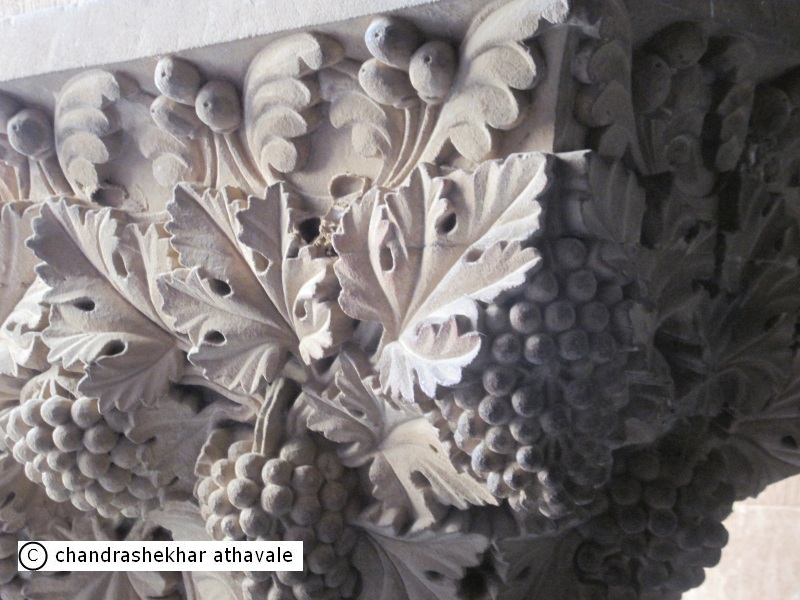
Polished Pillar base


Terraced Stadium


Citadel well


White Rann seen from Citadel


Even more elaborate arrangements were made for the drainage of waste water. The rooms of the palaces had terracotta earthen pipes in a corner to drain off the waste water, which were connected to main drainage lines. These main drainage ducts were provided with air breathing holes at the top to avoid formation of air locks. The waste water was then let off in the sea ( Presently Rann) not far from the western end of the city. Beyond western fortification walls, were servant, quarters and grain storage tanks and more water storage tanks. The Citadel fortification walls on east, north and west had entry gates. Just near the door, chambers were built at a height with roofs supported on pillars, parts of which can be seen even today. The main through-way in the citadel was segregated in three sections, marked by means of 2 polished pillars. In one of the two north gate chambers, archaeologists found a huge name board written with 10 Indus script glyphs or symbols. Each of this was made from Gypsum and was 15 inches high. Total length of this board was about 3 meters and the gypsum symbols were embedded in wood, which had rotted away later, leaving only the symbols intact. Archaeologists believe that this sign board displayed the name of this place to outsiders. Beyond the north gate, there was a terraced stadium that could house 10000 people. It is believed to be the place for social and ceremonial events, festivals and Bazars. Mr. Ravji Bhai tells me that the staircases in the citadel have 7, 15 or 30 steps and archaeologist believe that these were used as a calender system to keep track of time. He also shows me a rock where fossils of sea shells can be clearly seen.


A polished pillar


A slotted stone for pillar base 


After finishing my visit of the citadel, I visit the adjoining museum. The museum has a collection of pottery, tools and clay models of some of the objects found by archaeologists and also a display gallery of photographs of objects found here. I manage to collect lots of information about this place and the way these people lived.


Terracotta  toys 


After a satisfying visit, we have our packed lunch and start on our return journey. Between Rapar and Chitrod towns, we see a 'Nilgai' (Boselaphus tragocamelus the largest Asian antelope, family Bovidae) crossing the road. We return to Samakhiali town, have cup of tea and instead of turning right towards Bhachau and Bhuj, push south on highway 27. My next destination is town of 'Morbi' or 'Morvi', where I might get a chance to visit the 'Little Rann of Kutch.' By dusk, we make it to this dusty town.


(To be concluded)

8 February 2013


Thursday, February 7, 2013

Kutch and Kathiawar: A tryst with history, Part IV


Friday


I get ready early and after breakfast, say good bye to this wonderful camp in a desert in a far corner of India, where I have enjoyed superb hospitality and comfort for last 3 days. I am simply amazed at the efficiency and planning of the camp organizers, who have made this camp a grand success. Our Bus leaves for Bhuj and has a mandatory stop at Bhirandiyara again. This time, I get down and buy some 'Mawa', a tasty treat made from milk. I reach Bhuj around 11 AM and check in the hotel. I decide to spend the day seeing sights from this ancient city, which derives its name from Bhujiyo Dungar, (Serpant Hill) a 160 Meter high hill that overlooks the city, and is said to be the residence of the Great Serpent Bhujang, to whom a temple stands at the top of the hill.


From the 8th to 16th centuries, Kutch was ruled by the Samma Rajputs from Sindh, during what is considered to be Sindh's Golden Age. As the power center in Sindh declined, there were a series of complicated successions and intro-familial murders and intrigues, eventually leading to ascension of Lakho Jadeja, descended from the Samma Rajputs, to the throne as kings. From then on, the monarchy was known as the Jadeja Rajputs, who ruled directly from Kutch, not from Sindh. In 1549 Khengarji I moved the capital from Anjar to Bhuj, given its strategic location in the center of Kutch and Bhuj came into being.

During Mughal dominance followed by British Raj, Jadeja kings of Bhuj always managed to retain there independence to certain extent and this reflects into the individuality of this city. From the times of Lakhpatiji in eighteenth century, successive rulers of Bhuj, added many palaces in the city and did much for the beautification of the city. However a series of earth quakes happening on regular basis had been the biggest detriment for everything that has been built in Bhuj and palaces were no exceptions. The most disastrous Earthquake of them all happened on 16 June 1819, followed by other ones in 1844-45 and 1864. Next big one struck in 2001. These earthquakes have flattened or extensively damaged most of the old buildings in Kutch.


Aina Mahal

For a tourist, Bhuj is an an ideal place, because most of the places worth seeing are located all around a central lake called Hamisar lake. Only last year, this lake had overflown and I was expecting it to hold reasonable amount of water. So, after having for my lunch of so called “Kutchi Pao-Bhaji,” I decide to start my Bhuj sight seeing, with a visit to Aina Mahal (hall of Mirors) located on one of the banks of the lake. I hire a 3 wheeler, an extremely noisy and uncomfortable type of transport and reach the Aina mahal. It is well described in most travel guides and I quote:

Aina Mahal Palace was built by Rao Lakhpatji in 1750 AD. Aina Mahal is a part of a large palace complex. It is a two storey building with Darbar Hall, hall of mirrors, and suites for royal family. In the 18th century, the Rao Lakhpatji sent a local craftsman Ramsingh Malam to Europe to perfect his skills in glassmaking, enamelling, tile making and iron founding. After he returned back, he constructed the Aina Mahal with the hall of mirrors of Venetian glass. The Hall of mirror has white marble walls which are covered with mirrors and gilded ornaments and the floor is lined with tiles. The design and decoration of the Aina Mahal was due to the efficiency of Ramsingh Malam. The platform above the floor is surrounded by a series of fountains operated by an elaborated system of pumps below a Venetian chandelier. Aina Mahal is a unique example of an Indian palace built in the mid-eighteenth century with European influence.”


Bass relief carvings on the exterior walls of Aina mahal


Unfortunately, great disappointment awaits me. Being a Government holiday on account of Eid, the palace is closed for visitors. I have to remain satisfied with few photographs of the exterior, which is not very inspiring. 


Pragji Mahal


The palace next door is known as Prag Mahal. It was constructed by Rao Pragmalji II (1838-76 AD) and was designed by a famous British architect, Colonel Henry Saint Wilkins, who also had designed many buildings from my home town Pune, like Deccan College, Sasoon Hospital, Ohel David Synagogue. It seems that Prag Mahal took about 10 years to get built at the cost of 20 lakh Rupees. May be, because of my familiarity with similar buildings in Pune, and in particular to the Main building of University of Mumbai with its clock tower, I am not much impressed with this building. Even the cornices or ledges on top of pillars look similar. Fortunately for me, the palace is open for visitors. I buy an entry ticket and move in. 


It is a typical palace museum for a small time ruler of a princely state. Usual things like carpets, period furniture, darbar (court) hall, paintings, utensils, hunting trophies, guns, toys for the young once and so on. In one corner I found a series of reprints of paitings done by one of the great Indian painter of that period, Raja Ravivarma. Someone had added semiprecious jewels on the reprints making them unique and worth while to see. From the terrace of the palace I can view the Hamisar lake. Unfortunately, there is almost no water in the lake because of the scanty rainfall this year. A major water tank near the palace known as 'Ramkund' also is dry and empty. A solitary, wheeled gun is seen next to the front porch of this palace, perhaps the only mute witness to all the damge done by the earthquakes.


Ramkunda

Opposite Prag Mahal, there is another but much dilapidated palace known as 'Rani Mahal' (Queens palace). Series of earth quakes have taken their toll on this palace and today it is not safe even for entry. It has some nice architectural features such as windows with beautiful lattice workmanship, balconies and door frames. I spend few minutes admiring the Rani Mahal. My next stop is 'Kutch Museum,' which is supposed to have been founded by Maharao Khengarji III in 1877 AD. The museum has a large collection of Kshatrapa inscriptions, various archaeological objects, arms and specimens of various crafts of the Kutch region. Bad luck keeps following me, as I find the doors closed because of the holidays.


Rani Mahal

Since I have time on hand, I visit Swaminarayan temple, a huge glitzy kind of set up, constructed fully with white marble and hundreds of full relief sculptures on pillars and walls. The sculptures look like printed pictures with the lips of figures painted red and with a mandatory vermillion coloured dot on the foreheads. The temple has a huge following of disciples, and there is a great crowd of devotees. I move on next to 'Chhatardi,' which is supposed to be a memorial for past kings of Kutch. These memorials have been so much destroyed by the earth quakes, that they have built a stone wall around them. I can only have a look from a distance and manage to take some photographs.


Chhatardi

Before returning to my hotel, I loiter around the main market and indulge in little bit of shopping. Later, after having a sumptuous dinner, I go to sleep early as I have to leave tomorrow morning for a destination, 250 Km away from Bhuj. The place, I am planning to visit, was a thriving and prosperous metropolis of 20,000 people, about 5000 years ago.

(To be concluded)

7th February 2013


Monday, February 4, 2013

Kutch and Kathiawar: A tryst with history, Part I


Tuesday


My flight to Bhuj from Mumbai is delayed by at least half an hour. This means that I am waiting at this terminal 1B of Mumbai's domestic airport, for almost 4 hours. Earlier I had left my home town Pune around 8.30 in the morning. For commuting to Mumbai, I had taken a state transport bus service, named as 'Shivneri.' This service is fairly punctual and extremely comfortable, and on any day, I would recommend it. The Bus had dropped me just opposite the airport terminal and I had no problems at all in reaching the airport. The waiting hall at terminal 1B, is quite huge and I kill time looking at the wares displayed in number of shops and a cafeteria, provided for the convenience of the passengers. The flight is finally announced and after some usual confusion, I manage to reach the aircraft. The aircraft is quite full and since this particular flight is designated as low cost, airline does not serve anything free, except for drinking water.


A journey to Kutch and Kathiwar can be truly said to be a tryst with history of Indian sub continent. Almost on every step, a visitor comes across, period markers on a time scale from prehistoric periods around 3500 BCE to years of India's independence struggle in twentieth century, and subsequent years of building modern industrialized India of later years. The region is blessed with such wide range of landscapes on a mega scale, that one feels amazed at the wondrous scenarios produced by mother nature.


The time is well past 5 in the evening, as our plane lands at Bhuj. The airport is quite huge and I see only one Indian air force MI 17 Helicopter standing on the tarmac. Even the arrival hall is quite large, considering the fact that only a couple of flights land here or take off from here, throughout the day. Since I had checked in very early, as expected, my bags arrive on the baggage belt after considerable delay. By the time I come out of the terminal, most of the people have already left. Very few vehicles can be seen now parked in the parking zone. Luckily, I get a taxi rather easily, which does not appear to be a good sign at all, because that means that I am going to get fleeced. In spite of that feeling, I take the taxi, because prospects of getting stranded at the airport unnerve me. The airport is just 3 KM from my hotel and I reach there within 10 minutes. My hunch, proves absolutely correct as the taxi driver claims Rs. 500 or US$ 10 for that distance from me. Reluctantly I pay the amount and walk to my room.


Later I decide to take a walk through the crowded street, which leads to the 'Hamisar lake.' This lake is the central point of this town and a short walk of about 15 minutes takes me there. To my surprise, there is almost no water in the lake. Apparently, rains have been very scanty this year and the lake has not been filled at all. The roads are crowded with unruly and undisciplined vehicular traffic. There are no footpaths and heaps of garbage lie everywhere. My first impressions of Bhuj are not exactly favourable. I return to the hotel.


Wednesday


I have planned to check out of the hotel at 7.30 AM to reach the spot near Bhuj railway station, where welcome center is supposed to have been erected by the organizers of the Rann or the desert camp, my destination for next couple of days. I find much to my resentment that the hotel room service is rather slow and it takes ages to get a cup of tea. I somehow manage to check out of the hotel only around 8 A.M. And reach the welcome center at Bhuj railway station by quarter past eight. I am all wrapped up in warm clothing as the weather is bitterly cold with biting morning breeze.


The scene at the welcome center is rather uninspiring with number of buses standing in haphazard fashion and heaps of baggage lying everywhere. I manage to enter a tent with a welcome sign and go to a counter. To my complete surprise, the staff at the counter, extremely courteous and helping, sees my papers and allots a tent to me and asks me to tag all my luggage pieces with that tent number with paper tags provided by him. He tells me to go outside, give the luggage to one of the bus attendants and get on board of the same bus. I come out and immediately I find a bus waiting for passengers. Within next 10 minutes our bus leaves for Dhordo, approximately 80 Km northwest of Bhuj. We take highway 45 going in northerly direction and pass the Bhuj airport on way. I can see number of jet fighters in their hangers with covers fully on. The landscape outside is quite unusual with patches of waste land and blackish green fields intermixed. I can even see small ponds, which I believe was the result of earlier week's rains. The fields mostly have standing crops of 'Erandi' or castor plant, Ricinus communis (Euphorbiaceae). The seeds yield castor oil, widely used in many applications such as cosmetics and lubricants. Between the field, there are large patches of wastelands with soil looking whitish because of the ground salts. Only 'Babhul' or Gum Arabic shrubs can grow here. As we proceed north, more wastelands appear on our sides with scattered fields seen only near about villages. Villages have round shaped houses with terracotta tiled conic roofs. Occasionally, I can also see some thatched roofs also of conic shape. These are known locally as 'Bhunga” and apparently can stand the earthquakes and storms rather well.


After travelling about an hour, we stop at a road side village known as 'Bhirandiyarni.” We now enter from here the 'Banni' or grasslands of Kutch. We leave the highway and turn left on a small single lane road. On both sides, there are forests of Babhul or Gum Arabic trees with grasses, which have all dried up by now. Kutch area produces large quantities of cow and buffalo milk, and I can see the reason as large number of cattle appear grazing on the grass lands. In another half an hour, bus comes to a halt. We have arrived.


The desert camp is a huge affair with hundreds of tents having all modern facilities, dining hall, recreation areas, a strip mall for shopping and an amphitheater. They even have WiFi in the tents. I go through procedural formalities like registration and receive my camp ID, food coupons and then walk leisurely to my tent. Surprisingly, my baggage has already reached my tent. I am advised to have my breakfast quickly as it is served only up to 10 AM. All the meals are served piping hot, in huge air conditioned dining halls. I have my breakfast of purely Gujarati food like Poha, Jalebi and Gathiya served with sweet spicy tea.


I have free time now, up to Lunch time. After that, we would be taken on a tour to see village craftsman’s fabric embroidery. I decide to spend my time in the shopping mall, buy a few odd things and return to my tent. 


I however end spending well over 2 hours in the strip mall, just amazed with colours and designs of the fabrics and beautiful workmanship of other artifacts. 


I return to my tent. All tents are very well equipped with two beds, a side table and a table with an air heater, water heating kettle, chairs and a modern washroom. I relax a little, have my lunch, again an all Gujarati food affair, and get ready to reach the bus parking area before 2 PM.


(To be concluded)


4 February 2013