Showing posts with label Bass reliefs. Show all posts

Tuesday, November 18, 2014

North of Northeast Part IV


After spending a day of rest, at the Kaziranga resort, we all are ready today, for another long spell of travelling. For a change, we shall now be travelling to the North and enter the border state of Arunachal Pradesh, before ending the day at “Bomdila,” a beautiful township on mountain slopes of Himalayan ranges with an altitude of about 8000 feet. Yesterday, we made some short outings and visited one or two points on the highway NH 37, from where, wild animals of Kaziranga are usually seen. At one of the points, where wild elephants are sometimes seen, we drew blank as the spot was totally deserted. Luckily, at the other vista point, we were more fortunate to see some rhinos and deer. Our Kaziranga sanctuary safari is actually planned during the return leg of our journey after about a week and I thought that what we saw yesterday, was a kind of a teaser.

We are back on highway NH 37 going westwards till the town of Nagaon and then take a right turn on highway NH 37A. Our first destination today is the mighty Brahmaputra river, located at about a distance of 22 Km, which we would be crossing over to go to our first stop of the day; Tezpur. For first few Km, the landscape is typically rural Assamese, with lush green paddy fields, groves of trees of various hues and shades of green with sprinklings of villages scattered amongst them with red coloured galvanized iron sheet roofing. But as we proceed further towards the river, the human habitats slowly start to disappear, their place being taken by marshy wastelands and grasslands. Every summer the mighty Brahmaputra, pours millions of cusecs of water in this area and this stretch of marshy wastelands get completely flooded. Much area under Kaziranga forest also meets the similar fate each and every year. This is the reason for the sanctuary to close during monsoon months and it reopens only on 1st of November.


I can see now the vast bed of this mighty river stretched almost to the horizon. As we approach the river, the car stops before a police check post. The guards wave to us and we are on the “Kalia Bhomora Bridge” crossing the Brahmaputra. After crossing the bridge, the cars stop near a small hillock. I come out to have a view of the bridge and the surroundings. This 1.3 Km long bridge was constructed during a period of 1981 to 1987. I climb a small hillock to see if I get some better view of the bridge but feel disappointed as nothing can be seen from there. There is also a small red coloured “Shiva” temple on one side of the road. On the left sidewall, from where the actual bridge and its railing starts, bass reliefs of seven female figures representing the seven northeast states are carved in concrete. Though the craftsmanship is just about pass'e, I like the symbolism. The bridge, connecting the city of Tezpur to Kaliabhor town has been named after “Ahom general Kalia Bhomora Phukan, who had defeated in 1671, much larger Mughal forces in a battle known as Battle of Saraighat. The bridge has been named after this general because it is believed that he had made an unsuccessful attempt to build a bridge at the same site in the seventeenth century.


Tezpur city is situated along the north bank of the river. As we enter the city, my thoughts immediately run down the memory lane, because in the 1962 border war, Chinese forces had reached within 70 Km from Tezpur and the inept city administration had almost given up the city. There was complete loss of control on 20th November 1962 with thousands of people fleeing the city by crossing Brahmaputra to the safety of the south. That is history; now Tezpur is a normal thriving city.


Our first stop in Tezpur is at a small hillock named as “Agnighar.” An impressive entry gate leads to a circular stairway for going up the hillock. The entry gate gives a feeling, that the way up would be an easy one. However, as I climb up, I find that it is not so and climbing up in one breath looks quite tough. I reach the crest of the hill. A nice manicured garden and some plat things for children can be seen here. An observation platform made from steel stands here. From the top of this platform, a breathtaking view of the mighty Brahmaputra is so bewitching that I spend quite a few minutes watching and enjoying the grand spectacle. The Bhomora bridge, which we had just crossed, shines in the morning sun towards the left. There are number of statues of some mythological figures and some imaginary encounters between them. A demon king “ Banasura” his daughter “Usha,” her companion “Chitralekha” and finally Lord Vishnu and Lord Shiva. The sculptures of these mythological figures have been erected at several spots around the circular stairway. I do not know from what material these statues have been made from but they all have been painted with Gray colour. These statues remind me of similar statues of mythological figures set up all over the Indonesian island of Bali.The hillock of “Agnigarh” is believed to be the fortress of a mythologiocal king “Banasura” in which he had kept his daughter “Usha” in isolation, fearing that she may elope with someone. Tezpur perhaps prefers to link itself more with the Mythological demon king “ Banasur” than any one from recent history.


We move on. Just next to this hill, we come across a place called “Ganesh Ghat.” This place is directly on the river bank and if desired, one can go and touch the waters of one of the greatest rivers of India. None of us however seems willing as the entire area is littered with garbage, flowers thrown away and plastic bags. I remember that near Leh city in Ladakh, excellent “Ghats” or stepped terraces named as “Sindhu Darshan” have been built on bank of river Indus, which allow people to touch the water or wash their hands and feet in the river, I remember having done that during my visit there. But that place was spotlessly clean compared to what I see here on the bank of Brahmaputra. I had wished that I would be able to wash my hands and feet in the Brahmaputra waters during this visit, just the way I had done in waters of Indus, but can not dare do it because of the filth.


Readers would agree that the entire history and culture of India is closely related to triplet of rivers- Indus, Ganga and the Brahmaputra. I had wished that someday I would be able to see all of them and would be able to touch the waters of all of them. For me it was like a secret pilgrimage of the sorts. I had touched the waters of Ganga at Rishikesh near Haridwar city besides waters of Indus at Leh. Unfortunately, here on the bank of Brahmaputra, I can not dare do that as the place is filled with Garbage.


Feeling disappointed, I move on. There is a temple nearby of Lord “Ganesha.” I watch it only from a distance and then continue towards our next halt, an excellet and neatly laid out city garden known as Cole park during British days. It was named after Mr. Cole, a British commissioner of Assam. Now it is known as “Chitralekha Garden;” the mythological connection coming up once again. It is a well laid out nice garden with lawns and flower beds on sloping grounds. In the middle there are two water ponds or mini lakes side by side. Activities like boating are available. I am more interested however, in a number of bass reliefs done in stone from 9th and 10th century, couple of massive ornamented stone pillars, gate ways and sculptural remains from the famous Bamuni hills that are being displayed at strategic places in the garden by Archaeological department of Assam.The massive pillars, gates and bass reliefs are very intricately carved. The carved human figures on these bass reliefs have a distinctly different look, when compared to contemporary bass reliefs from Pattadakal in Karnataka or from Ellora caves in Maharashtra. I also notice surprisingly, that there are some similarities in the figures displayed here with bass relief figures found in Siam Reap temples of Cambodia. But this needs more study. The pride of place of the park is at the center of the park, flanked by the two water ponds on the sides. This spot is occupied by a massive stone slab, which bears the famed inscriptions of Bhomoraguri, ordered by Ahom general Kalia Bhomora Phukan and recording the ancient plans of a bridge across the Brahmaputra, at the very spot, where the current Kolia Bhomora Bridge has been built. This is an exhibit worth a visit. Though, there appears to be some controversy, regarding the inscription. According to some references, the rock inscription actually mentions the construction of a rampart by Ahom King Pratap Sinha (1603-41 A.D.) after defeating the Mughals and not the bridge.


Bhomora Inscription slab


Image of the demon "Banasur" in Chitralekha park


Bass relief of Shiva from Bayon temple in Siem Reap, Cambodia


 Leaving the controversy to archaeologists, our flotilla of cars now leaves Tezpur and we take highway NH 15 to north. Tezpur's strategically important airport is located here. This airport was in the imminent danger of being captured by Chinese forces in 1962. Seeing the alarming situation and developing threats to Tezpur, army headquarters had decided to airlift 5 infantry battalions from Punjab to Tezpur airport on 19th November 1962; an advanced party of divisional headquarters and one battalion had flown in with troops quickly digging in for the defense of this airfield. The Chinse had however declared unilateral cease fire within next two days and no action ever took place here.


Leaving Balipore town, we leave the city areas behind and now forests flank us on both sides of the road. This area has been converted to a tiger reserve now and is beingcalled as Pakke Tiger Reserve. It connects with Kaziranga sanctuary in the east. A river makes a sudden appearance to the right. This is the Kameng river also known as Jia Bhoreli in Assam. Kameng originates near India-China border in Tawang district and flows for 264 Km to its confluence with Brahmaputra near Tezpur. I can also see a railway line being constructed on the left. The entire area is very picturesque and beautiful. To motor down this road to the Arunachal border town of Bhalukpong, is a wonderful experience, that is difficult to describe in words.


It is almost lunch time, when we stop near Bhalukpong town. From here the Arunachal Pradesh starts and we need to submit our Inner line permits at the checkpost to proceed further. We break our journey in the town for the long awaited lunch. After a delightful lunch topped by wonderful “Gajjar Halwa,” I decide to take a stroll in the hotel courtyard. At one end of it, I find one small out-house like structure, with a viewing veranda. I step in and take a few steps. My feet just freeze on the spot, as an unbelievably stunning landscape, unfurls before my own eyes. It is a perfect picture post card view. On the left is the gorgeous looking, foaming white, Kameng river rushing out of Himalaya ranges bending sharply towards Assam. The left bank of the river is rising and merging into the green foliage lined mountainside, almost touching the sky. To the right, near the bend, the white river transforming into a slow current of azure blue contrasting with the golden white sands of the flat river bank. The Bhalukpong town itself extends further to the right. I loose all sense of time, as I watch the scene, spell bound. 


A friend calls me and says that its time to move on. Within minutes, we all are out of the town, entering the enthralling valleys of the the Himalayas; kings of the mountains of the world.


18th November 2014

Wednesday, August 27, 2014

A Siem Reap Sojourn-Part III


I am on my way to visit the Angkor temple called ‘Banteay Srei’. This temple is not a part of the Angkor Archeological Park and is located at least 25 KM to the north of Siem Reap. For anyone who wants to visit a temple in Siem Reap, the person must first pass through a check post, set up by the Apsara Authority, the organization which looks after the safety, security and maintenance of the temples. My car had to travel by this check post today, even when I was going to a place bit far away. At the check-post, I present my 3 day pass for visiting the temples and only then could proceed onwards. I am told that if a vehicle is found to have bypassed the check-post, it would surely be stopped further on the way. A fine of 200 Dollars per person and 100 Dollars for the driver is collected from the errant vehicles. To avoid payment of such huge fine, everyone seems to follow the rules. On way, I see a large lake and decide to stop here on my way back. The landscape on this road to Banteay Srei, reminds me of south India, with paddy fields stretching on both sides to the limit of my vision. This area, in which I am traveling, is known as ‘East Baray’. This name comes from the name of a huge water reservoir built by Khmer kings, which had existed on this very land few centuries ago. Because of this, the soil is very rich here. This fact however does not reflect in the rice crop yields, as the farmers are dependent only on monsoon rains and there is a general shortage of fertilizers. In the days of Khmer Kings, farmers in this area, grew 3 rice crops every year, with the abundant water supply from East Baray. Farmers today, can just grow at the most, one crop in an year. The villages along the road however, look fairly affluent. I learn that the affluence has come because of the flow of tourists along this road. My car now takes a sharp left turn and comes to a halt in a nicely developed parking area. This is the entry area for the temple of ‘Banteay Srei’. It is clear that someone has taken lots of pains to plan and develop this area with well arranged basic tourist facilities. The time is 10 ‘O’ clock in the morning but the Sun is already scorching. It is important that any visitor to Angkor, must carry with him a good quality Sunscreen cream.


The East Entrance
 

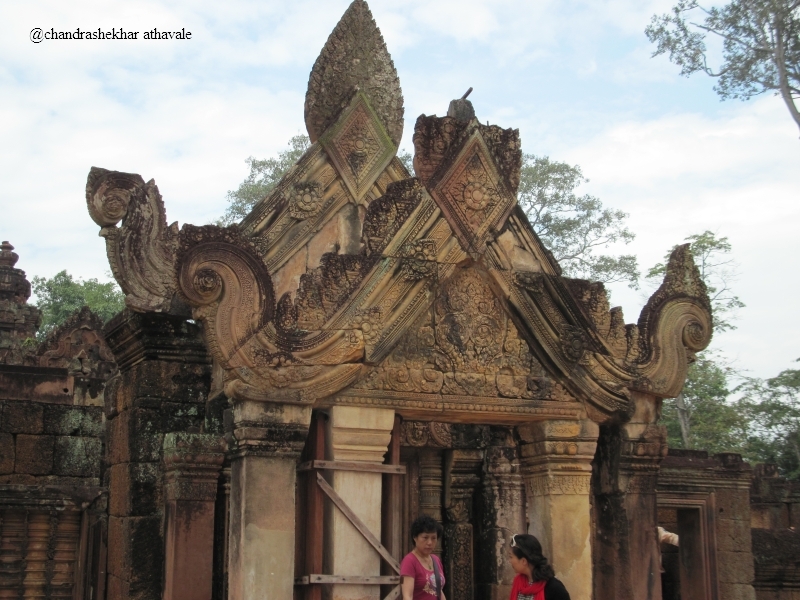
I start walking towards the temple.Banteay Srei means a Citadel of the woman. This was not the original name of this temple. The temple was known earlier as ‘ Tribhuvanamaheshwara’ (Shiva, the God of three worlds) or ‘Ishwarapura’ ( Abode of God). This temple was built during the reign of king Rajendravarman (944-968) and Jayavarman V (968-1001) and was dedicated to Hindu God Shiva. This temple surprisingly, was not built under authority of any of the Khmer kings and was built by Yajnyavaraha, a Brahmin adviser to the King, who also was of Royal descent. The present name was adopted much later. Why this temple is called a Citadel of the Women, could be anybody’s guess. I read that the name came from presence of some of the dainty and feminine carvings on the temple. The first view of this temple could be a sort of an anticlimax, if one visits this place after visiting a temple like Angkor Wat. Compared to the bombastic dimensions of Angkor Wat, this place is a miniature or even could be called tiny. This might have been necessary to highlight or emphasize the fact that the temple is not built under King’s authority. As I walk towards the temple, I compare it to the temples in India that I have seen and I rate this one as just one amongst those. Nothing very special. I walk through a gate. This must have been a Gopura in the past but now only a door frame exists. There is a sort of passageway and I proceed on that. On both sides, I see ruins of several buildings. There are sign-boards here, that the ruins are worth a visit. I however continue towards the entry tower or Gopura. This Gopura, is part of a red enclosure wall which completely encloses the temple complex. I look upwards. I see a triangular shaped Fronton on top of the door frame. The Fronton is completely filled with incredible kind of engraved figures of Gods, animals, flowers and many other shapes. I realize as to why this temple of Banteay Srei, is called the most beautiful temple in Angkor. I enter through the Gopura into the inner courtyard and cross a pedestal, on which a broken sculpture of Nandi the bull is seen. Only legs and part of the body exists. I look ahead and see a sea of pink and red in front. Each and every building in this complex has been constructed from a special pink sand stone, which gives a special aura to the whole complex. They say that the sandstone even smells like the Sandle lwood from India. Inner complex has several annex buildings all along the perimeter. These have been mostly destroyed and only the walls stand erect. At the center, there is another enclosure with an entry gate. This entry gate is blocked. However as the enclosure wall is of only few feet height, I can clearly see all the details of the buildings inside this central enclosure. As I go round the enclosure and see the walls and particularly the lintels on the door frames, my mind is filled in wonder. I had never seen before such exquisite and dainty carvings on stone. The bass reliefs at other places are carved in such way that a picture materializes in your front. In Angkor Wat, some of the bass reliefs have three or even four depth levels to make carvings appear more realistic. But the carvings here, are three dimensional. A flower or a sea shell kind of shape, appears as if the real thing has been pasted on the stone. This is just unimaginable.


Main Sanctuaries


Fine workmanship
 
 
There are three sanctuaries at the rear with the middle one having an elongated shape. In the front there are two side buildings called libraries(I do not know why?) . Most of the structures have only one entry door. However on all sides of the structure, dummy and engraved door panels are seen. There are few idols of monkey faced humans sitting next to the sanctuary doors. I understand that these are not originals but copies. The originals have been moved to museums for safe keeping.Attempts have been made to steal even the replicas. The lintels on the doors and the windows each tell a story from Hindu mythological scriptures. Since I have read most of the stories in the past, its fun for me to see the carvings in details. I can see Demon king Ravana shaking the Himalayan abode of God Shiva, while Shiva’s wife Parvati is terrified. In another panel, Krishna fights his uncle Kounsa in his palace. There is a beautiful fronton depicting God Indra blessing the animals, birds, trees and humans with celestial rain . One of the best frontons depicts the story of the God of Love Kamdeva, shooting his flowery arrows at Shiva so that he would get enmoured with the beauty of Parvati. Shiva gets angry instead, opens his third eye and burns Kamdeva. Later, Shiva marries Parvati and brings Kamdeva back to life.


Indra’s Celestial showers


Shiva and God of Love


Shiva and Ravana


Krishna and Kounsa


Vishnu as Man-Lion
 
 
Besides the detailed carved lintels and frontons, flower designs and the Apsaras appear on each and every temple carved exquisitely. Its time now for me to move on. I go around the temple and manage to get some good shots of the temple reflections in the waters of the mote. While returning, in one of the side buildings, a fronton showing Vishnu’s Man-Lion incarnation, is kept on the ground. This is another exquisite example of the art at Banteay Srei. Because of its beauty and the small size, this temple has been looted the most. Even the celebrated french author Andre Malraux, tried to steal four Devata statues from this place. Most of the original statues have been now moved to museums with dummy replicas kept here. But such is the beauty of these sculptures that attempts were made, to steal even the dummy replicas.


Banteay Srei reflections
 
 
Reluctantly, I move out of Banteay Srei and start my return journey. I stop on my way, to see one more temple ruin. The temple of Preah Rup was built by Khmer King Rajendravarman II (944- 968). I included this temple in my itinerary because this temple was built some 175 years before Angkor Wat. This temple sanctuaries are built with bricks, which were glued together with a vegetable glue.


Preah Rup  Temple


Lintel Carvings
 
 
The temple construction appears similar to Angkor Wat, with three levels. I find the climb rather steep. My efforts are rewarded however, when I reach the top. I see some beautiful carved panels showing Indra riding a three headed elephant and an Apsara in much simpler attire. On the road, I cross again the big lake. The shoreline is dotted with many fine Khmer food restaurants. I decide to break my journey here and enjoy some Khmer dishes for my lunch.


Sra Srang, largest swimming pool in the world


Royal bathroom
 
 
The lake in front is known Sra Srang (Royal Bath) and is called many times as the largest swimming pool in the world. It was built specially for King Jayavarman VII (1181-1220) to allow him to bathe in Royal grandeur and also meditate. An island was built in the middle of the pool with a wooden hut for that purpose. I linger for few moments on the Bathing platforms and imagine how the things must have been hear one millennium ago. After lunch, I am on my way to see perhaps the last temple on my itinerary, the temple of Ta Prohm. This temple was again built by King Jayavarman VII (1181-1220) dedicated to his mother. Some say it is a Buddha temple. There is view also that this temple was originally for Brahma, the ancestor of all Hindu Gods. Ta Prohm is a classic example of the encroachment of the Jungle on structures left unattended for a long period. There is so much vegetative growth here that even in the blazing sun, the temple area , always shaded because of the huge trees, is very cool and relaxing.


A joint effort by India and Cambodia
 
 
The car drops me at the east entrance. At the entrance I see a big signboard announcing that the Government of India and Cambodian Government are co-operating to renovate this temple. I really feel happy that Indian Government is making some effort to restore this precious heritage of the mankind, particularly when it bears such direct relationship with ancient Indian culture and traditions.
 
 
Incredible Ta Prohm


The strangler
 
 
I walk along well shaded pathway which leads me to the temple. In front of me, I see a most weird and crazy scene. There is a stone platform. On top of the platform a dilapidated stone building stands with a huge tree growing out of it. The view is fit to be in a Indiana Jones type Hollywood potboiler. In fact several movies have been shot at Ta Prohm. The latest one being Angelina Jolie’s Tomb Raider . I pass the building and see how this huge tree has spread its roots on the building,holding it in a vice like grip. Many years ago, I had seen a film called “20000 Leagues under the Sea”. In this film a huge squid or an octopus was shown with long tentacles. Trees of Ta Prohm remind me of that creature.


Repairing the dancers hall
 
 
It is not possible to walk straight through Ta Prohm on a per-determined route. The trees have grown in such haphazard and crazy fashion that you have to go round avoiding them. I loose all sense of orientation and just follow the guided path. On my way, I see a big crane and few experts working on the roof of one of the Galleries, which was damaged recently, when a giant tree s fell on it during a thunderstorm. In spite of the unwieldy and unearthly growth of the trees, collapsed walls and heaps of stones lying everywhere, I see some beautiful carvings and Apsaras, hidden in nooks and corners. At one place I find a Unique Lintel decoration with the Trinity of Hinduism, Bramha-Vishnu -Mahesh. Unfortunately the central Shiva is missing from the decoration, perhaps stolen. Further down the path, I see even more number of trees growing on top, sides and along the temple balconies and galleries. The stone walls cracked because of this onslaught, have turned green with moss as moisture leaks through. In some dark alleys of the temple, I get a very eerie kind of feeling. But then, just on the next corner, a beautiful carving appears suddenly.


Elephant’s foot


Hindu Trinity of Brahma-Vishnu-Mahesha


An Apsara
 
 
Ta Prohm was one of the largest monastic complex during Khmer days. An inscription on stone in Sanskrit found here tells us its story. Ta Prohm owned 3140 villages. 79365 people lived in these villages and maintained this temple, which included 18 high priests, 2740 officials,2202 assistants and 615 dancers. Among the property of the temple, there was a set of gold dishes weighing more than 500 Kg, 35 Diamonds,40620 pearls, 4540 precious stones, 876 veils of silk, 512 silk beds and 523 parasols. I do not know whether the figures given in the inscription are true or not. One thing is certain. The temple was extremely wealthy. A Tirupati temple of sorts in those times perhaps.
 
I walk out through the western Gopura. The Gopura has, by now familiar to me, quad faces of the King. As my car leaves the temple, I look back. I can still see the smiling faces of the King perhaps beckoning to me to come back again. As my car is speeding towards Siem Reap, I have a strange feeling that even though I have seen for last three days, many temples of the Khmer era, I am unable or incapable to complete the whole picture of Angkor in my mind. In other words, there is no closure. Something is missing and I can clearly see th missing link. The temples I saw were all empty shells. There was no idol seen in any of the temples. The central sanctuaries, were just vacant waiting for someone to take the place of honour. . I know that I would have to look for this missing link, otherwise my trip to Siem Reap just would not be complete. I decide to go to the Angkor National Museum for the missing link. The name of the museum is somewhat misleading. It is actually a commercial enterprise launched by Vilailuck International Holdings, a private trust from Thailand. They have invested money in the buildings and infrastructure. The exhibits however, are all genuine and are on loan from National Museum in Knom Penh and ‘ ‘Ecole Française d’Extrème Orient (French School of Asian Studies)’, originally a french institute, now run by Cambodians. The museum even though much smaller than National Museum at Knom Penh, covers only Angkor era and would suffice my purpose. The museum has eight halls. The first hall has thousand Buddha idols. This does not interest me much because many places boast similar kind of Buddha exhibits. However next 7 halls have the exhibits, I am looking for. There are statues of Khmer kings, their history, wars and achievements. There are idols or at least the replicas of the idols of the Gods that adorned the temple sanctuaries once. Vishnu in his full glory, Shiva in human form and also in Linga form. The next hall exhibits the stone inscriptions that were found in the temples. Some are in Khmer language and some in Sanskrit as their legend plates suggest. However the Sanskrit inscriptions are not written in the Devnagari script as done in India. My efforts to read these are futile. Here the Sanskrit inscriptions are written only in Khmer script. There are more halls depicting other objects like pots and utensils. The final hall has many statues of Apsaras, some beheaded, some without legs or hands. Still the beauty of the original work of art quite in place. Some more details about jewelery, ornaments and the costumes of men and women of those times. I come out of the museum, totally satisfied. I realize that I have spent about 2 hours here. There is no feeling now of any uncertainty. No dissatisfaction of having only watched a shell. I feel sort of complete with a feeling that I have seen the temples of Angkor completely and fully. As I think about these temples, Khmer kings and people, I feel saddened by the fact that Indians know so little about this place and its people. Here are the people who still claim that their ancestor was an Indian, they still follow a religion born in India, picked up Indian culture a millennium and a half ago, made it their own and raised the glory of that culture to unprecedented grandeur and have left these glorious monuments behind for all the world to see. Yet, Indians, know so little about them, have done almost nothing, as these people suffered in horrible civil wars and are still struggling to become a nation. Not many tourists from India come here. There are no direct flights to Siem Reap from India. I have mentioned before a quote from famous English author Somerset Maugham. He says that “ No one should die before seeing Angkor Wat” I would prefer a little modification to this quote. I would like to say that No Indian should even think of dying before seeing Angkor. 
 
(Concluded)

23 November 2010

Friday, July 4, 2014

Amaravati all set to gain its past glory


Amaravati is a tiny town, situated 35 Km north of the city of Guntur on the right or the south bank of river Krishna, in the Indian state of Andhra Pradesh, which has been bifurcated very recently. In local language it is known as “Dipaldinne,” which means a Hill of the Lamp.

Amaravati and the adjoining areas have had been great seats of Buddhist learning and religion at the beginning of our era. The famous Chinese monk and pilgrim, Xuel Zang mentions in his travelogue from 7th century that at Amaravati, though many Buddhist monasteries were deserted by then, at least twenty were still in use with a thousand monks living there.


Few readers would be able to imagine that this obscure tiny town in the interior, once boasted of a grand monument that could be compared or perhaps was even grander than the famous Taj Mahal and was visited by thousands of Buddhist pilgrims every day. The monument in form of a great Buddhist Stupa, was however lost in the passage of time and all that remained was a mound of earth. This mound was eventually called the 'Hill of the lamp' by local people and the town got its name from this hillock.

In the year 1796, a local landlord wanting to shift to Amaravati, started quarrying rocks from nearby mounds of earth to build his house. He also attempted to dig the 'Hill of the lamp' and to utmost surprise of everyone around found stone slabs with sculptured bass reliefs. The news reached a British officer Colonel Colin Mackenzie, who was a passionate collector and student of antiquity. He visited the spot and immediately perceived that the mound of earth was in fact a great Stupa having about Ninety feet diameter and Twenty feet height. Mackenzie returned to the site in March 1816 armed with a team of draftsmen and surveyors. For next 2 years they made detailed plans and drawings of the monument.


After the great Stupa was discovered, a mad rush began amongst British officers to acquire the stone slabs of the Stupa. Many slabs were also distributed by the officers to various museums within India. In 1845, another British officer carried out excavation in the south west part of the mound and found large number of fragments. He sent them to Madras, where they lay neglected and exposed. In 1856 a new museum was opened in Madras. Edward Balfour, officer-in charge of the museum, decided to collect all the pieces and catalogue them. Finally 121 stone slabs were sent to England in 1859. They were sent from a museum to museum and finally in 1880 they reached British museum, where they are exhibited since.

In 1880, Duke of Buckingham, then Governor of Madras, ordered complete excavation of the site. The site not converted to a large pit. More than 400 fragments were recovered mostly from the outer railing and were sent to museum at madras, where they can be seen even today. A few balance pieces are exhibited at the site in a small museum. This is the sad story, how a great monument built by Satavahana kings, somewhere around first or second century CE, was totally destroyed, after discovery, instead of being renovated and rebuilt for the future generations. From whatever that is left of the great monument, one can easily imagine its grandeur and also the importance and glory that Amaravati must have enjoyed in the past, very well comparable to Taj Mahal itself.


So, how this great monument really looked like? At the centre was a giant solid dome of a Stupa some one hundred and forty-eight feet in diameter. This was surrounded by two highly sculptured stone railings. The inner railing actually almost touched the drum of the Stupa and carried all the decoration on it. The outer railing constructed from limestone slabs, was One hundred and ninety two feet in diameter and was pierced by four gates provided in cardinal directions. The outer railing was also elaborately carved with bass reliefs depicting many scenes from Jataka stories and Buddha's life. It is not knows how such a great monument was slowly forgotten and became totally neglected. It soon became a pile of rubble and in a few centuries of time became a mound of earth and with its disappearence, the famous town of Amaravati also became a forgotten obscure town in the interior of 'Andhradesa.'

It is now reported that this obscure town, will hit the limelight again in future, as it has been selected as the possible site of the new of capital of the bifurcated Andhara Pradesh state. The present Chief Minister of the state is known for his acumen for conceiving and building things, from what he did in the Hyderabad city few decades earlier. He is keen to build the new capital on both sides of the river with all modern facilities and world class transportation.

It seems that after lapse of more than two millenniums Amaravati is all set to gain it's lost glory as it's star is rising again. Perhaps it might become even more famous than in the past.

4th July 2014


Saturday, December 15, 2012

Hampi and Badami: Deccan delights, Part VI


I have mentioned earlier that the “Chalukya” kings, who had firmed up their power over Deccan plateau in sixth century CE and had continued to rule till 8th century CE, had established their capital at “Aihole” and later shifted it to “Vatapi” (present day Badami) in Bagalkote district of Karnataka state. In spite of “Vatapi” being the state capital, the royal family of Chalukyas', considered a village located about 22 Km away from the capital, as a place of special significance. This village known as “Pattadakal” also happens to be a nondescript and ordinary village today. However, Chalukya Royal family built in this village, a number of beautiful temples over the generations. One of the reasons that is put forward for selection of this village for construction of Royal temples is, it's geographical location. Most of the rivers in peninsular India flow from west to east. “Malaprabha” river, which is a subsidiary of the mighty Krishna river, flows next to this village and is no exception to the rule of flowing from west to east. But it so happens that near this village, this river suddenly changes course by 90 degrees and flows from south to north for some distance. “Pattadakal” temples were built just next to this river bed. In all, there are eight superb temples in the “Pattadakal” archeological complex. For Chalukya royal family, this place was the most revered one and the kings also had their coronation or “Rajyabhishek” ceremonies performed here at “pattadakal” temples, instead of at state capital “Vatapi.”


Our bus is now negotiating the road between “Aihole” and “Pattadakal.” This road also can not be considered as comfortable for travel. The road, in the first place is very narrow and full of pot holes. On both sides of the road, I can see standing crops of sugar cane almost ripe for cutting. That explains the almost continuous traffic of huge trailers carrying tons of sugar cane, being pulled by tractors to some sugar factory around. To add to our woes on road, are the number of cattle herds being driven to some nearby grazing spot and also hot blazing sun. Many travellers like me, bear with all this happily, for one and only one reason, the expectant joy of visiting something that is considered as one of the best in the world, the fabulous architecture of “Pattadakal” temples. These temples are compared by many to solid gold, a standard with which other temples may be judged. They say here that if “Aihole” temples are considered as artifacts created by kids studying in primary school, then “Badami” rock cut temples would have to be considered as artwork done by middle school boys and without any doubt, “Pattadakal” temples could be only considered as art forms created by university students.


Our bus stops next to the “Pattadakal” archeological complex. The entire area has been well secured and protected with chain link and barbed wire barricades. I buy entry tickets for me and my camera and enter the complex premises. The first view is rather impressive. In front of me are large tracts of well manicured green grass lawns, glistening in the mid noon sun and behind the grasses are the stunningly beautiful temple structures of Pattadakal. These temples were built in seventh and eighth century CE and, when compared to “Aihole,” the over all plan and workmanship appears to be far superior.


Kadasiddheshwar Temple 

I cross the greens along the well marked walkways and enter the temple premises from the northern gateway to come across the first two temples of “Kadasiddheshwara” and “Jambulingam.”which in reality, are two forms of same deity; Shiva. For both temples, the towers above are similar to the Sun God temple at “Aihole,” and are of curvilinear pattern ( North Indian style) and the construction appears simple , straight forward and somewhat similar to each other. On the eastern wall of “Kadasiddheshwara” temple there are high reliefs of two standing doorkeepers, whereas in the other or “ Jambulingam” temple, the wall stand plain and simple. “Pattadakal” temple architects were keen to try out new techniques and experimented continuously with newer forms. In both these temples, the curvilinear towers bear a bass relief sculpture on the front side, which was something new.

Galagnath temple

Curvilinear tower of Galagnath temple

Siva in his doomsday dance

Sangameshwar Temple

I continue walking. The next temple is known as “Galagnath” temple. The temple tower is also curvilinear but here there is a new change in design. On both sides of the temple, two verandas have been added, which appear to me like two wings. The verandas have sloping stone slab roofs. The front door lintel has a bass relief showing Shiva doing his “Tandava” or doomsday dance along with small figures of “Parvati” and “Nandi.” The next temple is the “Sangameshwar” temple. In the year 2009, there were huge floods in the “Malaprabha” river and entire “Pattadakal” village had gone underwater. Many of the villagers had then taken refuge on the roof of this temple. This temple is quite specious and appears to have rock solid construction. I am not able to see much of decorations here on the roof but the walls have nice lattice work windows cut in stone and some relief sculptures but of smaller size.


Temples of Pattadakal; Mallikarjun on left, Virupaksha on right and Kashi Vishveshwar in middle

View of Malaprabha river from Virupaksha temple

The bull, Nandi

Virupaksha temple prayer hall

Sun God riding a chariot with 7 horses

Vishnu on outer wall of Virupaksha temple
The next temple ahead is “Pattadakal's” biggest and most famous temple of “Virupaksha.” This was constructed by queen “Lokamahadevi” pf Chalukya king “Vikramaditya II.” This temple was constructed as a mark of the famous victory won by this king over his arch-rival, “Pallava” king at “Kanchipuram.” The outer walls of the temple have some superb high relief sculptures, which not only include Gods and Goddesses like Shiva-Parvati, but also portray other subjects like all time favourites; couples in love and also an ascetic doing yoga. The 'couples in love' sculptures here appear to me somewhat of different style. Along with couples embracing each other, I can also see a couple here, where the lady is questioning or ordering her man.

Facing the main entry door to the temple a huge black coloured “nandi” or the bull, sits waiting for the command of his master, the God “ Virupaksha.” Behind this bull is the river bed of “Malaprabha.” This temple is quite impressive and shall always remain etched in my memory. I enter in the main prayer hall of the temple. Up above on the roof is a fabulous bass relief of the Sun God riding in his chariot of 7 horses representing 7 days of the week. All the pillars in this hall have small panels of miniature bass reliefs depicting stories from Ramayana, mahabharata and Bhagavata; important Hindu scriptures. To observe and study all sculptures here, one would need to spend at least few weeks here. Since I do not have that kind of time available, I continue to move.

Shiva killing a demon

 
Shiva, Parvati, Nandi

Angry lady as her man says no

Vishnu


The lady questions her man

Mahabharata bass relief panel

Bramha, Vishnu, Mahesh Parvati bass relief

Mallikarjun temple bass relief

churning of the sea

A panchatantra story


The bull and elephant with same head

Just on the side of “Virupaksha” temple, there is a similar temple, which was constructed by “Trailokyamahadevi,” the second wife of king “Vikramaditya II,” who incidentally was the younger sister of “Lokamahadevi.” This temple is known as “Mallikarjun” temple. The overall layout of this temple is very similar to “Virupaksha” temple. The difference is in the subjects chosen for the bass reliefs in side the temple hall, which are mostly from stories narrated in books like “Panchatantra,” and “puranas.” “Panchatantra” carries animal stories just like Aesop's fables. Both “Virupaksha” and “Mallikarjun” temples have towers of typical south Indian style and look quite different from other temples having north Indian curvilinear towers.


the couple have same hair style 


couple in love 

An argument

 
Latest fashions, a miniskirt and a kurti

The temple adjacent to “Mallikarjun” temple is known as “Kashi Vishveshwar” temple. In all the temples that I saw so far, the presiding deity was Shiva. This temple is also no different. The presiding deity here is also none other but Shiva. This temple has north Indian curvilinear style tower, yet the intricate design on the tower appears quite different and is making this temple to stand out.


Kashi Vishveshwar temple

In the history of temple Architecture of India, “Pattadakal” temple architecture is considered as a major milestone. Experts say that in “Pattadakal” one can find a eye pleasing combination of north and south Indian styles of architecture. Frankly I am no expert in this line and can not really add anything worthwhile.

As a layman, I am comparing the temples and sculptures of “Aihole” and those that are here. The temple architecture here is far superior, no doubt on that. I somehow prefer the high reliefs of “Aihole” which appear more lively and lifelike. The relief sculptures here are many more, have much varied subjects, yet do not appear that live, at least to me.

I have to hurry as our bus leaves now for “Badami”, the formal capital of Chalukyas. I am quite tired and also hungry. I must have my lunch, then relax for little and then proceed to the final stop for the day; the famous rock cut temples of “Badami.”

15 December 2012